
A DreamBreaker settles a 2-2 MLP tie with one rotating singles game to 21. The 2026 rules, how they changed, and why MLP Asia raises the stakes.
Florida Atlantic led 20-11. One more rally and FAU 1 were college world champions. Instead, on Sunday at Brookhaven Country Club in Farmers Branch, Texas, Utah Tech 1 won the DreamBreaker and the title. DUPR called it the biggest comeback in College Pickleball Tour history. Liam Duffin, who started the fightback, told Selkirk afterwards: “At the beginning of the Dreambreaker, I told everyone, ‘let’s win this point by point.’ Being down so much, you can’t think about the current score, but only focus on the current point you’re playing.”
That is the DreamBreaker at its best, and its most unfair. A team can lose two doubles games, win two, and then find the whole match reduced to a singles shoot-out that can turn in a dozen rallies. Its critics say it is a gimmick. Its defenders say it is the best thing in team pickleball. The honest answer is that it is a gimmick that works, which is rarer than it sounds.
With MLP Asia starting in nine days, here is how it works, and why it will matter more in Asia than it does in America.

What is a DreamBreaker in pickleball?
Major League Pickleball is a mixed team league. Every tie between two teams is four games, played in a fixed order: women’s doubles, men’s doubles, then two mixed doubles games. Under the 2026 MLP rules guide, those four games are played to 11, win by two, with traditional side-out scoring.
If one team wins three or four of those games, the tie is over. If it is 2-2, the teams play a fifth game. That is the DreamBreaker. It is singles, it is played to 21, and it uses rally scoring, so a point is scored on every rally, not only by the serving side.
MLP Asia describes it on its own site as “a rotating singles tiebreak to 21”. That is a fair one-line summary. The detail is in the rotation.
What are the DreamBreaker rules?
These are the rules as written in the 2026 MLP rules guide, published by the UPA-A.
The score. The game is to 21, and a team must win by two. A team can only win the game while serving. So at 20-19, the leading side cannot close it out on the other team’s serve.
The rotation. Each team puts four players into a set order: two men and two women. Each player plays four rallies, then the next player comes on. Once all four have played, the rotation starts again from the top. Because rallies are the unit, a long rally and a one-shot ace count the same for the rotation.
The serving side. A player serves from the right when their team’s score is even, and from the left when it is odd. That is the singles convention, applied to a team score.
The line-up. Teams give their DreamBreaker line-ups to the referee after the second mixed doubles game. They can name any rostered player, including someone who did not play in any of the four doubles games.
The extras. Each team gets one timeout and two line reviews. Teams change ends when one team reaches 11. If a point penalty is given during the DreamBreaker, it counts as a rally rotation for the players on court.
How has the DreamBreaker changed?
The format has been tweaked every year, which tells you MLP is still working out what it wants.
In 2024, all of MLP’s doubles games were rally scoring to 25. The DreamBreaker line-up was a game of chess in itself. The team that chose to receive in mixed doubles declared its first player, then the other team declared its first, and so on, back and forth, until all four on each side were named.
In 2025, MLP went back to side-out scoring for the doubles but kept the DreamBreaker as rally scoring to 21, “switch every 4 points”, as its own announcement put it. Line-ups were submitted before the match, and each team got one “free” challenge.
For 2026, line-ups moved to after the second mixed game. That matters more than it looks. A coach can now see who is tired, who is hot and who has just lost a 13-11 mixed game before picking the order. It also allows a team to rest a singles specialist through the doubles and bring them in fresh.
MLP itself started in 2021 with one event, eight teams and 32 players. Its rules guide says it was the first organisation to bring rally scoring and a team format into pickleball.

How do you win a DreamBreaker?
The conventional view is that a DreamBreaker is a lottery. It is not quite. It rewards three things.
Singles depth. Every player on court in the DreamBreaker has to play singles. A team built around two great doubles players and two passengers will be found out. Four rallies is short enough that a strong player cannot win it alone, but long enough for a weak one to lose three points in a row.
Order. Because the rotation is fixed, the order is a tactic. Do you put your best singles player first, to build a lead? Or last, so they are on court when the score is 18-all? The 2026 rule, which lets teams choose after the doubles, makes this a live decision rather than a guess made before the tie.
Nerve at the end. With rally scoring and a must-win-on-serve rule, leads can evaporate. Utah Tech were nine points down. Every rally from 11-20 was a match point saved. That is not something the side-out doubles format can produce, and it is why crowds love it.
How often does a tie go to a DreamBreaker?
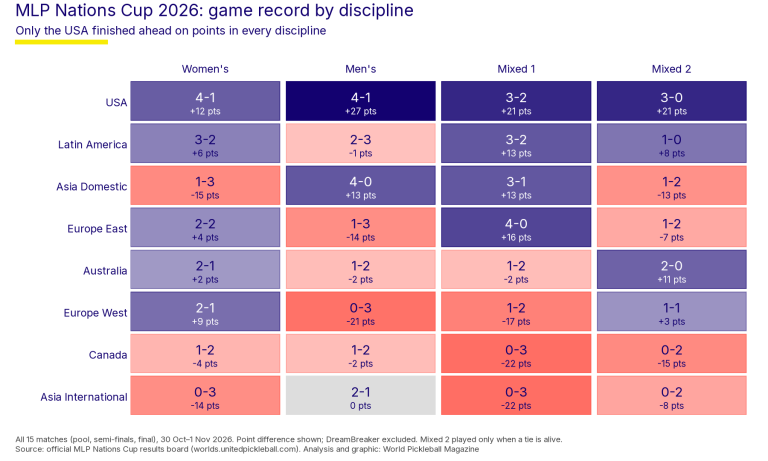
It depends on how even the teams are. At last week’s MLP Nations Cup on the same Texas site, only one of the 15 ties went to a DreamBreaker. That was the USA against Asia Domestic, which finished 13-11, 6-11, 12-14, 11-4 in the doubles. The USA then won the DreamBreaker 21-18. MLP called it “the first and only one so far”. The USA team won all its ties, and that was the closest anyone came to beating them.
Our own previous coverage has followed the format closely, from Anna Bright’s DreamBreaker critique in June to the DreamBreaker drama at MLP Australia’s Brisbane event and New Jersey’s route to the 2026 MLP title. The pattern is consistent. In a league where teams are drafted to be equal, more ties end level than you would think.
A note on the college final. The College Pickleball Tour runs its own format, with rally-scored doubles games to 21 in the Selkirk match report. I have not seen its full DreamBreaker rules, so I would not assume they match MLP’s in every detail. The principle is the same.
How do MLP Asia’s points work with DreamBreakers?
This is where the Asian league differs from the American one. MLP Asia awards points like this:
- Regulation win (4-0 or 3-1): three points
- DreamBreaker win (3-2): two points
- DreamBreaker loss: one point
- Regulation loss: no points
So a DreamBreaker is worth a point to both teams before the first rally. Win it and you take two rather than three. Lose it and you still take one. Over a three-week regular season with a top-four cut for the Finals, those points will decide places.
There are six teams (every franchise gets a home night): THE DOTS TOKYO, Hong Kong Cannons, Manila Helios, Malayan Stripes, Viet Panthers and Dragon Warriors. Each carries six players: three domestic picks, including at least one man and one woman, and three international picks. That last part matters, because the DreamBreaker needs two men and two women. Every DreamBreaker four has to come from those six, so coaches will have to decide whether their home stars or their imports play the singles.
The season opens on Friday 13 November, when THE DOTS TOKYO host Manila Helios and Malayan Stripes. Play starts at 6pm in Tokyo, 09:00 UK time. The Finals are on 11 and 12 December, and the champions will get a ring presented on the last night.
Is the DreamBreaker good for pickleball?
The case against is real. It takes a doubles sport and settles team matches with singles. That can feel arbitrary, especially for a team that dominated the doubles but lost the ties on points.
The case for is stronger. It ends ties decisively and quickly, with no draws, in a format built for television. It forces teams to value all-round players. And it gives every roster spot a job. In tennis, team competitions such as the Davis Cup have long mixed singles and doubles, and nobody calls that a gimmick.
A quick word on the method. Rules here come from MLP’s own rules guides for 2024, 2025 and 2026, read on 4 November 2026. Where the guides differ, I have said so. The Nations Cup figures are from the official results page and MLP’s own post.
My verdict: the DreamBreaker is not fair, and it is not meant to be. It is meant to be decisive. In a six-team league with one shot at a first ring, decisive is exactly what MLP Asia needs.
Frequently asked questions
It is Major League Pickleball’s tiebreaker. If a tie is 2-2 after four doubles games, the teams play one singles game to 21, rally scoring, rotating four players every four rallies.
Yes. Under the 2026 MLP rules the game is to 21, win by two, and a team can only win the game while serving.
A DreamBreaker win earns two points and a DreamBreaker loss earns one. A regulation win earns three and a regulation loss none.

Chris Beaumont
Founder and Editor-in-ChiefChris Beaumont is the founder and Editor-in-Chief of World Pickleball Magazine, published by World Pickleball Media Ltd. He follows the global game closely, reporting on news, developments, stories and tournaments from all five continents. He also hosts the World Pickleball…
View All Articles →