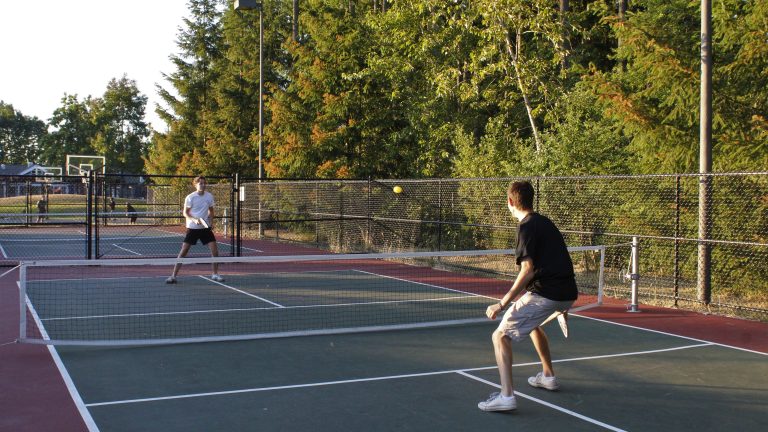

Pickleball is played to 11, win by two, on a 20 × 44 ft court. Here are the 2026 rules, scoring, kit and how to start.
The short answer: Pickleball is a paddle sport for two or four players on a 20 × 44 ft court with a 7 ft non-volley zone, the “kitchen”, on each side of the net. Serves are underhand and diagonal, the ball must bounce once on each side before volleys, and games usually go to 11, win by two. It was invented in 1965 on Bainbridge Island, Washington.
Pickleball is a paddle sport played on a badminton-sized court using solid paddles and a perforated plastic ball. Combining elements of tennis, badminton, and table tennis, it has become one of the fastest-growing sports in the world.
This complete beginner guide explains the rules, scoring system, court dimensions, essential equipment, and how to start playing pickleball in 2026, using the latest updates from the USA Pickleball Official Rulebook and global competition standards.
Invented in 1965 on Bainbridge Island, Washington, pickleball has evolved from a backyard pastime into a global sport played by millions across North America, Europe, Asia, and Australia. Its rapid rise is driven by a rare balance: easy to learn for beginners, yet strategically deep for competitive players.
Pickleball beginner quick facts
-
Players: Singles or doubles (most commonly doubles)
-
Court size: 20 × 44 feet (same as doubles badminton)
-
Game length: Usually to 11 points, win by 2
-
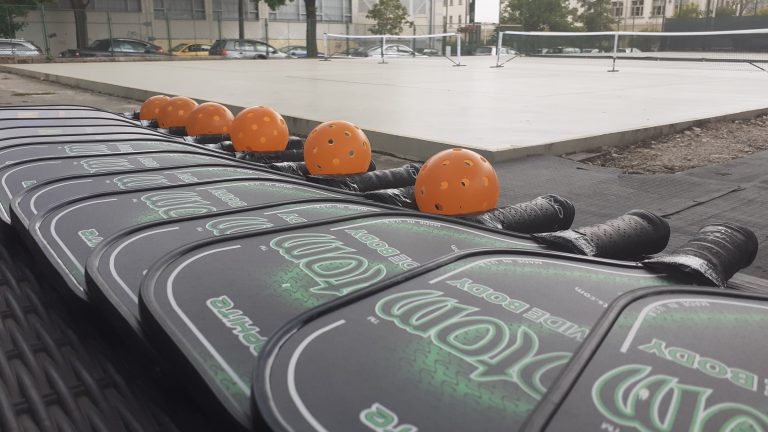
Equipment needed: Beginner paddle, plastic ball, court shoes
-
Time to learn basics: Often within one session
What pickleball is and why it is growing
Pickleball is defined as a tactical racket sport where placement and patience often triumph over raw power. While it shares DNA with tennis, the mechanics are distinct. The plastic ball creates less aerodynamic drag and bounces lower than a tennis ball, extending rallies and necessitating a “soft game” strategy that is unique to the sport.
The sport was invented in 1965 on Bainbridge Island, Washington, by Joel Pritchard, Bill Bell, and Barney McCallum to entertain their families. While folklore often attributes the name to a family dog named Pickles, historical accounts suggest it refers to the “pickle boat” in rowing—a crew assembled from leftover oarsmen—mirroring how the game was cobbled together from leftover equipment.
The Mechanics of the 2026 Boom
The sport’s explosion is not accidental. Structural and social factors have cemented its status:
- Infrastructure Efficiency: Municipalities and private clubs favour pickleball because four courts fit within the footprint of a single tennis court. This density fosters a high-energy, communal atmosphere that tennis often lacks due to the physical distance between players.
- Demographic Shift: The average participant is about 35, and 25–34 is the largest age group, according to the Sports & Fitness Industry Association (SFIA). That cuts against the idea that this is solely a sport for older players.
- Health and Social Utility: Research indicates that pickleball significantly enhances cardiovascular health and cognitive function while combatting loneliness through its inherently social structure.
Basic rules explained simply
The 2026 USA Pickleball Rulebook has introduced precise language to standardise play, particularly regarding the serve and line calls. Understanding these foundational rules is essential for avoiding faults and disputes.
The Two-Bounce Rule
This is perhaps the most critical rule for beginners. When the ball is served, the receiving team must let it bounce before returning it, and the serving team must then let that return bounce before hitting it. Both sides must play the first shot off the bounce. Only after these two bounces have occurred can players volley (hit the ball out of the air). This rule prevents the serving team from rushing the net immediately to execute a smash, thereby extending the rally.
The Non-Volley Zone (The Kitchen)
The “Kitchen” is a 7-foot (2.13m) area extending from the net on both sides. You cannot volley the ball while standing in this zone or touching the kitchen line. You may only step into the kitchen to hit a ball that has already bounced inside it. This rule is designed to prevent players from standing right at the net and smashing volleys downward.
2026 Updates on Line Calls and Conduct
The 2026 rules emphasise pace and clarity:
- Prompt Calls: Line calls must be made instantly. The “wait and see” approach—where a player returns the ball and then calls it “out” after seeing the result—is no longer permitted. If you hit the ball back, the ball is presumed “in” unless called immediately.
- Spectator Interference: Players are now strictly prohibited from consulting spectators regarding line calls. Doing so can result in penalties.
- The Net Post Winner: In a significant update, if a ball hits the net post after bouncing in the opponent’s court, it is now considered a live ball (and a winning point) rather than a fault.
Scoring system with clear beginner examples
Scoring is often the steepest learning curve for new players. The sport typically uses a “side-out” scoring method, meaning you can only score points when your team is serving.
The Three-Number Score
In doubles, the score is announced as three numbers:
- Serving Team’s Score
- Receiving Team’s Score
- Server Number (1 or 2)
Every game starts at 0-0-2. The starting team is allowed only one server before the serve turns over (side-out) to the opponents.
Example Sequence:
- Start: You serve at 0-0-2. You lose the rally.
- Side-Out: The serve goes to your opponents. They start as Server 1. The score is 0-0-1.
- Point Won: They win a point. Score is 1-0-1.
- Second Server: They lose the next rally. The serve moves to their partner (Server 2). Score is 1-0-2.
- Side-Out: They lose the rally. Serve returns to you. Score is 0-1-1.
Games are generally played to 11 points and must be won by a margin of two points.
Rally Scoring (2026 Update)
While side-out scoring remains the standard for most recreational play, “Rally Scoring” is approved as a provisional format for 2026 to speed up events. In this format, a point is scored on every rally, regardless of who served. Crucially, the 2026 update removed the “freeze” rule, meaning a team can now win the game on a receiving point, eliminating the prolonged stalemates of previous years.
Court layout and official dimensions
A regulation pickleball court is identical in size to a doubles badminton court, but the playing mechanics require specific markings.
Official Dimensions
- Total Size: The court measures 20 feet (6.10 metres) wide by 44 feet (13.41 metres) long for both singles and doubles matches.
- Service Area: The service courts measure 15 feet from the non-volley line to the baseline.
- The Kitchen: The non-volley zone extends 7 feet from the net on either side.
The Net
The net in pickleball hangs slightly lower than in tennis. It must be 36 inches (91.44 cm) high at the sidelines and 34 inches (86.36 cm) at the centre. This curve allows for more aggressive cross-court angles while maintaining a barrier for down-the-line drives.
Indoor vs. Outdoor Considerations
While the dimensions remain constant, the playing surface varies. Outdoor courts typically use an acrylic coating over concrete or asphalt for traction. Indoor courts may use wooden gym floors or specialised modular tiles. It is vital to note that outdoor play is susceptible to wind due to the lightweight ball, which is why serious competition venues often invest in wind screens.
Equipment needed to start playing
The barrier to entry for pickleball is low, but selecting the correct gear is vital for safety and performance.
Paddles: Material Matters
Modern paddles are a far cry from the wooden bats of the 1960s. In 2026, composite and carbon fibre are the industry standards.
- Graphite/Carbon Fibre: Lightweight and responsive, these materials offer the best control and touch. They are favoured by intermediate to advanced players.
- Composite: Usually a fibreglass face with a polymer core. These offer more “pop” or power and are excellent for beginners.
- Wood: While cheap, wooden paddles are heavy and offer poor control. They are largely obsolete in modern play except for strictly casual use.
Regulatory Note: Always ensure your paddle is “USA Pickleball Approved” if you intend to play in tournaments or competitive clubs. The 2026 equipment standards have tightened testing on surface friction to prevent paddles that generate excessive spin.
The Ball
Pickleballs are plastic spheres with precision-drilled holes.
- Outdoor Balls: Harder, heavier plastic with 40 small holes to resist wind interference (e.g., Franklin X-40).
- Indoor Balls: Softer, lighter plastic with 26 larger holes, designed for gym floors.
Footwear: A Safety Priority
Do not wear running shoes. Running shoes are engineered for forward motion and lack the lateral stability required for pickleball’s side-to-side shuffling. Wearing them significantly increases the risk of ankle rolls. You require “court shoes” (tennis or volleyball shoes) that provide reinforced sidewalls and a lower centre of gravity.
How beginners can learn quickly and improve
The learning curve in pickleball is famously short, but mastering the nuance takes time.
The “Clearly” Legal Serve (2026 Rules)
The volley serve has undergone scrutiny to reduce ambiguity. As of 2026, three elements must be clearly visible to the referee or opponent:
- The arm must move in an upward arc.
- The contact with the ball must be below the waist (navel).
- The paddle head must be below the wrist at contact. Borderline serves are no longer given the benefit of the doubt in officiated play; they are called faults immediately. Additionally, using fingers to impart spin on the ball release is strictly prohibited.
Strategic Fundamentals
- Master the Dinks: Beginners often try to drive every ball. The “dink”—a soft shot landing in the opponent’s kitchen—is the neutraliser that resets the point and forces opponents to hit upward.
- The Third Shot Drop: This is arguably the most important shot in the game. After the return of serve, the serving team should attempt a soft “drop” shot into the kitchen. This allows them to advance from the baseline to the net safely.
- Stop and Split: When your opponent is about to hit the ball, stop moving and take a “split step” (a small hop to balance weight). Hitting while running is a primary cause of unforced errors for novices.
Avoiding Common Mistakes
New players often stand in “No Man’s Land”—the transition area between the baseline and the kitchen. This is a dead zone where the ball will be hit at your feet. You should either be back at the baseline (defending) or up at the kitchen line (attacking).
Where pickleball is growing around the world
The United States remains the epicentre, with 19.8 million participants in 2024 (SFIA 2025 Topline Participation Report), but the sport has gone global.
- United Kingdom: Participation is growing, with clubs expanding across London and the Midlands.
- India: The sport has seen exponential growth, with a national federation now in place. The number of players is unknown (no published national count), and the country is becoming a hub for professional leagues.
- Australia: Australia has a fast-growing club scene.
- Asia: The sport is building on the region’s strong table tennis and badminton culture.
International bodies are working to align professional schedules and rankings across these regions.
Continue learning pickleball
- Beginner strategy guide
- Pickleball rules explained simply
- Best pickleball paddles for beginners
- How to improve your DUPR rating
Conclusion
Pickleball in 2026 has matured from a casual trend into a sophisticated international sport. Its low barrier to entry belies a tactical depth that keeps millions of players engaged worldwide. By understanding the updated rules—specifically regarding the serve and line calls—and investing in the correct footwear, you are well-positioned to join the fastest-growing sporting movement of the decade. Whether your goal is social fitness or competitive play, the court is open.
Frequently asked questions
Serve underhand and diagonally, let the ball bounce once on each side before volleying, and never volley from inside the kitchen. Games usually go to 11, win by two.
A pickleball court is 20 ft wide and 44 ft long (6.10 m × 13.41 m) for singles and doubles, the same size as a doubles badminton court.
Yes. The court is small and the paddle is simple to use, so most new players can play a full game in their first session.
Sources
- SFIA, 2025 Topline Participation Report (19.8m US participants in 2024), 27 Feb 2025 (accessed 25 October 2026)
- SFIA, pickleball demographics (average age about 35; 25–34 largest group) (accessed 25 October 2026)
- USA Pickleball, Official Rulebook (accessed 25 October 2026)

Chris Beaumont
Founder and Editor-in-ChiefChris Beaumont is the founder and Editor-in-Chief of World Pickleball Magazine, published by World Pickleball Media Ltd. He follows the global game closely, reporting on news, developments, stories and tournaments from all five continents. He also hosts the World Pickleball…
View All Articles →