A Thai retiree travelled to Singapore for her first tournament. Vietnam’s amateurs paid for their own visas and went by road to China, then won six titles. Southeast Asia’s amateur boom has stopped being about who plays. It is now about who travels.

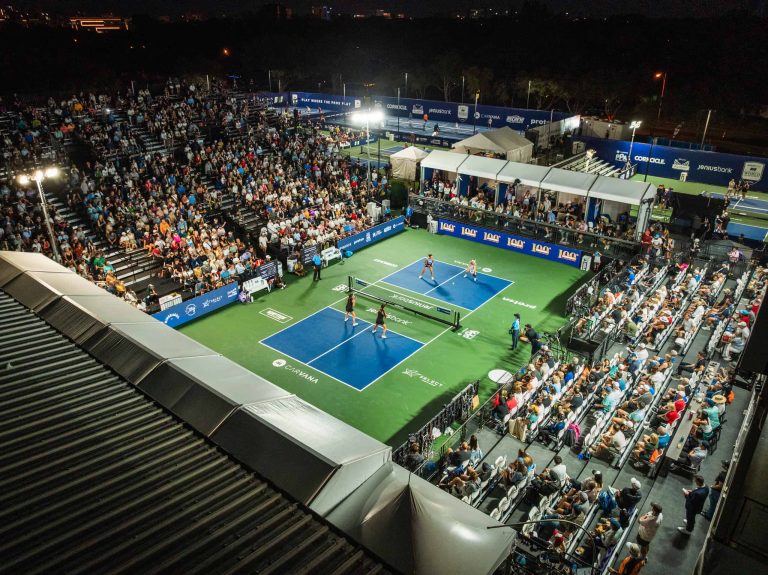
The short answer: Last weekend, 23–25 October, more than 1,000 amateurs aged 13 to 75 played over 600 matches at the first OCBC-Great Eastern Pickleball Open in Singapore. Over the same two days, 24–25 October, a self-funded Vietnamese team topped the medal table at the Beihai Open in China, with six golds. My verdict: the region’s boom has become a travelling amateur circuit. Its limit is now floor space and funding, not appetite.
Punnee Amornviputpanich is 56, retired and Thai. Until last weekend she had never played a competitive pickleball match. She played her first one in another country, at OCBC Arena in Singapore. According to the organisers’ account, she had picked up the game socially “across the region” before deciding a 1,000-player tournament was the place to start. “The Novice category made competition feel accessible for players like me,” she told SportPlus, “while the scale of the event gave me the confidence to travel from Thailand.”
The scale gave her the confidence. Most of us would have put it the other way round. A first tournament is usually a small thing at the club down the road, where if it goes wrong only the regulars see.
Some 2,300 kilometres to the north, at the Boyang Pickleball Arena in Beihai, on China’s Gulf of Tonkin coast, a Vietnamese team was doing much the same thing on a bigger budget of effort. Their federation’s deputy head of communications, Nguyen Quang Hung, later told Tiền Phong that the players “contributed their own money for visas, travel and incidental costs, and covered a long distance by road, yet still gave everything for the Vietnamese flag”. They still won six of the seven finals they reached. (Quotes from Vietnamese-language reports are my translation.)
Two events, one weekend, 1,400-odd miles apart. Put them side by side and they say something the usual “pickleball is booming in Asia” story misses.
Isn’t this just another “Asia is booming” story?
No. The conventional wisdom measures the Southeast Asian boom in participation: how many people play, how many courts are going up, which celebrity turned up. Those numbers are real, but they are the old story. The new one is that amateurs have started crossing borders to compete, in numbers that organisers can sell out and national federations can put a flag on.
A travelling amateur behaves differently from a local one. She pays for flights and hotels as well as entry fees, picks events by size and reputation, and turns a tournament from a community fixture into a regional product. Marathon running made that shift decades ago. Southeast Asian pickleball appears to be making it this autumn.
How big was Singapore’s weekend, really?
Big, though slightly less big than billed, and I think the gap is the most interesting number in the story.
A quick word on the method. Every figure below comes from the organisers’ own announcements as reported by The Straits Times, The Business Times and Baseline. The arithmetic is mine. Where a figure is a floor (“more than 1,000”) I treat it as a floor and not a count.
When OCBC launched the event in July, it spoke of “roughly 1,600 tournament slots” across four doubles categories, and we reported that figure at the time. The post-event release says “more than 1,000 players”. Both the Novice and Open categories sold out within the first two weeks of registration, and nearly 1,000 spectators came through the doors. More than 600 matches over three days works out at about 200 a day.
So the public categories filled almost before the press release had dried, yet the headline count lands somewhere between 1,000 and 1,600. My reading, and I flag it as a guess, is that the ceiling was floor space and the corporate and invitational draws, not public demand. But it fits everything else we know about Singapore, where one coach has likened the ballot for a public court to “fighting for Taylor Swift concert tickets”.
The champions were as varied as the field. Christopher Encarnacion, 28, and Ralph Kevin Barte, 37, two tennis coaches playing as Kosing Pikoleros, won the Open, beating Charles Yong and Ng Ka Wei 15-10, 15-14. “This is our third tournament together and our first time finishing on the podium, so it feels very special,” Barte said. The detail that caught my eye is in the same release: the pair had already played tournaments in Vietnam and Hong Kong. Even the winners were travellers.
Ng, 21, did not go home empty-handed: partnered by his cousin Basil Yeo, 18, he won the Bank of Singapore Corporate Challenge for Zenith Interns. That is the only double podium the organisers mention. The oldest competitor, Sam Ho Soo Hock, 75, made his tournament debut a few months after first picking up a paddle on OCBC’s free programme for seniors. “Just a few months ago, I had never played pickleball,” he said.
Who pays for a 1,000-player weekend?
The bank does, mostly, and that is both the model’s strength and its weak point.
Entry cost S$132 per pair at the early-bird rate and S$148 after that, according to The Straits Times, so S$66 to S$74 a head. If 1,000 players means roughly 500 pairs, the entry fees come to between S$66,000 and S$74,000 before cardholder discounts. Against that, the organisers advertised “more than S$100,000 worth of prizes”. Much of that was in kind: car-rental credits, wellness passes, paddles. The air-conditioned arena, the officials and a 24-workshop learn-to-play series came on top. On my rough sums the players’ money did not cover the prize table, let alone the event.
That is not a criticism; it is what a sponsor-led event looks like. OCBC’s Koh Ching Ching called the turnout “a strong start to our support of pickleball”, and banks buy customer goodwill in bigger lumps than this every week. But it means the Singapore model depends on a marketing budget’s second-year appetite. Nobody outside the bank knows yet whether it will last, me included.
What did Vietnam actually win in Beihai?
More than the headline says, and in a more revealing way.
The 2026 “Dream Come True · Boyang Cup” Beihai Open drew players from Vietnam, Singapore, Thailand, Hong Kong and Macau. Vietnam finished first overall with six golds, three silvers and two bronzes, VietnamPlus and Tiền Phong reported. Go through the medal list event by event and it gets sharper. Vietnamese pairs reached the final in seven events and won six. Two of those finals, the men’s doubles 18–35 and the mixed 18–35, were all-Vietnamese. The only final they lost to someone else was the mixed doubles 50–65. Vu Thu Hang won two golds, in women’s doubles and the mixed 18–35.
The reports do not say how many events were on the card, so six of seven finals is the honest number. It is a dominant one.
Now the context. The Vietnam Pickleball Federation held its founding congress in Hanoi on 28 July 2026, three months ago. Its stated goals include building national teams and entering international events. Beihai, Nguyen Quang Hung said, was the first time since the federation was founded that a Vietnamese team had entered an international amateur tournament. As recently as March 2025, Tuoi Tre News was reporting a sport with no governing body, new referees and line calls “judged by the naked eye”. The trip to Beihai is what happens when a federation exists but its budget has not caught up. The flag was official. The players paid for the road trip.
Why are amateurs suddenly crossing borders?
Because at home the courts are full and the tournaments are not big enough.
Take Singapore. When ActiveSG first piloted pickleball bookings in its sport halls in 2014 there were fewer than 20 a month, a Sport Singapore spokesperson told CNA last year. In the first half of 2025 there were close to 8,000 a month, a roughly 400-fold rise. Singapore Pickleball Association figures show participants in the annual Pesta Sukan competition rising from 424 in 2022 to 2,106 in 2025. Today the public can book more than 80 pickleball courts, used at more than 90 per cent at peak hours, the culture ministry said in March. One coach told CNA that “50 people” can be fighting for a single court. One weekend at OCBC Arena put more than 1,000 players into one building, roughly a dozen for every publicly bookable pickleball court in the country.
Vietnam has the opposite problem with the same result. By one industry count, from Webthethao’s WTT Insight, courts went from about 260 at the start of 2025 to 4,180 by mid-2026, a 16-fold increase. That analysis also found growth flattening from the second quarter of this year. When a home market levels off, the keenest players look outward.
They are not alone. Soham Nitin Jane and Arsh Ravi Pakhare flew in from India and reached the last 16 of the corporate event. “Pickleball is growing quickly in India, but opportunities to compete in tournaments of this scale are still quite rare,” Jane told SportPlus. In Manila, Dickie Bachmann, a former Philippine Sports Commission chairman backing the city’s 2027 PPA events, made the same point from the other end: many Filipinos “will go to Vietnam, Malaysia, just to play in the PPA,” he told Philstar, “And now they don’t have to fly over.”
Is the pro tour leading this, or following it?
Following it, and doing so sensibly.
PPA Tour Asia’s first four events of 2027, announced in the past few days, are Bangkok, Manila, Penang and Ho Chi Minh City. All four are Asia 500s, and all four are in Southeast Asia. Bachmann’s travelling Filipinos are not, for the most part, flying to Vietnam to play Anna Leigh Waters. They are entering the amateur draws alongside the pros, and the tour is pitching its tents where those players already are. Anna Bright, visiting Manila, put the spectator case: “Here you have courts in malls, and there’s tons of people watching.” She thinks the sport “can even grow faster than the United States”. I would not go that far yet. The United States has a half-century’s start and a great many retirees with time on their hands. But on this weekend’s evidence, the region is building the amateur base that pro tours in America took years to find.
What could spoil it?
Three things.
First, the numbers. Last year a regional body’s claim that 16 million Vietnamese play pickleball was picked apart by Tuoi Tre. It turned out to be about 1,000 survey respondents scaled up to a population of 100 million. An earlier unofficial estimate, reported by the same paper, was about 30,000. Sixteen million against thirty thousand is a gap of more than 500 times. A 1,000-player weekend is a better unit of truth than any survey.
Second, the money. Singapore’s model rests on a sponsor, and Vietnam’s trip on players’ own savings. Neither is a system yet.
Third, the neighbours. Most of Singapore’s public courts sit beside housing blocks, and CNA reported last year that at least four town councils had restricted play after noise complaints. More enthusiasm means more paddles at 7am, which is not a sentence that wins friends on the 14th floor. (Vietnam has its own boom-time headaches, from counterfeit paddles to a missing pathway for women.)
What happens next?
My calls, for the record.
First, the 1,000-player weekend becomes the region’s standard unit. From here on, a Southeast Asian city’s pickleball standing will be judged less by the pros it books than by whether it can put four figures of amateurs under a single roof.
Second, Vietnam’s federation will have to start paying for its travelling teams, or at least part of the cost. A federation cannot win six of seven finals abroad on players’ own savings and expect them to keep doing it. If the second trip is self-funded too, the flag will start to look borrowed.
Third, the OCBC event will return bigger. The organisers’ website already signs off with “We look forward to seeing you back on the courts next year”, and the public draws sold out in a fortnight. If the 2027 edition does not offer more than 1,600 slots, the reason will be The Kallang’s floor plan, not demand.
Which brings me back to Punnee Amornviputpanich and the idea that a first tournament should be a quiet affair at the local club. In Southeast Asia, it seems, the local club is full. These days the quiet first tournament starts with a passport.

Chris Beaumont
Founder and Editor-in-ChiefChris Beaumont is the founder and Editor-in-Chief of World Pickleball Magazine, published by World Pickleball Media Ltd. He follows the global game closely, reporting on news, developments, stories and tournaments from all five continents. He also hosts the World Pickleball…
View All Articles →