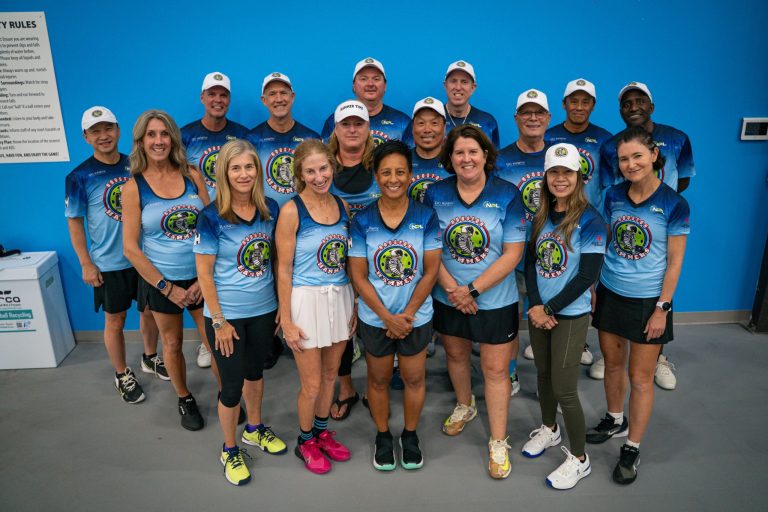

Ben Cawston and Mateusz Matysik won men’s Open gold 11-3, 11-3 as Gosling and Wrixon, Minogue-Stone and Kenna, and Love and Linton also took titles.
The short answer: Ben Cawston and Mateusz Matysik won men’s Open gold at the Amber Valley Open at Courtside in Stourbridge, beating Stuart Parminter and Jack Macgregor 11-3, 11-3 with a 63-18 knockout aggregate. Lauren Gosling and Emma Wrixon, Alexander Minogue-Stone and Evie Kenna, and Richard Love and Anna Linton also won, with weekend two at Derby Arena on 26–27 September.
Ben Cawston and Mateusz Matysik dominated the men’s draw as Lauren Gosling and Emma Wrixon, Alexander Minogue-Stone and Evie Kenna, and Richard Love and Anna Linton also claimed titles during the opening weekend of an Amber Valley Open attempting something increasingly significant in British pickleball.
Key takeaways
- Ben Cawston and Mateusz Matysik won men’s Open gold, beating Stuart Parminter and Jack Macgregor 11-3, 11-3 and completing the knockout stage with a 63-18 aggregate score.
- Lauren Gosling and Emma Wrixon came from behind to beat Diana Toia and Rachel McCrae 7-11, 11-7, 11-8 in the women’s final.
- Alexander Minogue-Stone and Evie Kenna won 18+ mixed, while Richard Love and Anna Linton recovered from an 11-0 second-game defeat to take the 45+ mixed title.
- This was only weekend one. The Amber Valley Open moves to Derby Arena on 26-27 September for eight 3.5 and 4.0 competitions.
- The wider question is whether Amber Valley’s combination of prize money, facilities, officiating and match volume offers a model capable of standing out in Britain’s increasingly crowded tournament market.
The first half of the Amber Valley Open is complete. The tournament itself is not.
That distinction matters because what Amber Valley Pickleball Club is attempting stretches beyond four Open draws and a collection of weekend winners. Its 2026 flagship has been constructed across two weekends, two venues and 12 competitions, with an anticipated prize fund of £18,000 and a second phase still to come at Derby Arena.
Weekend one belonged to the Open players at Courtside in Stourbridge, and among them Ben Cawston and Mateusz Matysik produced the clearest statement.
They completed four knockout victories by an aggregate score of 63-18, finishing with an 11-3, 11-3 victory over Stuart Parminter and Jack Macgregor in the men’s final.
The other three championships required rather different solutions.
Lauren Gosling and Emma Wrixon recovered after losing the opening game of the women’s final to Diana Toia and Rachel McCrae, eventually winning 7-11, 11-7, 11-8. Alexander Minogue-Stone and Evie Kenna dominated the 18+ mixed final against Macgregor and Gosling, 11-3, 11-4, while Richard Love and Anna Linton somehow recovered from losing the second game of the 45+ mixed final 11-0 to beat Chris Frylinck and Amanda Evans in the decider.
Cawston and Matysik turn the men’s draw into a procession
Cawston and Matysik’s numbers deserve examining because their route through the knockout stage became increasingly emphatic rather than more difficult.
They began by beating Tom Crisp and Jacob Lee 11-3 in the last 16. Ben Coots and James Mathie were then beaten 15-3 in the quarter-finals before James Lofthouse and James Ling managed only six points against them in a 15-6 semi-final.
Waiting in the final were Parminter and Macgregor, whose own route had been convincing. Harvey Ravenscroft and Mackenzie Crofts were beaten 11-1 before Parminter and Macgregor defeated Luke Whitfield and Rob Adams 15-5 and Alexander Minogue-Stone and Martin Thomas 15-4.
On paper, that created the possibility of the tightest match either partnership had encountered.
Instead, the gap widened.
Cawston and Matysik won 11-3, 11-3, completing four knockout victories with 63 points won and only 18 conceded. Lofthouse and Ling recovered from their semi-final defeat to claim bronze, beating Minogue-Stone and Thomas 11-7, 11-5.
Cawston came into the weekend with experience beyond the domestic circuit. His previous professional appearances include PPA competition in the United States and Asia, while earlier this year he was selected for Team Europe at Major League Pickleball’s Mid-Season Tournament in Grand Rapids.
Amber Valley brought him together with Matysik and the partnership immediately worked.
Nobody in the men’s knockout draw found a solution.
Familiarity matters for Gosling and Wrixon
The women’s final produced the opposite competitive pattern.
Where Cawston and Matysik established control immediately and never surrendered it, Gosling and Wrixon had to discover a way back into a match that was beginning to move away from them.
Their opponents, Toia and McCrae, had arrived in the final in formidable form. They beat Carolina Castro and María José Correa Finsterbusch 11-3 in the last 16, shut out Hannah Payne and Tracy Matthews 15-0 in the quarter-final and defeated Millie Sharma and Sonali Patel 15-10 in the last four.
Gosling and Wrixon had been similarly convincing, particularly in a 15-2 semi-final victory over Fiona Hughes and Clare Faherty.
There was also an existing partnership behind the run. Speaking earlier this year, Wrixon explained that she plays regularly with Gosling and that the pair had finished fourth together at the Nationals, familiarity that also carried into their time together with R3 Sport in the Premier Pickleball League.
That became relevant when Toia and McCrae took the first game of the Amber Valley final 11-7.
Gosling and Wrixon did not need to build a partnership on the fly. They needed to change the direction of a match.
They reversed the opening score to win the second game 11-7, then took the deciding game 11-8, turning what had initially looked like Toia and McCrae’s final into the closest championship contest of the four Open divisions.
Hughes and Faherty also had to come from behind in the bronze match, beating Sharma and Patel 7-11, 11-10, 11-3.
Minogue-stone and Kenna shut the door in mixed
Alexander Minogue-Stone had already been within one match of the men’s final when he returned for Sunday’s 18+ mixed competition.
Alongside Evie Kenna, he went one step further.
Their knockout campaign began with an 11-0 victory over Ben Coots and Hannah Murphy, followed by a 15-7 quarter-final win against Tom Corfield and Abby Fung.
James Ling and Ellie Tomkinson finally made them uncomfortable in the semi-final, pushing Minogue-Stone and Kenna to 15-12.
That was as close as anybody came.
Macgregor and Gosling arrived in the final with their own opportunity to complete significant weekends. Macgregor had taken men’s silver alongside Parminter; Gosling already had women’s gold with Wrixon.
Their mixed run included consecutive 15-11 victories over Anakin Owen and Sonali Patel and then Matysik and Rachel McCrae.
The final did not follow that pattern.
Minogue-Stone and Kenna won 11-3, 11-4, closing the championship without allowing Macgregor and Gosling to establish the kind of pressure that had characterised their previous two matches.
For Minogue-Stone, the weekend ended with mixed gold after a men’s semi-final. For Gosling, women’s gold was followed by mixed silver. For Macgregor, two finals produced two silvers.
Love and Linton survive an 11-0 game
The 45+ mixed final supplied the result that makes least sense when read purely as a sequence of scores.
Richard Love and Anna Linton reached it after beating Darren Wilmott and Julie Griffiths 15-4 in the quarter-finals before surviving a considerably tighter semi-final against Chris Beaumont and Gail Emms, 15-13.
Frylinck and Evans emerged from the opposite half, defeating Adrian Henley and Jas Tutt 15-5 and then Richard Green and Ally Pringle 15-6.
Love and Linton took the opening game of the final 11-7.
Then the match appeared to flip completely.
Frylinck and Evans won the second 11-0.
A shutout in the middle game of a best-of-three final would normally suggest that one partnership had found the tactical adjustment that might decide the championship. Instead, Love and Linton effectively discarded what had just happened, regrouped and won the deciding game 11-5.
It made theirs the least linear title of the weekend: win a competitive opening game, fail to score in the second, then recover strongly enough to take the third.
The bigger Amber Valley question
Those four competitions tell us who performed best at Open level.
They do not yet tell us whether the wider Amber Valley Open model works.
That is the more interesting story developing underneath the results.
This is an independent, club-built tournament rather than a national championship or a stop belonging to one of pickleball’s major professional tours. Amber Valley has nevertheless attempted to package several characteristics normally associated with a more substantial event: meaningful prize money, dedicated pickleball facilities for its Open weekend, extensive officiating, live streaming, guaranteed match volume and a second weekend capable of accommodating a much broader section of the competitive playing base.
According to the Amber Valley Open’s published tournament information, the headline figure is an anticipated £18,000 prize fund.
The word anticipated matters.
That creates a different proposition from entering another weekend tournament primarily for ranking points, medals or competition.
Players are being asked to pay more, but the event is attempting to give them more in return.
Frequently asked questions
Ben Cawston and Mateusz Matysik, 11-3, 11-3 over Parminter and Macgregor.
Lauren Gosling and Emma Wrixon, 7-11, 11-7, 11-8 over Diana Toia and Rachel McCrae.
Derby Arena on 26–27 September, for 3.5 and 4.0 events.

Chris Beaumont
Founder and Editor-in-ChiefChris Beaumont is the founder and Editor-in-Chief of World Pickleball Magazine, published by World Pickleball Media Ltd. He follows the global game closely, reporting on news, developments, stories and tournaments from all five continents. He also hosts the World Pickleball…
View All Articles →