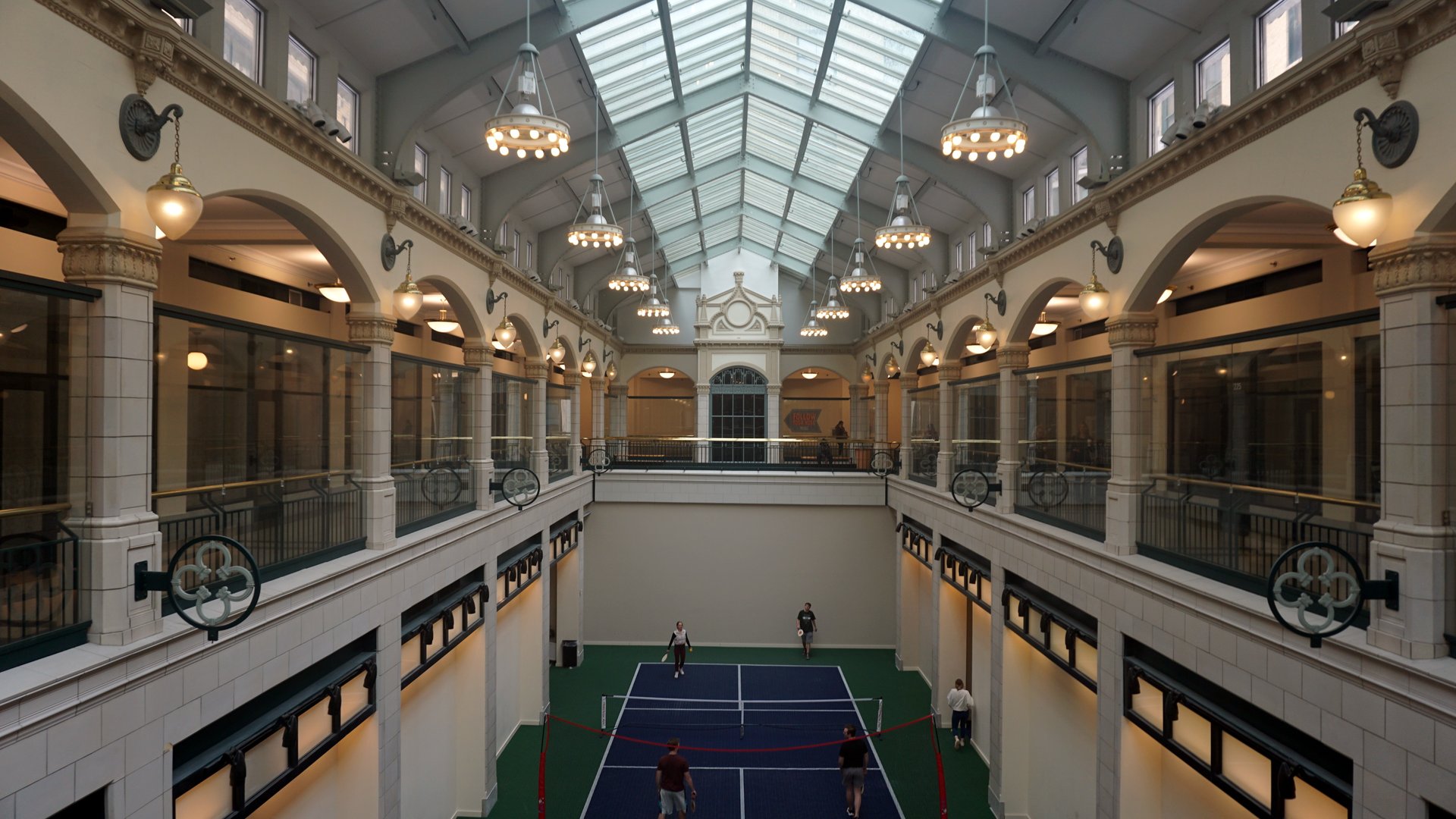
A pickleball court in the restored Plankinton Arcade, Milwaukee, November 2022. Indoor courts in former retail space are the model the Picklr built its expansion on. This is not a Picklr venue. Photo: Michael Barera / Wikimedia Commons, CC BY-SA 4.0.
The short answer: On 10 November, at 2pm in a Dallas courtroom, Judge Scott W. Everett will hold the final hearing on up to $4.365 million in rescue financing for the Picklr, the indoor pickleball club chain that grew faster than almost any franchise in America and then filed for Subchapter V bankruptcy in October. The clubs are open, the franchisor has not filed, and a sale of the franchise agreements is built into the loan terms. The lesson is not that indoor pickleball has failed. It is that the Picklr sold its growth with guarantees it could not afford to honour.
“Our clubs are open. Our members are playing.” That was the company’s message, quoted by the IAPPF, when Picklr, Inc. filed for Chapter 11 on 9 October, followed by its subsidiary Picklr Clubs, Inc. the next day. The phrase was reassuring, and it was also true. Members could still book courts. The question before the court is who will own the business by the spring, and who will pay for the leases signed along the way.
What happens on 10 November
The two cases, numbers 26-34687 and 26-34690 in the US Bankruptcy Court for the Northern District of Texas, were consolidated for administration on 19 October and granted complex-case treatment on 21 October, according to the court docket. Both are Subchapter V cases, the faster, cheaper route Congress created for smaller businesses. Behrooz P. Vida has been appointed Subchapter V trustee.
The same day, the court entered an interim order approving debtor-in-possession (DIP) financing from Dynamus Alliance LLC. The total facility is $4,365,000: $3.51 million in new money, of which up to $900,000 was available on an interim basis, and an $855,000 “roll-up” of existing debt. The final hearing on that facility is set for 10 November at 2pm before Judge Everett in Dallas. The loan has milestones at 45, 75 and 90 days tied to what the papers call a “Franchise Agreement Sale”.
That phrase matters most. The DIP lender is not simply keeping the lights on. It is financing a path to selling the franchise agreements. The rest of the calendar follows: a meeting of creditors on 18 November, a status conference on 24 November, a claims deadline in mid-December and a reorganisation plan due by 7 January 2027.
The Sports Business Journal reported on 10 October that an investor group led by Tom Neale had committed $4.8 million to support the reorganisation; the IAPPF and The Dink put the figure at $4.5 million. The docket figure for the DIP facility is $4.365 million. The figures have not been reconciled in public, and the 10 November hearing is the place where the court’s number becomes the one that counts.
Who did not file, and why it matters
The franchisor, Picklr Franchise, Inc., did not file. Nor did the franchisees, about 77 groups according to court filings, who own and operate most Picklr clubs. That is the most important structural fact in the case. Franchisees pay fees and royalties to a franchisor that is still solvent, while the parent company and its corporate clubs reorganise.
The problem is the guarantees. To help franchisees secure leases on large industrial and retail units, Picklr, Inc. guaranteed many of their rents. SBJ quoted chief executive Ryan Barragan as saying about 40 locations were covered by lease guarantees, and court filings refer to landlords seeking to enforce “the nearly 40 corporate guarantees”. The filings describe rents of at least $750,000 per location under many of those leases. When a franchisee struggled, the landlord could pursue the parent. Enough of them did.
Landlord disputes listed in the case include Slink ($832,497.02), Vestavia ($428,009.97), Bluffdale ($337,510.27) and Villa Park ($138,029.99). Bankruptcy halts that litigation for now. Whether those guarantees survive the plan is the real fight of the next three months.
Barragan’s own diagnosis, reported by the IAPPF, was blunt: “We were growing faster than we could operate.”
How the Picklr grew
The Picklr began in Utah and sold a simple idea: a large indoor box full of dedicated courts, run on memberships. It sold that idea to franchisees with numbers that were hard to ignore. In January 2024, according to the IAPPF’s review of the company’s own material, the Picklr said its top clubs were generating about $1.2 million in revenue at a 42% EBITDA margin.
Growth followed. Utah Business reported that the company went from 27 to 64 locations in 2025 and ranked 43rd on the Inc. 5000 list of fast-growing private companies, with 6,124% growth. In September 2025 it announced its 50th club on PR Newswire. Its franchise disclosure document, as summarised by the IAPPF, showed 56 franchised outlets at the end of 2025 against 22 at the start. The two counts measure different things, but both show the same rapid expansion.
The franchise terms, also summarised by the IAPPF, were a $60,000 franchise fee, a 7% royalty, a 2% marketing fee and a 4% “guaranty fee”. That last item is worth noting. Franchisees paid the parent to stand behind their leases, which meant the parent was collecting a fee for taking on a risk it could not afford to cover once several clubs struggled at once.
The celebrity layer came on top. Athletech News reports that Drew Brees became an ambassador in January 2024, and that Nick Kyrgios, the Australian tennis player, became an equity partner in March. A Series B round, led by Pickleball Inc., valued the company at $59 million, according to Athletech.
The numbers behind the filing
The reality was less glamorous. SBJ reported a 2025 net loss of $4.4 million on revenue of $10.3 million, and about $19 million in liabilities as of the end of March. According to the IAPPF, the franchise disclosure document showed that the 12 clubs open for a full year averaged about $963,000 in revenue. That is below the $1.2 million the company had highlighted for its top performers in 2024, though the two figures are not directly comparable.
Where the numbers come from matters. The IAPPF reported a balance sheet showing $915,000 in assets against $2.39 million in liabilities at 31 August, a much smaller figure than SBJ’s $19 million. These figures appear to describe different entities or dates, and they should not be added together or treated as one statement. Readers should treat the docket, rather than any summary, as the authority, and WPM will update when the debtors file their schedules.
There were warning signs. The IAPPF notes that a Picklr club in Goleta, California, left the brand for a competitor, The Grove, and that a franchisee, 3 Strand Holdings, filed its own Chapter 11 in the Middle District of Florida on 24 September, two weeks before the parent.
The market around it
It would be easy to read this as proof that pickleball’s boom is over. The participation numbers do not say that. The Sports & Fitness Industry Association counted 24.3 million US players in 2025, according to the IAPPF. But growth has slowed: Athletech, citing SFIA data, reports participation up just 1.3% in the first half of 2026, while padel grew 14.5% over the same period.
Slower growth matters to a model built on long leases. A long lease at $750,000 a year assumes demand will keep rising for years. A sport that has stopped adding players quickly can still fill courts on weeknights. It is less able to fill 40 large boxes, each needing to clear its rent before paying staff, royalties and that 4% guaranty fee.
WPM covered the filing on 12 October and the wider question of where pickleball money is moving in July. The pattern since is consistent: the money is still coming in, but it is getting more careful.
The global footprint
The Picklr is not just an American story. SBJ reports more than 70 US locations plus clubs in Australia, Canada and Japan. Athletech reports a master franchise agreement for Australia and New Zealand covering 50 clubs. In September, WPM reported the opening of Picklr Tokyo Toyosu.
Because the franchisor has not filed, those international agreements are, for now, intact. But a “Franchise Agreement Sale” is precisely the transaction that will decide who international franchisees report to next year. Operators in Sydney, Toronto and Tokyo have a direct interest in what happens in a Dallas courtroom on 10 November, and none of them is a party to it.
There is a broader lesson for Asia, where indoor club chains are spreading fast. The Picklr’s model, with long leases and corporate guarantees behind rapid franchise growth, is exportable. So is its failure mode. Investors building club chains in Manila, Ho Chi Minh City or Singapore should be reading this docket.
What to watch
- 10 November, 2pm CT (8pm UK): final DIP hearing in Dallas. Watch for objections from landlords and the trustee.
- 18 November: meeting of creditors.
- 24 November: status conference.
- Mid-December: claims deadline.
- 7 January 2027: plan due. This is the document that will show what happens to the lease guarantees and the franchise agreements.
Verdict
The Picklr did not fail because people stopped playing pickleball. It ran into trouble because it guaranteed other people’s rent on the assumption that demand would grow forever, and charged a 4% fee for doing so. The clubs are open and may well stay open under new ownership. The guarantees are another matter. The indoor club model will survive. Selling it with a promise to pay franchisees’ rent if they cannot should not.
Sources: US Bankruptcy Court, N.D. Texas, case nos. 26-34687 and 26-34690 (jointly administered), via Omni Agent Solutions; Sports Business Journal; IAPPF; Athletech News; The Dink; Utah Business; PR Newswire. WPM has not contacted the company or the parties for this article. Figures are as reported; the docket controls.

Chris Beaumont
Founder and Editor-in-ChiefChris Beaumont is the founder and Editor-in-Chief of World Pickleball Magazine, published by World Pickleball Media Ltd. He follows the global game closely, reporting on news, developments, stories and tournaments from all five continents. He also hosts the World Pickleball…
View All Articles →