Pickleball Club 002 has opened six courts in Dubrovnik after Zagreb and Split. Can a three-city network on Croatia’s tourist routes last all year?
The short answer: Pickleball Club 002 has opened six dedicated courts on Babin Kuk in Dubrovnik, its third Croatian location in two years, after four courts in Zagreb in 2024 and 12 in Stobreč, near Split. The network increasingly overlaps with Croatia’s Adriatic tourism routes. The real test is whether year-round local demand can sustain the facilities once the summer visitor season ends.
Pickleball Club 002 has opened its third Croatian location in two years, taking the sport from Zagreb to Split and now Dubrovnik. Six new courts are modest enough. The geography behind them is considerably more interesting.
Key takeaways
- Pickleball Club 002 has opened six dedicated courts in Dubrovnik, following earlier facilities in Zagreb and Split.
- The three-city network is beginning to overlap with Croatia’s established tourism routes, particularly along the Adriatic coast.
- The real test will be whether year-round local demand can support the facilities once the summer visitor season ends.
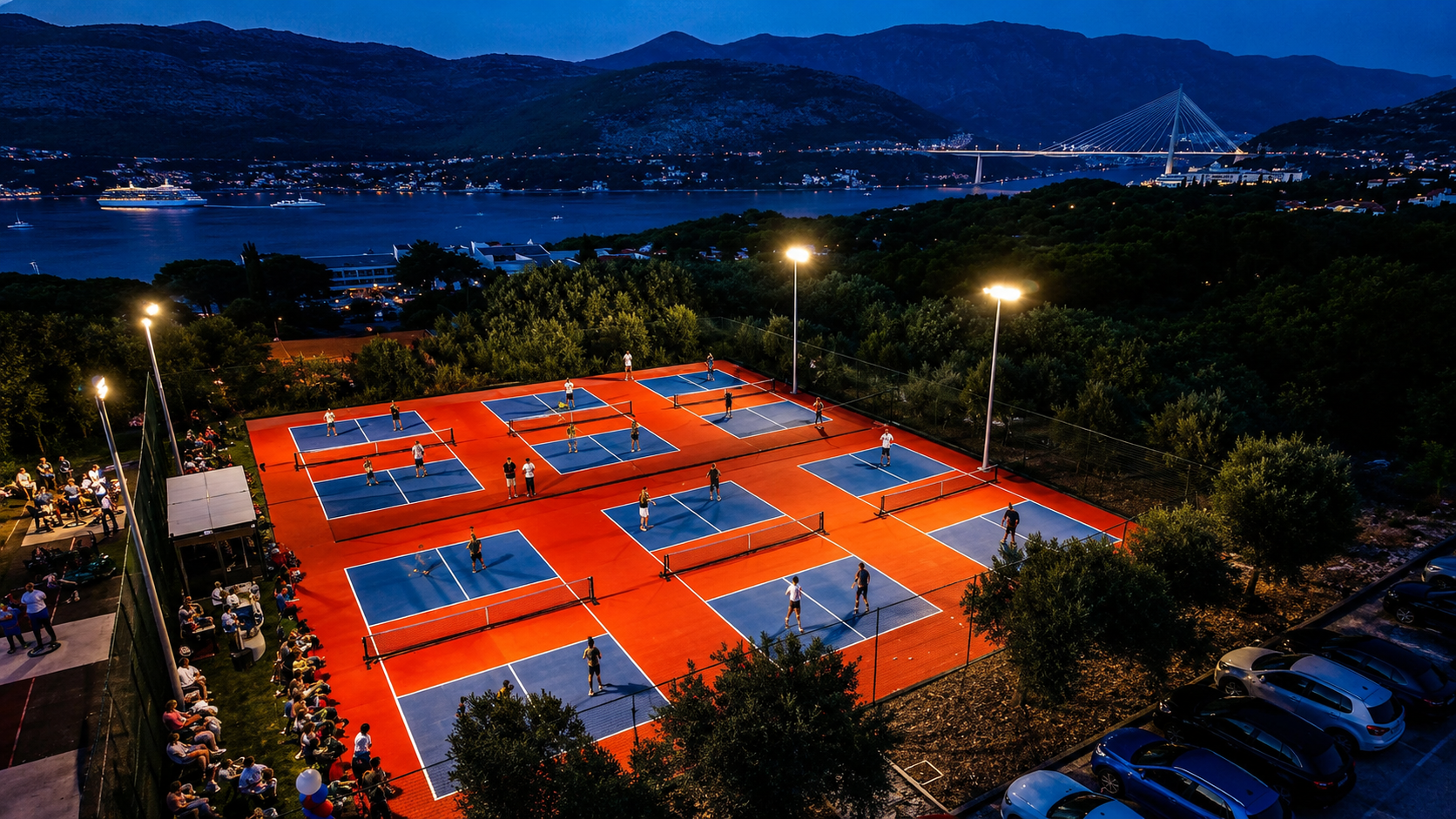
The newest pickleball courts in Croatia sit on Babin Kuk, the green peninsula on the northern side of Dubrovnik where hotels, beaches and holiday apartments crowd towards the Adriatic.
There are six of them.
That number is worth establishing early because it prevents this story becoming something it isn’t. Six courts do not make Dubrovnik a European pickleball capital. They do not prove that Croatia is about to become the continent’s next great market.
What they do is put another pin in an increasingly curious Croatian map.
Pickleball Club 002 opened its first dedicated centre beside the Sava in Zagreb in the summer of 2024. Four courts. Last year came Stobreč, just outside Split, where the same organisation went much bigger with 12 dedicated courts barely 100 metres from the Adriatic. This week, Club 002 arrived in Dubrovnik.
Zagreb to Split to Dubrovnik in a little over two years.
Seen that way, the interesting part of the Dubrovnik opening is what is beginning to happen between those three places.
A club that started in a school gym
Club 002 did not begin with a tourism strategy.
Its own account traces the story back to a group of friends playing pickleball in a Zagreb school gym. They liked the game enough to want somewhere permanent to play it, and in 2024 opened four dedicated courts at Veslačka ulica, beside the Sava.
The name came from the score called at the beginning of a doubles game: zero-zero-two.
There was nothing particularly exotic about the original proposition. Courts, open play, leagues, coaching and somewhere for a community to gather. Club 002 says more than 1,500 players used its facilities during its first three months, although that is the company’s own figure rather than an independently audited participation number.
Then came Split.
The difference was not merely scale. Club 002 built 12 professional courts in Stobreč, alongside a shop and social area, with leagues, coaching, open play and international tournaments. The Croatian Open moved there in 2025 and returns at the end of this month.
But the location altered the proposition too.
The courts are 100 metres from the sea.
That detail has made its way beyond Club 002’s own marketing. Split’s official tourist authority now lists the centre among the activities available in the area, highlighting its dedicated courts, Adriatic location and programmes for recreational and competitive players.
The pickleball club has entered the tourist map.
Then came Dubrovnik
The Dubrovnik centre opened on Monday, 17 August, at Iva Dulčića 34 on Babin Kuk, close to the Valamar Lacroma hotel.
Its six outdoor courts will operate year-round, with coaching, court hire, open play, summer schools and equipment rental. Opening hours run from 6am until midnight. The launch included demonstration matches involving Croatian and Austrian players, followed this week by free evening sessions designed to get newcomers onto the courts.
For somebody living in Dubrovnik, those details matter more than any theory about sports tourism. A permanent facility means somewhere to learn, somewhere to play regularly and, potentially, somewhere around which a local playing community can form.
Yet it is impossible to separate the centre entirely from where Club 002 has chosen to put it.
Dubrovnik’s permanent population is small compared with the number of people who pass through it. Babin Kuk exists partly in the rhythm of that visitor economy. Hotels and resorts occupy much of the peninsula, and the city’s name carries a recognition around the world that Croatian pickleball plainly does not.
Club 002 has put six courts where the audience changes every week.
The question is what happens when those two populations begin sharing them.
Pickleball with the holiday already attached
Pickleball tourism is not new.
There are organised trips, camps and resorts across mature markets, while specialist operators increasingly sell European holidays with court time included. The easy mistake is to see a new facility beside the Adriatic and immediately declare Croatia the next pickleball-tourism destination.
The evidence here is more interesting than that.
Club 002 is already involved in organising trips and events. Croatian pickleball holidays are already being sold by specialist operators. Split’s tourism authorities already promote its 12-court centre to visitors. Players arriving there are not being directed towards a faded tennis court with temporary lines. They are being sent to a dedicated pickleball complex.
Dubrovnik adds another stop.
A player travelling through Croatia can now play at a purpose-built centre in Zagreb, head south to a 12-court complex beside the sea in Split and continue down the Dalmatian coast to six more dedicated courts in Dubrovnik.
It is not difficult to imagine somebody doing exactly that because people already travel through Croatia in almost exactly that way.
The pickleball infrastructure is being laid over an existing tourist route.
Croatia does not have to persuade people to spend their holidays in Croatia and then persuade them to play pickleball. Millions of visitors already choose the country. The opportunity is to put enough good courts in the places they visit that playing becomes part of the trip.
There is a considerable difference between those two tasks.
The numbers need some care
The headline number attached to the Dubrovnik launch is striking.
Research supplied to WPM reports that Croatia has moved from five pickleball courts in two cities two years ago to 58 courts across 11 cities today.
If accurate, it would represent a remarkable change in physical infrastructure over a very short period.
It also needs treating carefully.
WPM has not found an independent national court registry that verifies the 58-court figure, so it should not be presented as an audited measurement of Croatian pickleball. Court counts can also become slippery in a young sport. Dedicated pickleball courts, permanently lined multi-sport spaces and tennis courts temporarily converted for play are not the same thing.
What can be established more firmly is the expansion of Club 002 itself.
Its Zagreb centre has four dedicated courts. Split has 12. Dubrovnik has six. Its tournament programme has grown with them: the Croatian Open began in Zagreb in 2024, moved to the larger Split facility in 2025 and returns there from 28 August this year. Zagreb has also hosted the Zagreb Masters and TOPSERIES competition.
There is recreational play, organised competition and now a three-city footprint.
For a project that began in a school gym, that is enough movement to warrant attention without inflating the national numbers.
Split may be the more important clue
Dubrovnik provides the news this week, but Split may tell us more about whether the idea works.
The Stobreč centre has now had more than a year to exist beyond an opening ceremony. It offers leagues and open play as well as court bookings. It stages tournaments. It is also listed within Croatia’s MultiSport network, placing pickleball alongside the country’s more established fitness and recreational activities. Local tourism bodies have incorporated the centre into their visitor information.
Those things are less glamorous than photographs of pristine courts beside the Adriatic. They are also considerably more useful.
A tourism-dependent sports facility is vulnerable to the calendar. Croatia welcomed more than 21 million tourist arrivals in 2025, but the country’s visitor economy remains heavily seasonal. A court can be packed with foreigners in August and still have a problem in February.
That is why the Zagreb origins of Club 002 matter.
The organisation did not begin by chasing holidaymakers. It first built a community around regular players in the capital, then took the model to the coast. Split still offers the ordinary machinery of a club: coaching, leagues, open play and recurring local competition.
Dubrovnik will need the same machinery.
The tourists can help fill the booking sheet. They cannot be the booking sheet.
A Croatian route
European pickleball will inevitably behave differently once it collides with the economies and sporting cultures of individual countries.
Croatia has fewer than four million residents. It is not going to reproduce the American participation market by brute scale.
What it does have is an extraordinary visitor economy, an established reputation for active holidays, a long Adriatic coastline and destinations that international travellers already connect naturally.
Dedicated courts therefore do not necessarily have to be sustained solely by a huge domestic playing population. Local players and travelling players can use the same infrastructure at different times and for different reasons. Residents provide repeat business and community. Visitors provide additional demand and expose the facilities to players who may already know the game.
Whether those two groups are enough to make the economics work is the part we do not yet know.
Club 002 is a private operator expanding quickly in a sport where reliable participation data remain scarce. Its own claims naturally present that expansion positively. Dubrovnik has only just opened. Even Split has not existed long enough to establish what several years of year-round demand will look like.
This is an experiment still near its beginning.
The test comes after summer
For the next few weeks, Dubrovnik is the easy version of this idea.
The Adriatic is warm. The hotels are busy. Visitors are everywhere. Club 002 is offering free introductory sessions, and six new courts carry the uncomplicated appeal of something new.
The harder months will tell us much more.
There will eventually be a wet Wednesday outside the tourist season when Babin Kuk is quiet, the hotel occupancy has fallen and nobody is arriving in Dubrovnik because they saw a pickleball court on Instagram.
Someone will still need to book Court Four.
If the local players do, then the visitors who arrive next summer become a bonus rather than a business plan.
And somewhere between those two groups, Croatia might begin to show Europe what a pickleball destination actually requires.
Frequently asked questions
Six dedicated courts on the Babin Kuk peninsula.
In Zagreb, with four courts beside the Sava, and Stobreč near Split, with 12 courts.
From the score called at the start of a doubles game: zero-zero-two.
Further reading
- Latest pickleball news from around the world
- Tournament coverage and results
- Rankings and player profiles
- Regional pickleball coverage

Chris Beaumont
Founder and Editor-in-ChiefChris Beaumont is the founder and Editor-in-Chief of World Pickleball Magazine, published by World Pickleball Media Ltd. He follows the global game closely, reporting on news, developments, stories and tournaments from all five continents. He also hosts the World Pickleball…
View All Articles →