Gary Vaynerchuk says he paid around $500,000 for the New Jersey Fives. MLP franchises now reach eight-figure valuations. Are they cheap?
The short answer: Gary Vaynerchuk says his original New Jersey Fives investment was around $500,000. MLP has since recorded a $13 million valuation for a controlling stake in the LA Mad Drops and $16 million for the Palm Beach Royals expansion franchise, while the 2026 MLP Finals averaged 773,000 viewers on CBS. Whether today’s valuations prove cheap is open.
Gary Vaynerchuk bought into Major League Pickleball when plenty of people were still laughing at the idea. Four years later, MLP franchises have reached eight-figure valuations, institutional capital has arrived and his New Jersey Fives are champions. He may have been right about the first bet. The much bigger question is whether today’s valuations will eventually look just as cheap.
Key takeaways
- Gary Vaynerchuk says his original investment in the New Jersey Fives was around $500,000; contemporary reporting described the 2022 expansion fee only as an undisclosed six-figure sum.
- MLP subsequently recorded a $13 million valuation for the sale of a controlling stake in the LA Mad Drops and a $16 million expansion-franchise valuation for the Palm Beach Royals.
- SFIA says 24.3 million Americans played pickleball in 2025, including 7.5 million core participants who played at least eight times during the year.
- The 2026 MLP Finals averaged 773,000 viewers on CBS and attracted more than 10,000 spectators across three days in Central Park, both league records.
- A $225 million structured investment into Pickleball Inc. provides further evidence of commercial confidence, but participation, capital and franchise valuations still do not guarantee mass professional fandom.
Gary Vaynerchuk has heard the jokes about pickleball.
He has heard the scepticism around franchise valuations, the doubts about whether people will ever watch the sport in sufficient numbers and the familiar argument that enormous recreational participation does not necessarily translate into a viable professional product.
His response is essentially to wait.
Writing recently about the rise of alternative sports, Vaynerchuk pointed towards the modest beginnings of the Super Bowl, the NBA’s struggle for television prominence and the period when UFC faced widespread restrictions across the United States. His argument was straightforward: today’s enormous sports properties were not born enormous, and people underestimate how much room remains for sports such as pickleball to develop.
There is an obvious temptation for anybody working within the sport to nod along.
The evidence makes that temptation stronger than it once was.
Vaynerchuk and Ryan Harwood entered Major League Pickleball ownership in 2022, when contemporary reporting described the expansion fee only as an undisclosed six-figure sum. Vaynerchuk has since said he bought the team for approximately $500,000.
Three years later, the sale of a controlling stake in the LA Mad Drops valued that MLP franchise at $13 million. The Palm Beach Royals entered the league at a $16 million expansion-franchise valuation.
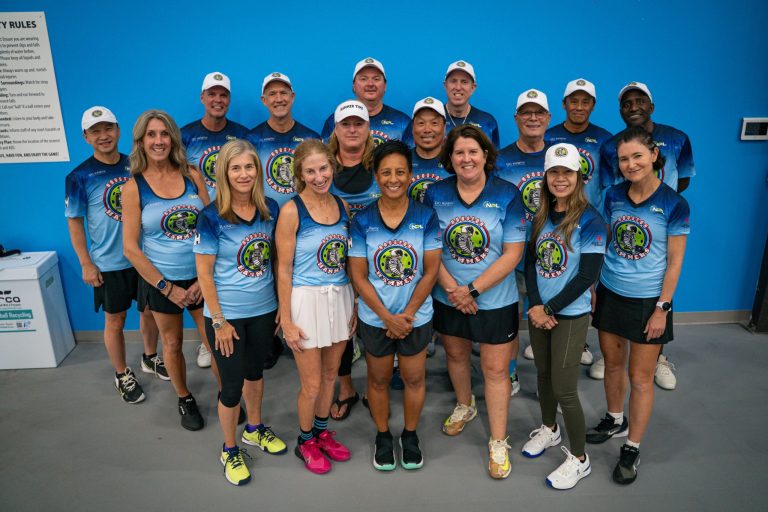
Vaynerchuk’s New Jersey Fives have now won the 2026 Major League Pickleball championship, defeating the St. Louis Shock in New York, while the deciding weekend produced MLP’s largest television audience and highest single-event attendance to date.
Whatever happens next, dismissing his original investment as foolish is becoming difficult.
But that is no longer the interesting question.
The question is whether today’s $13 million and $16 million valuations will one day look the way Vaynerchuk’s early entry point does now.
That requires a much bigger leap.
Gary vee’s bet has already changed
When Vaynerchuk entered MLP, he was not buying into a mature sports business.
Sports Business Journal reported in March 2022 that the incoming expansion owners had paid an undisclosed six-figure fee and would also be responsible for operating expenses. Vaynerchuk said then that he would be “flabbergasted” if there was not a substantial, viable professional pickleball league in the United States and internationally within 15 years.
Four years later, that proposition looks considerably less eccentric.
MLP survived the expensive battle between rival professional structures, eventually joining the PPA Tour under the same commercial umbrella. In 2026, the ecosystem expanded again with the creation of Pickleball Inc., bringing professional competition together with additional technology, retail and infrastructure businesses.
In May, Apollo Sports Capital led a $225 million structured investment into that company.
The businesses combined within Pickleball Inc. generated more than $140 million in revenue during 2025.
Those figures require an important qualification. Pickleball Inc. contains considerably more than Major League Pickleball, and its combined revenue cannot be treated as MLP revenue or even purely as professional-sport revenue.
They nevertheless establish something significant.
Professional pickleball is no longer merely an idea supported by celebrity owners and participation projections. It now sits inside a broader pickleball business capable of attracting nine-figure institutional investment.
There is an economy underneath the wager.
Then there are the 24.3 million players
The participation case is even harder to ignore.
According to the Sports & Fitness Industry Association, 24.3 million Americans played pickleball during 2025, up from 4.2 million in 2020.
More important than the headline number may be what is happening underneath it.
SFIA counted 7.5 million “core” participants who played at least eight times during the year, compared with 1.4 million in 2020. It also found that people aged 13 to 24 now have the highest participation rate of any age group, while women account for 42.9 per cent of US players.
That matters because the lazy version of the pickleball investment thesis used to rely upon two assumptions: everybody was suddenly playing it, but everybody playing it was old.
Neither description is adequate anymore.
The sport has a substantial recreational base and that base is broadening.
For investors, this is enormously attractive because most emerging professional sports face the opposite problem. They have to persuade people to understand the game before they can persuade them to care about a league.
Pickleball already has millions of people who understand what they are watching. They know why a third-shot drop is difficult, recognise the tension in a kitchen exchange and understand why an apparently innocuous ball can create the opening for a speed-up.
Golf and tennis have benefited from that relationship between participation and spectatorship for generations. Recreational players understand the difficulty of elite performance because they have tried to reproduce it themselves.
Pickleball potentially has the same bridge.
It simply has not yet proved how many people will cross it.
Playing is not watching
This remains the central weakness in the bullish case.
Twenty-four million participants are not 24 million professional pickleball fans.
Running is enormously popular without creating weekly mass audiences for professional athletics. Millions of people swim without following international swimming outside the Olympic cycle. Recreational participation provides potential customers, not guaranteed spectators.
That distinction becomes especially important once franchise valuations begin reaching eight figures.
There is now evidence that pickleball can attract increasingly meaningful audiences. The 2025 PPA World Championships and MLP Cup in Texas drew more than 60,000 attendees and generated more than $1.1 million in combined ticket and hospitality revenue, while Pickleballtv recorded more than 70 million minutes watched across the two competitions.
Major League Pickleball has moved further again in 2026.
The league says its championship broadcast on CBS on August 30 averaged 773,000 viewers, 55 per cent higher than the equivalent coverage a year earlier and the largest audience for an MLP broadcast. More than 10,000 spectators attended the three-day Finals event at CityPickle in Central Park.
Those are no longer negligible numbers.
They are also nowhere near the routine audiences generated by America’s established major leagues.
Both things can be true.
That is the territory Vaynerchuk is betting on.
The NFL comparison is useful until it isn’t
Vaynerchuk’s historical point is legitimate.
The first AFL-NFL World Championship Game, later known as Super Bowl I, attracted 61,946 spectators to the Los Angeles Memorial Coliseum in 1967 without filling the stadium. Around the turn of the 1980s, CBS famously showed NBA playoff and even Finals basketball on tape delay. UFC later endured political opposition and widespread restrictions before becoming a mainstream global property.
Anybody using pickleball’s present audience as proof of its permanent ceiling should remember that sports markets change.
History can be abused in the opposite direction too.
Every enormous sports property was once small.
Not every small sports property becomes enormous.
The NFL did not become America’s dominant league merely because enough people eventually discovered football. It developed scarcity, geography, ritual and appointment viewing. A relatively small number of games makes individual results matter, teams became deeply attached to cities, support passed between generations and the Super Bowl developed into a cultural event extending far beyond committed football supporters.
The NBA built a different machine around globally recognisable stars, city identities, rivalries and a media product capable of turning athletes into cultural figures.
Professional pickleball possesses very little comparable inherited equity.
Major League Pickleball has franchises, but they remain young sporting brands rather than civic institutions. Player movement can make sustained identification difficult, while the broader professional calendar contains enough events that distinguishing the indispensable from the merely available remains a challenge.
The historical comparisons demonstrate what is possible.
They do not explain how pickleball gets there.
The UFC may be the comparison that matters
The UFC analogy is more useful precisely because it began without inherited teams or century-old local loyalties.
It manufactured meaning.
Individual stars became entry points for casual viewers. Rivalries created narrative. Championships provided hierarchy. Events were promoted so audiences understood what was at stake before the first fight began.
Vaynerchuk appears to understand this distinction.
Speaking earlier this year about Anna Leigh Waters, who is represented by VaynerSports and plays for his New Jersey Fives, he argued that emerging sports need recognisable “superheroes”, pointing towards figures such as Conor McGregor and Ronda Rousey in UFC, Michael Jordan and Larry Bird in basketball and Joe Namath in football.
That is much closer to the problem pickleball actually has to solve.
Distribution alone will not create fandom.
Narrative gives distribution value.
Waters is the obvious current example because sustained dominance has given casual audiences something straightforward to understand. Ben Johns performed a similar function as the leading figure of the men’s game, while emerging regional stars can potentially perform that role as professional pickleball develops beyond the United States.
The sport needs more of them.
A casual viewer should know what somebody is chasing, what they stand to lose and why today’s match matters for tomorrow.
The UFC became exceptionally good at answering those questions.
Pickleball is still learning.
What is a $16 million pickleball team actually worth?
This is where Vaynerchuk’s argument becomes an investment question rather than a sporting one.
The $13 million LA Mad Drops valuation and $16 million Palm Beach Royals expansion valuation provide genuine market evidence, but they should be understood precisely.
The Mad Drops transaction involved the sale of a controlling stake at a $13 million valuation. The Royals figure represented the valuation attached to a new expansion franchise. Neither means somebody simply paid the quoted amount in cash to purchase an existing team outright.
Nor do those transactions prove that MLP franchises currently generate financial results sufficient to justify those valuations under conventional measures.
Investors are buying future possibilities: media rights, sponsorship, ticketing, franchise scarcity, merchandising, local commercial relationships and the prospect that today’s enormous recreational base becomes tomorrow’s professional audience.
The wager is less about whether the current business is worth the purchase price on today’s economics, and more about whether the future one might be.
Sports ownership has repeatedly rewarded that type of thinking.
The scale at the mature end of the market is extraordinary. Forbes’ 2026 estimates put the average NFL franchise at $9.5 billion and the Dallas Cowboys at $17 billion.
Nobody serious is suggesting MLP is approaching the NFL.
That is not the useful part of Vaynerchuk’s comparison.
The point is that sports assets can appreciate dramatically when attention, scarcity and cultural relevance compound over long periods.
The missing word is when.
Scarcity has little value if demand for the scarce asset does not grow. A league can limit itself to a small number of franchises. It cannot force future buyers to desperately want one.
The $225 million signal
This is why the Apollo investment matters.
Celebrity owners have always made useful headlines for pickleball. Major sporting and entertainment figures helped make MLP ownership culturally interesting before the underlying economics had fully developed.
Institutional capital is a different signal.
Apollo Sports Capital leading a $225 million structured investment does not guarantee that Pickleball Inc. succeeds, and the investment covers a broader collection of businesses than MLP alone.
It does mean a major institutional investor has examined that collection of professional, technology, retail and infrastructure assets and found sufficient opportunity to deploy nine figures into it.
That shifts the discussion.
The professional game is no longer asking only whether wealthy enthusiasts will fund its development.
It is beginning to ask whether an integrated pickleball economy can produce returns at institutional scale.
That is a much more serious test.
The part investors cannot spreadsheet
There are still reasons for caution.
Professional pickleball’s structures remain difficult for casual audiences to understand. The relationship between tours, team competition, rankings and international organisations is more complicated than it needs to be. The calendar can feel relentless, reducing the scarcity that helps major sporting events become appointments.
Television presents another challenge.
Pickleball makes immediate sense when you play it. On screen, some of its most sophisticated exchanges can look deceptively simple to somebody who has never stood at the kitchen line.
Production can improve that. Commentary can explain it. Better camera positioning, data, graphics, microphones and storytelling can expose the speed and tactical pressure hidden within the game.
Ultimately, however, the audience needs a reason to care about the result.
That remains the variable nobody can model confidently.
Asia changes the size of the wager
Vaynerchuk’s original 2022 prediction was not limited to the United States. He said he expected a viable professional league in America and around the world.
That part of the thesis has become considerably more interesting.
PPA Tour Asia now provides a professional circuit across the region, while MLP Asia begins its inaugural season in November with franchises representing China, Hong Kong, Malaysia, the Philippines, Japan and Vietnam. India and Australia have also developed professional league properties, while European competition continues to deepen.
This does not mean one unified global commercial structure is inevitable.
Quite the opposite.
Different organisations, ranking systems, governing bodies and investors could produce fragmentation just as easily as integration.
But international development changes the potential ceiling.
If pickleball becomes a sport with meaningful professional markets across North America, Asia, Europe and Australia, its eventual commercial opportunity looks very different from that of an American recreational craze supporting one domestic tour.
The risk expands with the opportunity.
So does the prize.
The missing ingredient is still meaning
After all the investment figures, participation statistics and audience data, professional pickleball’s central problem remains surprisingly human.
It needs people to care.
Why does this match matter? Why should somebody in New Jersey care whether the Fives retain their title next season? Why should a recreational player in Kuala Lumpur know who Tama Shimabukuro is? Which championships will still be discussed in 20 years, and which rivalries will persuade somebody who was not planning to watch to turn the television on?
Eventually, which franchises will be inherited rather than selected?
Those questions sound less sophisticated than a $225 million capital raise or a $16 million franchise valuation.
They are what those numbers ultimately depend upon.
Media rights become valuable because audiences care. Sponsorship becomes valuable because brands want access to those audiences. Tickets become valuable because people want to be inside the venue. Franchises become scarce because somebody desperately wants to own one.
Everything eventually comes back to emotional demand.
Gary Vee has already been partly right
That makes the verdict on Vaynerchuk more complicated than either believers or sceptics might prefer.
The easiest moment to dismiss his pickleball investment has already passed.
His original entry into MLP was reported at the time only as an undisclosed six-figure expansion fee, and he now puts his own purchase figure at approximately $500,000. Since then, MLP has produced franchise transactions carrying $13 million and $16 million valuations, while the league he predicted could become viable has survived consolidation and become part of a broader business that has attracted $225 million of institutional investment.
US participation has risen from 4.2 million to 24.3 million in five years.
Professional events have attracted tens of thousands of spectators.
The 2026 MLP Finals averaged 773,000 viewers on CBS.
Vaynerchuk’s own team won the championship in front of the league’s largest event crowd.
Those are facts, not projections.
They still do not prove that today’s franchise valuations are cheap.
That is the next wager.
For a $16 million MLP franchise to look the way Vaynerchuk’s early investment eventually might, professional pickleball must turn participation into sustained spectatorship, players into recognisable stars, franchises into meaningful identities and individual matches into events audiences believe they cannot miss.
The NFL, NBA and UFC prove that sporting hierarchies are not permanent.
They also demonstrate how extraordinarily difficult it is to build something capable of changing them.
Investors can fund leagues. Broadcasters can distribute matches. Owners can purchase franchises. Marketing departments can manufacture awareness.
None of them can simply declare that a sport matters.
The audience eventually decides that.
Gary Vee made his first pickleball bet when plenty of people were still laughing.
On that one, the evidence is increasingly on his side.
The much bigger question is whether, years from now, people will look at a $16 million pickleball franchise and wonder why anybody thought that was expensive.
Frequently asked questions
Around $500,000, he says.
$16 million as an expansion franchise.
24.3 million, according to SFIA.
Further reading
- SFIA: 2026 Pickleball Single Sport Report – The latest participation data behind the 24.3 million US player figure and the changing age and gender profile of the sport.
- Major League Pickleball: LA Mad Drops Transaction – Details of the $13 million controlling-stake valuation and the $16 million Palm Beach expansion valuation.
- Major League Pickleball: 2026 Finals Audience – MLP’s figures for the record CBS audience and Central Park attendance.
- Gary Vaynerchuk: The Rise of Alternative Sports Is a Marketing Goldmine – Vaynerchuk’s argument about pickleball, emerging sports and why today’s small properties can become tomorrow’s major ones.

Chris Beaumont
Founder and Editor-in-ChiefChris Beaumont is the founder and Editor-in-Chief of World Pickleball Magazine, published by World Pickleball Media Ltd. He follows the global game closely, reporting on news, developments, stories and tournaments from all five continents. He also hosts the World Pickleball…
View All Articles →