Seven paddle brands have reached agreements with JOOLA over its patent claims and three disputes remain, as paddle tech becomes intellectual property.
The short answer: Seven of the 11 paddle brands JOOLA brought before the US International Trade Commission in April have reached agreements with the company. JOOLA is seeking a default determination against Diadem, while Franklin Sports, RPM Pickleball and Friday Labs remain unresolved. The Commission has made no ruling on the merits, but disclosed settlements with Paddletek, ProXR and Proton include royalties and patent marking.
Seven paddle companies have now reached agreements with JOOLA over its patent infringement claims, while three disputes remain unresolved. The bigger story is what comes next: pickleball’s paddle arms race is no longer only about who can invent the next performance advantage, but who can establish ownership of it.
Key takeaways
- JOOLA launched patent infringement proceedings in April against 11 rival paddle brands over technology it associates with its Propulsion Core construction.
- Seven competitors have since reached agreements with JOOLA, while the company is seeking a default determination against Diadem. Franklin Sports, RPM Pickleball and Friday Labs remain unresolved.
- The ITC investigation concerns U.S. Patent Nos. 12,465,826 and 12,357,891, both titled “Game Paddle”. The Commission has made no determination on the merits of JOOLA’s allegations.
- Disclosed settlements with Paddletek, ProXR and Proton include royalties and patent marking, demonstrating that paddle intellectual property can now carry direct commercial consequences.
- The emerging patent picture could change how paddle companies approach research, product development, licensing and the cost of bringing new technology to market.
For much of pickleball’s paddle arms race, the contest has been fought in laboratories, factories, certification tests and marketing departments, as manufacturers searched for more power, greater spin and better control through changes to core construction, surface materials, foam, thickness and weight distribution.
Now another battleground is becoming impossible to ignore: the courtroom.
Five months after JOOLA launched patent infringement proceedings against 11 rival paddle brands, seven have reached agreements with the company, an eighth is the subject of a requested default determination, and only three of the original disputes remain unresolved.
The immediate story concerns technology JOOLA associates with its Propulsion Core construction and two US patents covering particular aspects of game-paddle construction. The larger one concerns an equipment industry reaching a stage at which technological ideas have become valuable enough to protect, license and fight over, as well as advertise.
Pickleball’s paddle arms race is entering its second phase. The first was dominated by the pursuit of invention. The next may increasingly be shaped by who can establish ownership of it.
From paddle launch to patent enforcement
JOOLA began the action on April 7, filing a complaint with the US International Trade Commission against 11 competing paddle brands. After an amended complaint and subsequent supplement, the Commission formally instituted Investigation No. 337-TA-1503 in June.
The investigation concerns U.S. Patent Nos. 12,465,826 and 12,357,891, both titled “Game Paddle”. According to the US International Trade Commission, the investigation covers specified claims within those patents and a category of accused products described as pickleball paddles containing a core made from foam or another material together with various filler materials.
The distinction between that language and the terminology used to sell paddles matters.
JOOLA describes the disputed technology through its Propulsion Core branding, but patents do not protect a marketing category or the general idea of producing a powerful paddle. They protect inventions through particular legal claims. Whether another product infringes therefore depends upon its construction and whether it falls within those claims, rather than whether it looks similar, produces comparable performance or belongs to a loosely defined generation of paddle technology.
JOOLA alleged that products sold by the respondents infringed its patent rights. Those allegations should not be confused with findings of infringement. When the ITC instituted its investigation, it explicitly stated that it had made no decision on the merits of the case.
What has happened since is nevertheless commercially significant.
Seven agreements and three disputes left
Paddletek and ProXR were the first to reach agreements with JOOLA in May. Those settlements concerned the Paddletek Reserve, HoneyFoam and ProXR Signature Jolt paddles.
Under the disclosed terms, Paddletek and ProXR could continue selling specified inventory while phasing the affected products out through the autumn. They also agreed to add JOOLA’s Propulsion Core patent number to relevant products and pay royalties.
Proton subsequently settled over its Flamingo Series 3 paddle. Manufacturing was to stop immediately, while existing inventory could continue to be sold through summer 2026. Proton also agreed to pay royalties and identify JOOLA’s patent rights on remaining products.
Facolos, Volair, Engage Pickleball and All For Padel, the company associated with Adidas-branded pickleball paddles, have also now reached agreements with JOOLA.
Diadem’s position is different. It has not announced a negotiated settlement. According to the latest reporting, the company did not respond to the complaint and JOOLA is seeking a default determination against it.
Franklin Sports, RPM Pickleball and Friday Labs remain the three unresolved competitors from the original group.
The technology is becoming intellectual property
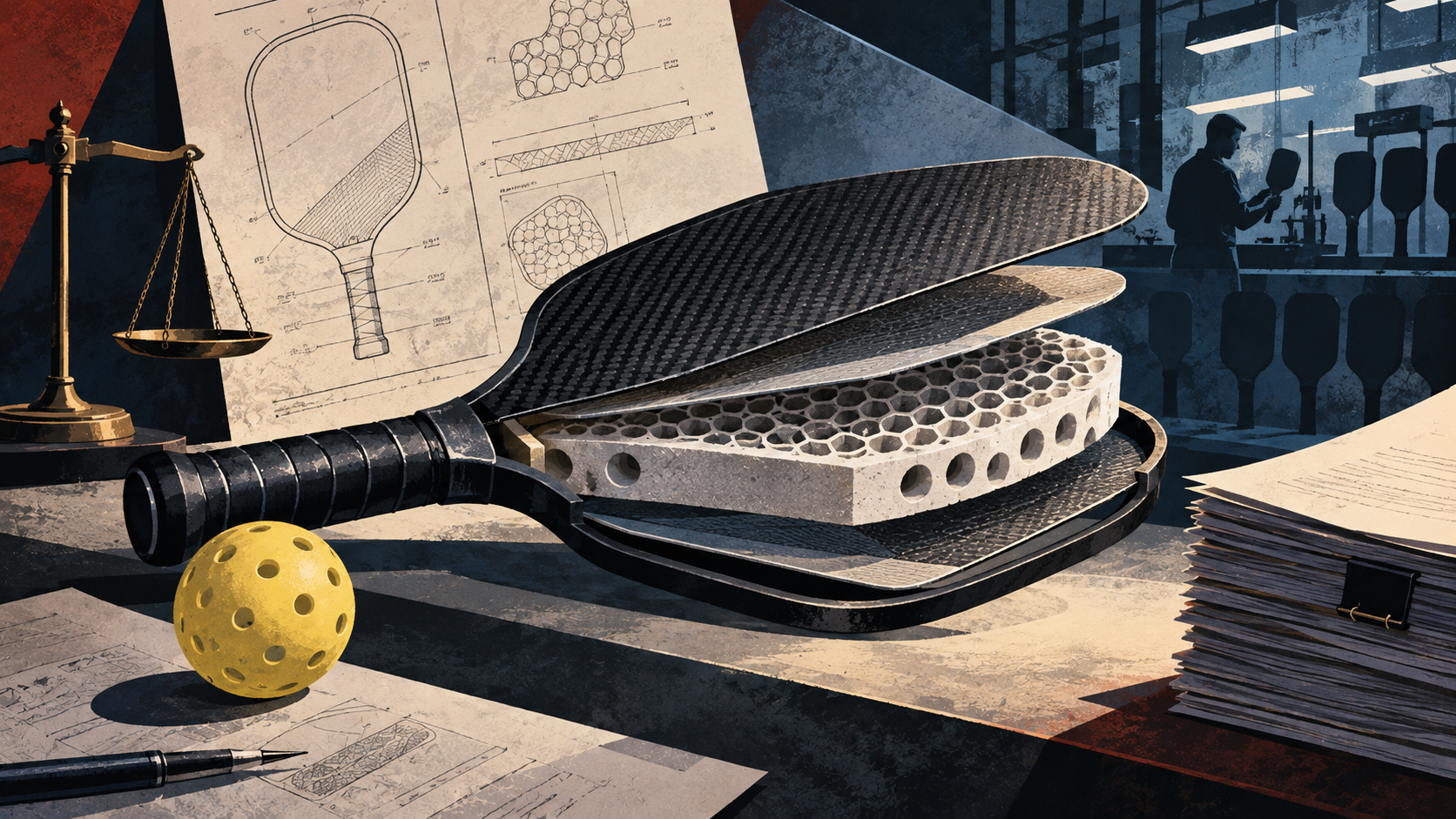
Propulsion Core became one of the most recognisable technologies of pickleball’s rapid paddle-development cycle because it sought to manipulate something fundamental to performance: the relationship between the paddle’s core and its hitting surface.
The patents asserted by JOOLA describe particular structural relationships involving a paddle core, removed or open areas around portions of that core and filler material. Those structures can influence how the paddle behaves when the ball makes contact.
Why the settlements matter without a courtroom victory
JOOLA has not obtained a contested ruling establishing that all 11 competitors infringed valid patent claims. Seven negotiated resolutions cannot be converted into seven judicial findings, while the requested default determination involving Diadem presents another situation again.
The Paddletek, ProXR and Proton agreements provide the clearest evidence because some of their commercial consequences have been disclosed publicly. Products could remain on sale for defined periods, royalties were attached and the companies agreed to mark relevant products with JOOLA’s patent information. Proton also agreed to halt further manufacture of the Flamingo Series 3.
Once that happens, every manufacturer has another calculation to make before launching its next product. What does the patent position around this construction look like? Does a proposed design risk falling within somebody else’s claims? Can it be redesigned? Is a licence available? What would that licence cost? Is the expected market for the paddle large enough to justify the investment and legal risk?
The smaller-brand problem
That could have particularly important consequences in a paddle market notable for the speed at which new brands have appeared.
The barriers to creating a pickleball paddle company have historically been relatively low compared with many sporting-goods categories. Manufacturing can be outsourced, products can be sold directly to consumers, and reviewers, social media and player sponsorships can give a young brand visibility without the distribution infrastructure once required to challenge an established equipment company.
That environment has helped create remarkable variety. It has also allowed product ideas to travel quickly, with commercially successful constructions often followed by competing approaches within product cycles considerably shorter than those traditionally associated with racket sports.
A major manufacturer can generally absorb specialist legal advice, patent applications and prolonged litigation more readily than a small company launching its first or second generation of products. Even where that smaller company believes its design does not infringe another patent, establishing that position can itself become expensive.
Enforceable patents can reward companies that invest in original research by giving them a period in which competitors cannot simply reproduce a protected invention. Without meaningful protection, the commercial incentive to spend heavily developing genuinely new construction can weaken.
Product development increasingly requires more than finding a manufacturer capable of producing a desirable paddle. Brands may need to investigate existing patents before designs are finalised, document how their own technologies were developed and consider protecting their inventions much earlier in the process.
The three disputes that remain
That is why Franklin Sports, RPM Pickleball and Friday Labs now become particularly interesting.
Their unresolved disputes could end in settlement like most of the others. If they do, the industry may be left with a powerful commercial signal without receiving a contested ruling setting the boundaries of JOOLA’s patents.
If one or more continue far enough for substantive determinations on infringement or patent validity, the consequences could be different. A decision favourable to JOOLA could provide stronger guidance about the scope of its rights, while a successful challenge could narrow those rights or undermine claims currently influencing how competitors assess their products.
Until then, restraint matters.
JOOLA is entitled to enforce patents it believes competitors infringe. Respondents are entitled to challenge the allegations and the patents themselves. Companies that settle may do so because they accept the commercial terms, because litigation is expensive, because continued uncertainty is damaging or for reasons never made public.
The next paddle arms race
As paddle technology becomes more sophisticated, the intellectual property surrounding it becomes more valuable. Manufacturers will not only compete to produce better equipment. They will increasingly compete to patent the ideas behind it, license technology where appropriate, challenge rivals they believe have crossed those boundaries and design around rights they do not control.
For players, much of that battle will remain invisible. They will encounter it only when a paddle disappears, changes construction, becomes more expensive or a technology becomes exclusive to particular brands.
For manufacturers, it is becoming part of the cost of doing business.
Frequently asked questions
US Patent Nos. 12,465,826 and 12,357,891, both titled “Game Paddle”.
Franklin Sports, RPM Pickleball and Friday Labs; JOOLA is seeking a default determination against Diadem.
No. The Commission has made no determination on the merits.
Further reading
- USITC: Certain Pickleball Paddles Investigation – The Commission’s official notice confirming the investigation, respondents and its position that no determination on the merits had been made.
- JOOLA and Paddletek Group Settle Patent Dispute – JOOLA’s announcement setting out the publicly disclosed terms involving Paddletek and ProXR.
- JOOLA Patent Register – JOOLA’s current list of products and associated patents, including the two US patents asserted in the ITC investigation.

Chris Beaumont
Founder and Editor-in-ChiefChris Beaumont is the founder and Editor-in-Chief of World Pickleball Magazine, published by World Pickleball Media Ltd. He follows the global game closely, reporting on news, developments, stories and tournaments from all five continents. He also hosts the World Pickleball…
View All Articles →