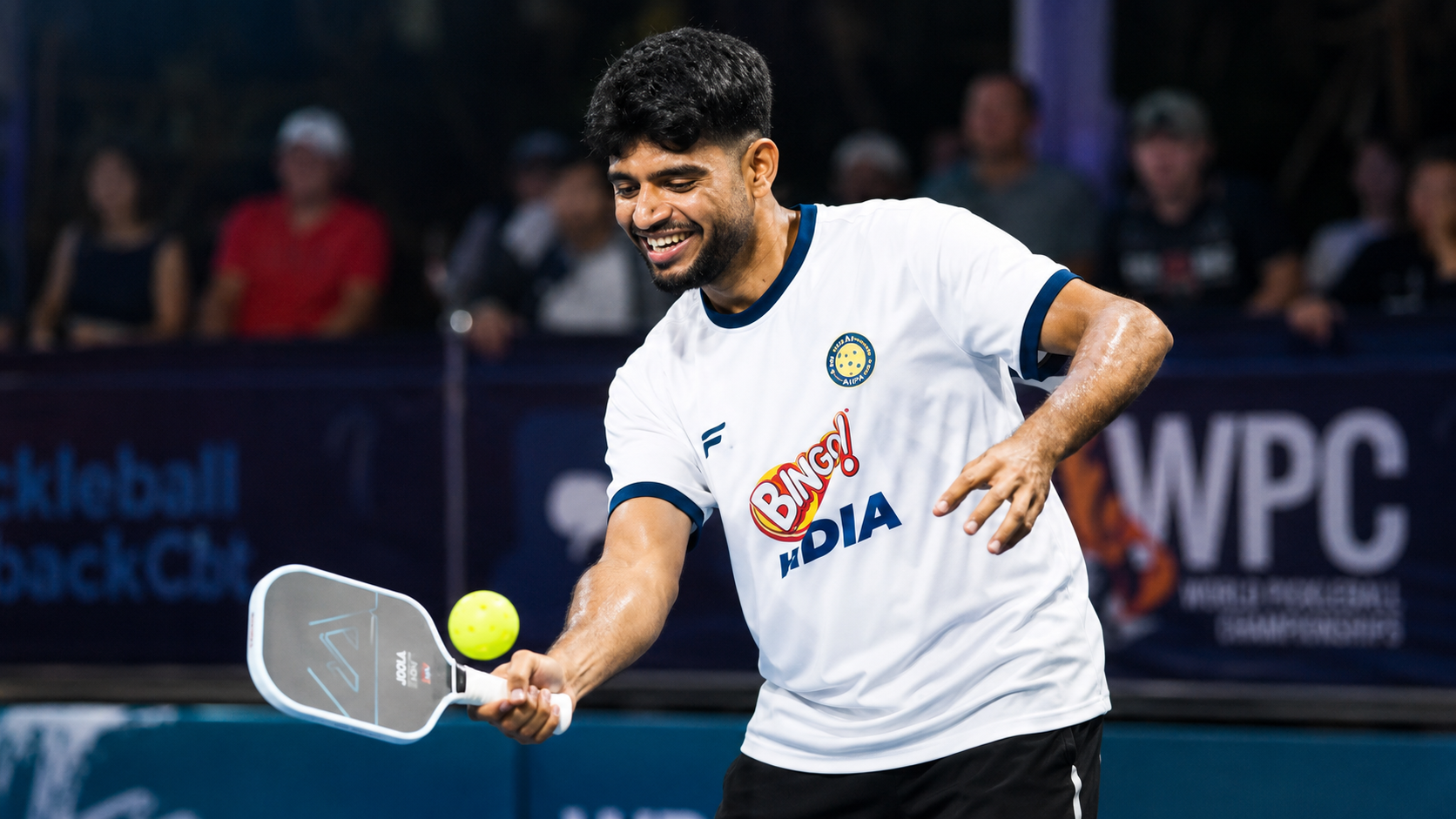
WPC world No. 1 Mayur Patil won men’s doubles gold and mixed silver at WPC Hatyai. Why his real test is now on the professional circuit.
The short answer: Mayur Patil, the WPC world No. 1, won the 19+ 5.0 men’s doubles title at WPC Hatyai with Thailand’s Bhannawitch Busarakul and took mixed doubles silver with Bermuda’s Imani Phillips. It followed men’s doubles golds in Bangkok and Penang in 2026. Having already played the World Pickleball League and PPA Tour Asia, his bigger question is how well his game travels.
Mayur Patil arrived at WPC Hatyai as the circuit’s world No. 1 and left with men’s doubles gold and mixed doubles silver. But after competing in the World Pickleball League and stepping into PPA Tour Asia, further WPC medals are no longer the only measure that matters.
Key takeaways
- Mayur Patil won the WPC Hatyai 19+ 5.0 men’s doubles title alongside Bhannawitch Busarakul and took mixed doubles silver with Imani Phillips.
- The result follows WPC men’s doubles golds in Bangkok and Penang earlier in 2026, both alongside Vanshik Kapadia.
- Patil has already tested himself beyond WPC through the World Pickleball League and PPA Tour Asia, changing the question from when he will step up to how successfully his game can travel.
Mayur Patil arrived in Hat Yai with very little left to prove about his place in the World Pickleball Championship hierarchy.
He was the WPC world No. 1, had already won men’s doubles titles in Bangkok and Penang during 2026 and had collected two silver medals in China. Three days later, another gold medal was hanging around his neck.
Patil partnered Thailand’s Bhannawitch Busarakul to win the 19+ 5.0 men’s doubles title at WPC Hatyai, having taken mixed doubles silver alongside Bermuda’s Imani Phillips a day earlier. Two events produced two medals and strengthened the position he had brought into Thailand in the first place.
At WPC level, Patil has become the player everybody else is trying to dislodge.
The more revealing part of his season is that WPC is no longer the only environment in which he is competing.
Patil has spent years building an international career from India, captained his country and played professional franchise pickleball. Earlier this month he also appeared in the qualifying field at the PPA Tour Asia 500 in Ho Chi Minh City, placing himself directly into a stronger professional environment.
Hatyai therefore did not leave Patil wondering whether he should try to step up.
He already has. The question now is how far the results can follow him.
Another weekend, another Patil medal
WPC Hatyai was the circuit’s first Asian event for several months and brought players back into a region where Patil has already built a substantial body of results.
The 19+ 5.0 men’s doubles field included players representing Malaysia, Taiwan, Thailand, India and Singapore. Patil’s partnership with Busarakul also paired the Indian No. 1 with a player from the host nation.
Mixed doubles brought silver alongside Phillips before the men’s competition ended with Patil and Busarakul taking gold.
The available public results do not provide enough match-by-match scoring to justify describing his weekend as outright dominance. What can be established is that Hatyai fits a much broader pattern.
In March, Patil partnered Vanshik Kapadia to win the Men’s Doubles 19+ Open at the WPC Asia Pickleball Open in Bangkok. A month later, they won the same category again at the WPC Series in Penang.
Hatyai brought another men’s doubles gold, this time with Busarakul.
Three significant WPC events in Asia have therefore produced three men’s doubles titles for Patil, despite the identity of the player alongside him changing in Thailand.
Patil’s career is already bigger than WPC
This is where the original interpretation of Patil’s season needs adjusting.
WPC has become an important part of his competitive calendar, but it is not the extent of his career.
Patil comes from Chopda in Maharashtra and has previously spoken about beginning the sport with rudimentary equipment and struggling to fund tournament travel. His progress eventually took him into India’s international team and into the captaincy.
At the 2022 Bainbridge Cup in Mumbai, Patil and Himansh Mehta reached the prize-money men’s doubles final before losing to Armaan Bhatia and Harsh Mehta.
Those experiences matter because Hatyai is not the story of a WPC specialist suddenly discovering that a higher standard of pickleball exists somewhere beyond the circuit.
Patil has been testing those boundaries for years.
The World Pickleball League provided a different test
The clearest evidence came through the inaugural World Pickleball League.
Patil represented Mumbai Pickle Power in a roster containing players from several established pickleball nations, putting him into a franchise environment where his opponents included professionals accustomed to competing at a higher international level.
One men’s doubles match in particular remains useful evidence.
Patil and South Korea’s Eung Gwon Kim fell 8-1 behind against Max Freeman and Ben Cawston of Hyderabad Superstars. They recovered to win 15-14, completing one of the more striking turnarounds of Mumbai’s campaign.
It did not establish Patil as an elite professional on its own, but it demonstrated that he could contribute meaningfully when the level around him rose.
WPM covered the inaugural World Pickleball League and Patil’s place in Mumbai Pickle Power, where he was one of the Indian players sharing a roster and court with experienced international professionals.
The next step has now taken him outside franchise pickleball as well.
PPA Tour Asia has already changed the question
The MB Ho Chi Minh City Open took place from August 6-9 with US$70,000 in professional prize money and 500 ranking points available to champions.
Patil entered the men’s doubles qualifying field alongside American Cameron Luhring.
That appearance matters more to this story than pretending there is a formal conveyor belt carrying a player from WPC into professional pickleball. There is not.
What Asia increasingly offers instead is a collection of competitive levels within travelling distance of one another: WPC events, domestic and franchise competitions, and a PPA Tour Asia calendar that now includes substantial professional fields across the region.
WPM has previously examined how PPA Tour Asia is building a more visible development structure, including events intended to create opportunities below its strongest tier.
Patil is a useful example of how a player can begin moving between those environments rather than remaining defined by one circuit.
WPC is becoming the floor, not the ceiling
That makes Hatyai more interesting rather than less.
Patil continuing to win WPC events tells us that his level has not disappeared while he tests himself elsewhere. He can return to these fields carrying expectation and continue collecting medals as partners and tournament conditions change.
There is, however, a limit to what another WPC gold can establish about his ceiling.
Repeated success at one level eventually creates a different question. The issue is no longer whether the player can continue winning there, but whether the qualities producing those wins survive when the pace, depth and consistency of the opposition increase.
Patil has started gathering that evidence through the World Pickleball League and PPA Tour Asia. He needs more of it.
This is also why the comparison with Europe in the original Hatyai report is unnecessary. Asia does not need to be described as possessing a perfectly defined pathway to make the point. The important development is simply that Patil now has several increasingly demanding places in which to play without having to base his career entirely in the United States.
The doubles-only format deserves restraint
Hatyai staged men’s, women’s and mixed doubles across its age and ability categories without offering men’s or women’s singles. It is an unusual feature of the tournament, but one event is not enough evidence to suggest that WPC or pickleball more broadly is moving towards a doubles-only future. For Patil, it simply meant Thailand could test only part of a game that Malaysia will ask him to show more fully.
Malaysia comes quickly
Patil does not have long to enjoy Hatyai.
WPC Series Malaysia begins this week, creating an immediate second Asian tournament after several months without a WPC event in the region.
This time his programme expands.
Patil is registered alongside American Jas Almauger in mixed doubles and is due to reunite with Vanshik Kapadia in men’s doubles, the partnership that has already won WPC titles together in Bangkok and Penang this year. He is also entered in men’s singles.
Malaysia therefore provides a broader WPC examination than Hatyai did.
Another men’s doubles run would test whether the Patil-Kapadia partnership can extend its sequence. Mixed doubles gives Patil another opportunity after silver in Thailand. Singles removes the partner entirely and asks him to carry the favourite’s status alone.
The field again contains substantial Asian representation, including players from Malaysia, Singapore, Hong Kong, India and Indonesia.
It is the obvious immediate target.
It is no longer the ultimate one.
What comes after being No. 1?
There is understandable satisfaction in reaching the top of a ranking, particularly when the results behind it keep reinforcing the position.
Patil has little reason to abandon WPC competition. The circuit gives him international matches, different partners and repeated opportunities to compete across Asia. Bangkok, Penang and Hatyai have also shown that he can carry expectation without allowing it to become a burden.
But his career is now producing another set of evidence alongside those medals.
He has represented India internationally. He has played professional franchise pickleball. He has beaten Freeman and Cawston after trailing 8-1 in a WPBL match. He has entered a PPA Tour Asia professional qualifying draw, while continuing to return to WPC tournaments and collect titles.
That is a more revealing position than simply being the WPC world No. 1.
Malaysia will tell us whether Patil can extend his control of the level at which he has become the benchmark.
The tournaments beyond WPC will answer the harder question.
Mayur Patil has spent 2026 establishing himself as one of the players to beat on the WPC circuit. The interesting part of what comes next is discovering who he can beat when he is no longer the player everybody expects to win.
Frequently asked questions
He won the 19+ 5.0 men’s doubles title with Bhannawitch Busarakul and took mixed doubles silver alongside Imani Phillips.
He won the men’s doubles titles in Bangkok and Penang earlier in 2026 alongside Vanshik Kapadia.
Yes. He has competed in the World Pickleball League and on PPA Tour Asia, testing his game against professional fields.
Further reading
- The PPA Is Building Two Different Tours — And Asia Is Where It’s Testing the Future
- Vietnam’s Biggest Name Brought Collin Johns. Its Best Partnership Beat Them
- India Isn’t Just Growing Pickleball. It’s Building a System.
- Regional pickleball coverage

Will Russell
EditorWill Russell is a journalism student at the University of Central Lancashire (UCLan) and a contributor to the World Pickleball Magazine Academy. He is particularly interested in player development, emerging talent and the stories shaping pickleball's growth around the world.
View All Articles →