Vietnamese players dominate the opening leg of the 2026 D-Joy Tour. Why Vietnam is becoming Asia’s pickleball powerhouse, from courts to shops.
The short answer: Vietnamese players dominated the opening leg of the 2026 D-Joy Tour, with Huynh and Tiến leading the singles. This opinion piece argues that Vietnam is becoming Asia’s pickleball powerhouse, pointing to the depth of its players, pickleball gear in everyday shops and the attention of global governing bodies ahead of the Da Nang World Cup.
The opening leg of the 2026 D-Joy Tour has delivered a compelling narrative, one that extends far beyond the physical confines of the court. As the international professional circuit descended upon Vietnam this week, the general expectation was a competitive blend of established touring professionals and emerging local challengers. Instead, what transpired was a clinical display of domestic dominance. The men’s singles bracket has forcefully underlined this reality, culminating in an entirely Vietnamese final. When Phuc Huynh systematically dismantled his compatriot Nguyễn Hữu Hùng Anh 11-7, 11-2 in his semi-final, and Nguyễn Đắc Tiến fought through a tense opening game to defeat James Chaudry 12-10, 11-7, it ceased to be a story about a surprisingly good weekend for local players. It became a clear statement of intent from a rapidly maturing scene.
To understand why this matters, we must look at the broader context of pickleball’s international expansion. For the past decade, the narrative has largely focused on an American export finding curious, isolated audiences overseas. International tournaments often felt like developmental outposts, waiting patiently for the rest of the world to catch up to the standard set in North America. That era is now effectively over. We are witnessing the rapid formation of distinct regional powerhouses, and Asia, with its immense population base and profound historical affinity for racket sports, is no longer a sleeping giant. It is wide awake, and the speed at which it is establishing its own professional hierarchy is fundamentally altering the global geography of the sport.
From my perspective sitting on the editorial desk, the conclusion is becoming inescapable: Vietnam is fast on the track to becoming the new global hub of pickleball. While the D-Joy tournament provides the raw data to prove the sheer quality of their players on the court, it is the tangibles surrounding the game that truly cement Vietnam’s position. Speaking recently with fellow sports journalists based in Ho Chi Minh City, the feedback from the ground is staggering. They report that within the local sporting ecosystem, pickleball is currently ranking higher in public engagement and daily conversation than football. In a country with a massive, deeply ingrained football culture, that is a monumental cultural shift.
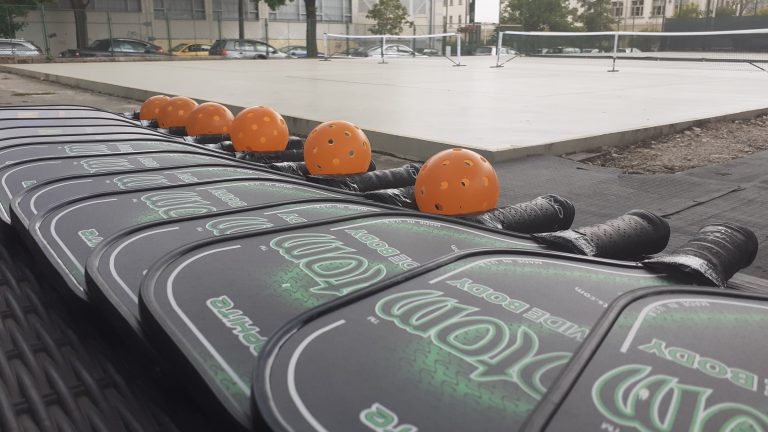
This penetration is highly visible at street level. Everyday shops on standard city streets are now stocking paddles alongside daily essentials, normalising the equipment in a way we rarely see outside of established tennis nations. Furthermore, the top players are no longer just niche athletes operating in obscurity; they are being treated like true sporting heroes, complete with intense public followings. But perhaps the most telling indicator of a sport’s maturity in any given market is the audience composition. In Vietnam, people who might never pick up a paddle themselves are beginning to care passionately about the stories, the rivalries, and the personalities surrounding the professional game. When a sport transcends its active player base and becomes a spectator event for the general public, it has achieved a level of cultural permanence that cannot be easily undone.
We can see this maturity reflected in the singles success of Huynh and Tiến, but in the sheer depth of the Vietnamese talent pool. The sprawling men’s doubles bracket at the D-Joy Tour is heavily populated by strong domestic pairings like Phuc Huynh and Trịnh Linh Giang, or Nguyễn Hữu Hùng Anh and Hồ Vũ Hoàn, who are seamlessly mixing it with, and frequently outperforming, international duos. This isn’t a case of one or two outlier talents carrying a nation’s hopes; it is a systemic wave of highly capable, tactically astute professionals who view themselves as the standard-bearers of the Asian circuit.
The global governing bodies are clearly reading these exact same signals. There is a very specific reason why the Pickleball World Cup is heading to Da Nang, Vietnam, in 2026. Choosing Da Nang as the host city for an event of this magnitude is a massive vote of confidence, officially branding the tournament with the ethos of “Asia Rising”. This is more than a geographic rotation of a sporting event to appease a new market; it is a calculated recognition of where the sport’s energy is currently burning the brightest. The World Cup arriving in Da Nang is the ultimate validation of a movement that has been building organically across the country. It provides the ultimate international stage for players who have already proven they belong at the absolute summit of the game.
As we look toward the next decade of professional pickleball, the geopolitical centre of gravity is undeniably shifting. The United States will, in all likelihood, always remain the sport’s spiritual home, the birthplace where the rules were forged and the foundations of the modern professional game were initially laid. But heritage and future potential are two very different things. For me, the future of the sport is undeniably anchored in Asia. And as the investments continue to pour in, the talent pool deepens, and the cultural obsession grows, the undisputed capital of that future could very well become Vietnam.
Frequently asked questions
Vietnamese players dominated, especially in singles.
Its player depth, street-level popularity and growing tournament base.
A World Cup in Da Nang.
Further reading
- Latest pickleball news from around the world
- Tournament coverage and results
- Rankings and player profiles
- Regional pickleball coverage

Chris Beaumont
Founder and Editor-in-ChiefChris Beaumont is the founder and Editor-in-Chief of World Pickleball Magazine, published by World Pickleball Media Ltd. He follows the global game closely, reporting on news, developments, stories and tournaments from all five continents. He also hosts the World Pickleball…
View All Articles →