A conversation with PEWPEW Analytics founder Scott Ross asks whether pickleball data can explain why points are won, not only what happened.
The short answer: Pickleball now has more data than ever, from DUPR ratings to smart courts and shot tracking. But, as a conversation with PEWPEW Analytics founder Scott Ross suggests, most of it describes what happened rather than why. The next breakthrough may come from understanding pressure, rally value and the hidden actions that decide points, much as xG changed football.
A conversation with PEWPEW Analytics founder Scott Ross raised a bigger question than player ratings, smart courts or AI coaching. Does pickleball actually know what it should be measuring?
- Pickleball has more data than ever, but much of it still describes what happened rather than why it happened.
- DUPR has given players a shared performance language, but the sport still lacks a deeper explanation layer.
- The next analytics breakthrough may come from understanding pressure, rally value and the hidden actions that decide points.
The numbers are here. The understanding is not.
Pickleball has never had more data around it.
Players check DUPR. Clubs are starting to install smart-court systems. Video platforms can track shots, build highlights and offer feedback. Companies such as PlaySight, Wingfield and PB Vision are all circling parts of the same future.
But a sport can have numbers everywhere and still lack understanding.
Football had possession. Baseball had batting average. Golf had total putts. American football had passing yards.
All of them told part of the story. None of them explained enough.
The real breakthroughs came later, when those sports began asking better questions. Football found expected goals. Baseball discovered the value of on-base percentage and later WAR. Golf moved towards strokes gained. The NFL embraced Expected Points Added and win probability.
The revolution was never just about having more data.
It was about working out which data actually explained winning.
Pickleball may be arriving at the same point.
What Scott Ross is really trying to solve
Ross, the founder of PEWPEW Analytics, is trying to do more than count shots.
That would be easy enough. How many drops? How many drives? How many speed-ups? How many winners? How many errors?
The harder question is contribution.
Who actually helped their team win the rally?
That sounds simple until you watch enough doubles pickleball. The player who finishes the point is not always the player who created it. The winner is often just the visible ending of a rally that was decided two or three shots earlier.
One player may force the weak ball. The partner may put it away. A normal stat sheet rewards the second player. A better model has to understand both.
That is the gap Ross is working in.
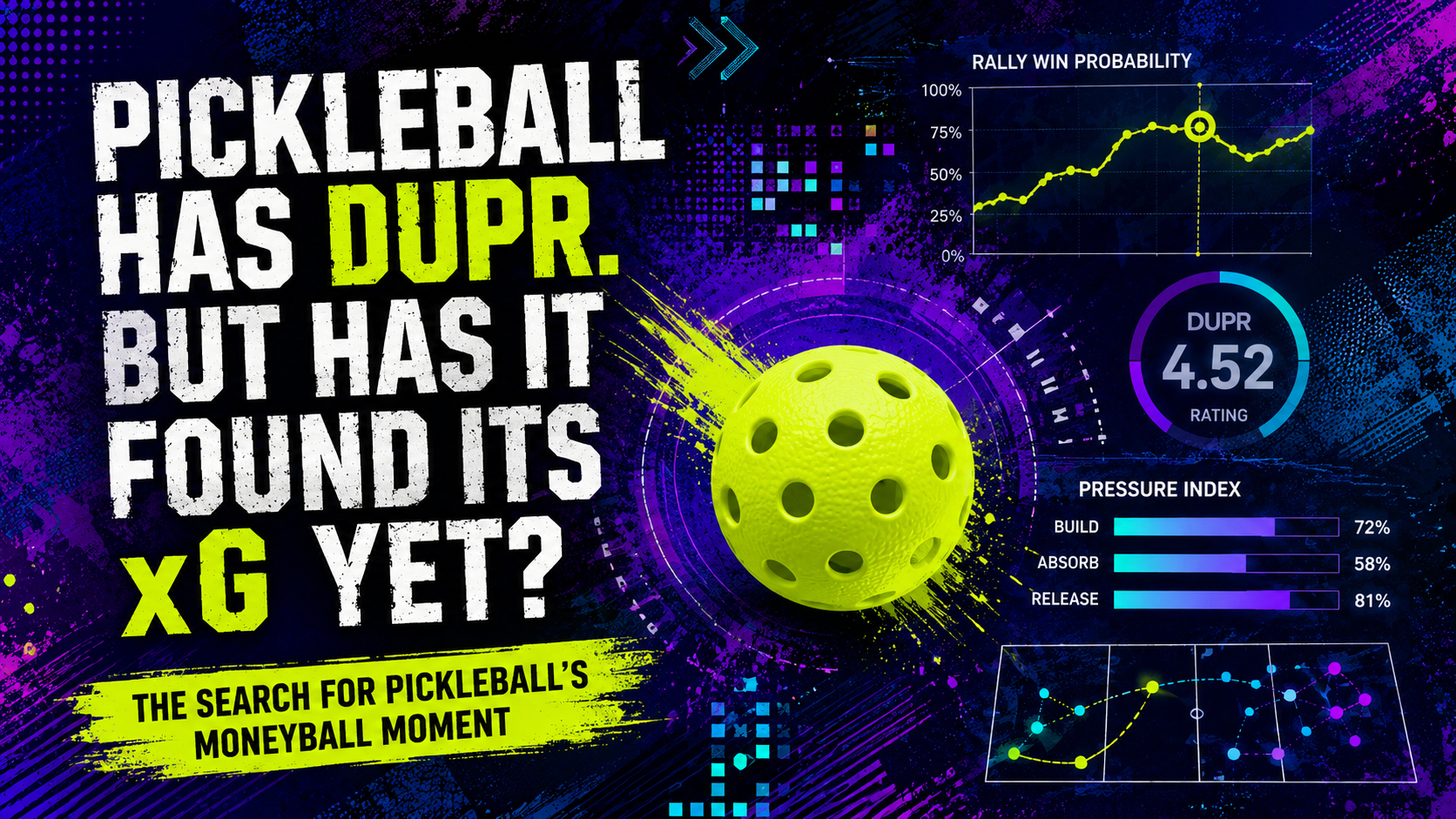
PEWPEW, short for Player Estimated Win Probability Effect With Shots, tries to value each shot by how much it increases or decreases a team’s chance of winning the rally.
This is where the conversation becomes more interesting than another debate about ratings.
Because if a player wins a match, the next question is why they won, as well as whether their DUPR should move up. Where did they create value? What part of the game actually changed the result?
That is the difference between a number and an explanation.
DUPR tells players where they are. it does not always tell them why.
Ross made a point during our conversation that stayed with me.
Maybe the frustration many players feel towards DUPR is not really about the number itself.
Maybe it is about the absence of explanation.
Most players can accept being rated. What they struggle with is not knowing what is driving that rating.
Did they lose because their third shots were poor? Because they attacked too early? Because they could not neutralise pressure in transition? Because their partner was targeted? Because they played well but ran into a better team?
That matters.
Anyone who has played enough pickleball knows the feeling. You walk off court after a loss and think you played well. Or you win and feel strangely unconvinced by your own performance.
DUPR may help place the result in a broader competitive system. But it does not sit beside you afterwards and explain the match.
That is where the next layer of pickleball analytics may live.
The smart-court question nobody has fully answered
This also leads to a much bigger technology question.
What is the killer app for smart courts?
Not the feature that looks good in a demo. Not the dashboard that impresses investors. Not the camera system that proves the technology works.
The real question is simpler.
What would make an ordinary player walk off court and immediately want to check the system?
Not once. Every time.
Video alone probably is not enough. Most players do not want to watch two hours of themselves playing pickleball. Highlights are fun, but novelty fades. AI coaching tips may help, but they risk becoming generic if they are not grounded in what actually happened during the match.
The more persuasive answer may be identity.
How did I play today?
Am I improving?
What type of player am I becoming?
Where do I create value?
Where do I lose it?
Why do I keep losing to that same pair?
This is where smart courts could move from novelty to necessity. Not by telling players they hit 78% of their drops in, but by helping them understand their game over time.
That is much more powerful.
The trap of borrowing from tennis
One of Ross’s strongest points is that pickleball has inherited a lot from tennis.
That has helped the sport enormously. Courts, clubs, tournament systems, ratings language and coaching infrastructure all benefited from tennis being there first.
But analytically, tennis may also be a trap.
Tennis is mostly an individual sport. In singles, the player who hits the set-up shot is usually the same player who hits the winner. A winner can be a rough proxy for a sequence of good play.
Doubles pickleball is different.
The partner who finishes the point may have done the easy bit. The player who created the point may never appear in the highlight. A dink, reset or transition ball may matter more than the final punch.
That is why standard racquet-sport language can feel inadequate.
Pickleball is different from tennis with a smaller court and different equipment. At doubles level, it behaves much more like a team sport.
The central question is how two players combine to move a rally towards winning.
The word I keep coming back to is pressure
This is where my own thinking has started drifting.
At first, I thought pickleball needed something like expected points. Then I wondered whether the answer might be transition play. Then killable balls. Then third-shot value.
But the word I keep coming back to is pressure.
The ability to reduce an opponent’s options. To make their next ball harder. To force lower contact. To move them half a step out of shape. To turn a neutral rally into one where the opponent is surviving rather than choosing.
That is often where points are really won.
The final shot may be the obvious one. But the decisive moment might be the ball before it, or the ball before that.
A great reset can be as valuable as an attack if it turns a 70-30 defensive position back into a 50-50 rally. A soft dink can be more damaging than a flashy speed-up if it shifts balance, narrows the angle and forces the next weak reply.
Maybe pickleball has not found its language yet
The most exciting part of this discussion is not that Ross has all the answers.
He would be the first to say the work is still evolving.
The exciting part is that people are beginning to ask better questions.
That is how sports analytics grows up.
Not through a perfect first model, but through a slow, sometimes awkward shift in language.
The next breakthrough may not look like a statistic
This is where Ross’s work feels important. It is part of a wider attempt to move pickleball beyond description and towards explanation.
And if the sport gets that right, the impact could stretch far beyond elite performance.
It could change how players understand themselves. How coaches teach. How clubs create loyalty. How smart courts justify their cost. How ratings become more useful and less mysterious.
Pickleball already knows who won.
The next frontier is understanding why.
Frequently asked questions
The founder of PEWPEW Analytics.
A layer that explains why points are won, not only what happened.
Pressure, rally value and the hidden actions that decide points.
Further reading
- Latest pickleball news from around the world
- Tournament coverage and results
- Rankings and player profiles
- Regional pickleball coverage

Chris Beaumont
Founder and Editor-in-ChiefChris Beaumont is the founder and Editor-in-Chief of World Pickleball Magazine, published by World Pickleball Media Ltd. He follows the global game closely, reporting on news, developments, stories and tournaments from all five continents. He also hosts the World Pickleball…
View All Articles →