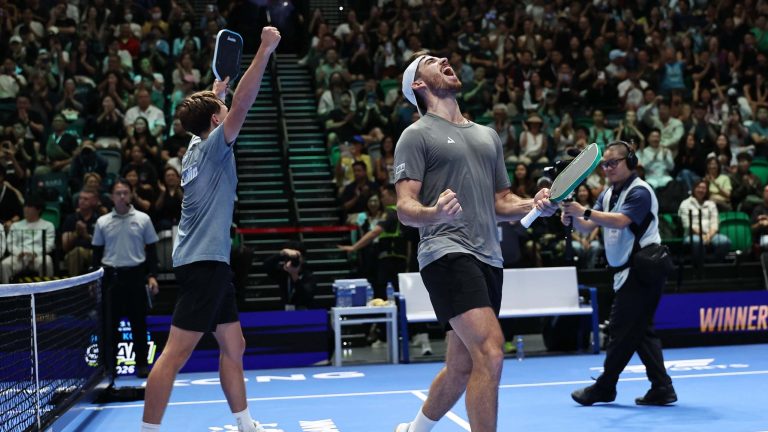

Tyson McGuffin survived three games and Sofia Sewing and Casey Diamond beat Lacy Schneemann and Jack Sock from 3-11 down at the PPA Arizona Open.
The short answer: In the PPA Arizona Open’s opening rounds, Tyson McGuffin beat Grayson Goldin 11-6, 6-11, 11-8 and No. 1 seed Christopher Haworth beat Nicolas Acevedo 11-4, 11-3. Sofia Sewing and Casey Diamond produced the mixed doubles result of the round, beating Lacy Schneemann and Jack Sock 3-11, 11-7, 11-2. Yuta Funemizu lost in singles but reached the men’s doubles Round of 32.
Tyson McGuffin was pushed to three games, Christopher Haworth began the long route required of the No.1 men’s singles seed and Yuta Funemizu experienced wildly different fortunes across two disciplines. Yet the most striking result of the PPA Arizona Open’s opening rounds belonged to Sofia Sewing and Casey Diamond, who recovered from an 11-3 first-game defeat to eliminate Lacy Schneemann and Jack Sock.
Key takeaways
- Tyson McGuffin survived Grayson Goldin 11-6, 6-11, 11-8 and now faces Rafael Lenhard in the men’s singles Round of 32.
- No.1 seed Christopher Haworth opened with an 11-4, 11-3 victory over Nicolas Acevedo and moves on to Connor Mogle.
- Sofia Sewing and Casey Diamond produced the result of the opening mixed doubles round, recovering from 3-11 down to eliminate Lacy Schneemann and Jack Sock 3-11, 11-7, 11-2.
- Yuta Funemizu won only one point in his singles defeat to Mohaned Alhouni but responded alongside Nicolas Acevedo to reach the men’s doubles Round of 32.
- Arizona’s progressive draw now moves into the Round of 32, with the tournament’s WPR-protected players still waiting further ahead.
The unusual structure of this Arizona Open meant its opening rounds were never likely to tell us who would win the tournament, particularly with many of the players expected to shape the weekend protected further into the draws by the new World Pickleball Ranking bye system.
What they could establish was who would still be around to meet them, and whether those required to start earlier could arrive at the more consequential rounds with momentum rather than simply additional mileage in their legs. Across singles and doubles, that produced a useful mixture of comfortable progress, early warnings and several partnerships whose opening performances have made their next assignments considerably more interesting.
Tyson McGuffin was forced to survive three games in singles. Christopher Haworth began the extended route required of the tournament’s No.1 men’s singles seed with considerably less difficulty, while Yuta Funemizu went from a brutal singles defeat to a valuable three-game men’s doubles victory alongside Nicolas Acevedo.
Mixed doubles then delivered the day’s clearest disruption, as Sofia Sewing and Casey Diamond turned an opening-game rout against Lacy Schneemann and Jack Sock into an emphatic victory of their own.
The Round of 64 did not settle Arizona, but it made the Round of 32 considerably more interesting.
McGuffin survives his first examination
McGuffin could hardly have asked for a better reminder that reputation offers limited protection once singles begins.
Facing Grayson Goldin, he took the opening game 11-6 before Goldin responded by the same score in the second, forcing McGuffin into a decider much earlier in the tournament than he might have wanted. The final game remained competitive before McGuffin eventually closed it 11-8, securing his place in the Round of 32 after an opening match that demanded rather more than the seedings might have suggested.
His next opponent is Rafael Lenhard, and the significance of that match lies partly in what McGuffin has already had to expend. Arizona’s new bye structure means some of the players waiting deeper in the singles draw will begin with fresh legs, while McGuffin has already had to solve a genuine three-game problem merely to reach the next stage.
Haworth’s opening experience was very different.
The No.1 men’s singles seed beat Nicolas Acevedo 11-4, 11-3 and now faces Connor Mogle, who needed three games to eliminate Anouar Braham 14-12, 8-11, 11-5. Haworth therefore arrives with a relatively clean first victory behind him, although the broader peculiarity remains that the top seed must continue progressing while players much further down the singles seeding wait deeper in the draw.
WPM has examined the competitive implications of Arizona’s new WPR bye structure throughout the week. The PPA confirms that this is the first Open at which the World Pickleball Ranking determines the top four players or teams advancing directly to the Round of 16.
On court, however, Haworth’s challenge is considerably simpler. If the structure gives him more matches to play, the only answer available to him is to keep winning them.
Elsewhere, several men’s singles players made more forceful openings. Gabriel Joseph dismissed AJ Koller 11-5, 11-2, while Mohaned Alhouni overwhelmed Funemizu 11-0, 11-1, setting up a Round-of-32 meeting between two players who conceded only eight points between them.
Hunter Johnson was similarly convincing in an 11-1, 11-2 victory over Darrian Young, while Jaume Martinez Vich beat Eddy Kim 11-3, 11-2. Jaxon Madsen’s victory over Zane Ford followed a different pattern, with a 15-13 opening game giving way to an 11-0 second as a potentially difficult match suddenly became straightforward.
The Round of 32 begins connecting those performances with stronger opposition. Connor Garnett meets Yates Johnson, Eric Oncins faces Madsen, Noe Khlif takes on Michael Loyd and Dylan Frazier meets Rafa Hewett, while Haworth and McGuffin attempt to build on opening victories achieved in very different ways.
Women’s singles offers opportunities before the heavyweights arrive
Women’s singles produced fewer obvious shocks, but several performances become more significant when viewed through what comes next.
Sewing was particularly convincing in beating Mary Brascia 11-3, 11-1, continuing the trajectory WPM identified before the PPA National Championships in Cary when her low singles seeding appeared increasingly disconnected from her current level. She now meets Emma Nelson, who edged Angie Walker 13-11 in the second game of their straight-games victory.
Milan Rane dispatched Audrey Adele Brown 11-2, 11-3, while Isabella Dunlap moved through Frida Mudsam 11-4, 11-9 and now faces Polina Libo, whose route was considerably harder after she recovered from losing the second game against Hannah Blatt to prevail 12-10, 5-11, 11-8.
Cailyn Campbell also needed a comeback, losing the opener 11-8 to Daria Walczak before responding 11-4, 11-6. Her meeting with Rane now becomes one of the more useful early indicators in the women’s draw, matching a player who has already survived adversity against another who barely encountered it.
There were other emphatic victories, including Jalina Ingram’s 11-0, 11-5 win over Carlota Trevino and Marcela Aguila Ampon’s 11-3, 11-0 defeat of Ella Cosma. That sends Ingram and Ampon directly into one another, ensuring that at least one player coming off a dominant opening performance will disappear in the next round.
Nicole Conard’s bracket records successive 11-0 games against Julia Ronney alongside a forfeiture notation, so the scoreline should not be treated as a conventional 22-0 victory. What matters competitively is that Conard advances to meet Judit Castillo, representing a considerable change in the level of opposition.
Further across the draw, Lea Jansen enters against Eileen Wang, Brooke Buckner faces Elsie Hendershot and the protected group containing Anna Leigh Waters, Kaitlyn Christian and other leading names remains further ahead.
For the women already playing, that creates the same tension visible elsewhere in Arizona. Early matches offer the chance to establish competitive rhythm, but every additional round also represents another opportunity for the tournament to end before some of the leading players have begun theirs.
Funemizu responds immediately in doubles
Few players experienced the extremes of the opening day quite like Funemizu.
His singles campaign lasted two games and yielded one point against Alhouni, but there was little time to dwell on it because men’s doubles presented a completely different problem and ultimately produced a completely different outcome.
Partnering Acevedo, Funemizu faced Miles Hoover and Jaxon Madsen in one of the more competitive matches of the Round of 64. Funemizu and Acevedo took the opener 11-9 before Hoover and Madsen responded 11-7, but the deciding game moved decisively towards Funemizu and Acevedo as they closed out an 11-4 victory.
That ability to reset across disciplines is one of the less discussed demands of a PPA week. A poor singles performance does not necessarily provide an evening to process what went wrong because another partner, another draw and another competitive problem may be waiting almost immediately.
Funemizu and Acevedo now face Erik Pailet and Nick Black, who progressed in straight games against Jace Morris and Darrian Young. It should provide a useful measure of whether the recovery against Hoover and Madsen was simply enough to survive or the beginning of something more substantial.
Will Howells and Pablo Tellez also needed a comeback after Kyle Koszuta and Cameron Luhring took their opening game 11-7. Howells and Tellez responded 11-6, 11-5 and now meet Luc Pham and George Wall, themselves three-game winners against Grayson Goldin and Daniel Phillips.
Jack Sock’s men’s doubles campaign remains alive despite what happened later in mixed. He and Augustus Ge lost a 14-12 opening game to Francis Chi and Maverick Messinger before taking control 11-4, 11-7, setting up a meeting with Anouar Braham and Luca Mack.
McGuffin had a considerably easier time alongside Casey Diamond. They defeated Ryan Camras and Ethan Bakalinsky 11-7, 11-2 and now face Will MacKinnon and Brandon French, whose 11-1, 11-1 victory over Gabriel Joseph and Yates Johnson was among the most emphatic doubles results of the round.
That is precisely the kind of Round-of-32 match Arizona now needs. Both partnerships have done what was required against their opening opponents, and the next round should tell us substantially more about what either might become later in the week.
Sewing and Diamond turn the match completely
Mixed doubles provided the opening round’s most dramatic reversal.
Lacy Schneemann and Jack Sock appeared to have established immediate control against Sewing and Diamond, taking the first game 11-3. The match-up had already been identified by the PPA before the tournament as one of the Round of 64 contests to watch, while WPM’s Arizona preview argued that the No.46 beside Sewing and Diamond considerably understated the threat they represented.
What followed justified that attention.
Sewing and Diamond responded 11-7 in the second and then accelerated away in the decider, winning 11-2 to complete a 3-11, 11-7, 11-2 turnaround. Rather than merely surviving after a difficult start, they progressively took control of the contest, turning an eight-point defeat in the opener into a nine-point victory in the third.
The result also continues a partnership story that predates their arrival in the PPA environment. Sewing and Diamond have already won together elsewhere on the professional circuit and reached the US Open mixed doubles final earlier this year, where they pushed Anna Leigh Waters and Jay Devilliers to three games.
Their next opponents are Angie Walker and James Delgado, who advanced 11-4, 11-2 against Luana Stanciu and Adam Harvey. Sewing and Diamond therefore arrive in the Round of 32 with the bigger scalp, but without the luxury of treating the comeback as anything more than the result that allowed them to play again.
Several other partnerships were forced to demonstrate similar resilience. Dekel Bar and Jessie Irvine lost their opener 11-8 against Daria Walczak and Rio Newcombe before taking the next two 11-3, 11-2, while Genie Erokhina and Ivan Jakovljevic survived Lauren Stratman and Clayton Powell 11-3, 4-11, 11-8.
Victoria DiMuzio and McGuffin also needed all three games against Alexa Schull and Darrian Young, eventually prevailing 12-10, 4-11, 11-9, while Jaume Martinez Vich and Milan Rane came through Mary Brascia and Haworth 11-7, 5-11, 11-7.
Martinez Vich and Rane now face Brooke Buckner and Dylan Frazier, one of the Round of 32’s more revealing tests because a partnership already required to negotiate a close three-game contest immediately encounters a pairing with considerably greater established pedigree.
Hunter Johnson and Judit Castillo had no such problems in their opener, beating Jace Morris and Kelly Goodnow 11-6, 11-1, while CJ Klinger and Ting Chieh Wei defeated Funemizu and Naomi Nguyen 11-8, 11-2.
The next layer of the draw introduces Connor Garnett and Kaitlyn Christian against Elliott Schupp and Kiora Kunimoto, Tyra Hurricane Black and Noe Khlif against Erokhina and Jakovljevic, Jonathan Truong and Catherine Parenteau against Christa Gecheva and Rafael Lenhard, and Tina Pisnik and Eric Oncins against Braham and Alex Walker.
Still further ahead sit Ben Johns and Anna Leigh Waters, Kate Fahey and Federico Staksrud, Rachel Rohrabacher and Christian Alshon, and Parris Todd and Andrei Daescu.
Arizona is getting stronger by the round.
The tournament begins to compress
That is what makes the Round of 32 more significant than simply another stage of elimination.
The opening rounds established a first layer of evidence. We know McGuffin has already been vulnerable enough in singles to be pushed to a decider but resilient enough to survive it, Haworth has begun his longer route through the draw without difficulty, Funemizu has experienced the sport’s multi-discipline demands in their most extreme form, while Sewing and Diamond have already shown an ability to transform a match that appeared to be escaping them.
Now those stories begin colliding with players who did not have to do any of that.
The PPA’s official tournament format uses a progressive draw, with one round per bracket per day and no bronze-medal matches. That gives each result more room to breathe, but it also means the physical consequences of a difficult opening match can follow a player through a week in which temperatures have been forecast to reach triple digits.
The deeper Arizona moves, the less useful reputation becomes and the more relevant the evidence accumulated on these courts will be. Some players will benefit from arriving fresh, others from already having solved competitive problems, and several will discover very quickly that the distinction matters less once the opponent across the net becomes good enough.
Opening day gave Arizona its first clues.
The Round of 32 should begin telling us which of them matter.
Frequently asked questions
He survived Grayson Goldin 11-6, 6-11, 11-8 and next faces Rafael Lenhard.
Sofia Sewing and Casey Diamond, 3-11, 11-7, 11-2.
The new World Pickleball Ranking bye system protects leading players further into the draw.
Further reading
- The Door Is Open in Arizona: New Partnerships, Missing Champions and a Rare Chance to Break Through
- Cary’s Draw Has a Ranking-Lag Problem. Sofia Sewing Is the Clearest Example
- Cary Has Already Broken the Draw: What Matters Before the PPA Round of 16
- PPA vs APP Wasn’t a Debate Until This Final

Chris Beaumont
Founder and Editor-in-ChiefChris Beaumont is the founder and Editor-in-Chief of World Pickleball Magazine, published by World Pickleball Media Ltd. He follows the global game closely, reporting on news, developments, stories and tournaments from all five continents. He also hosts the World Pickleball…
View All Articles →