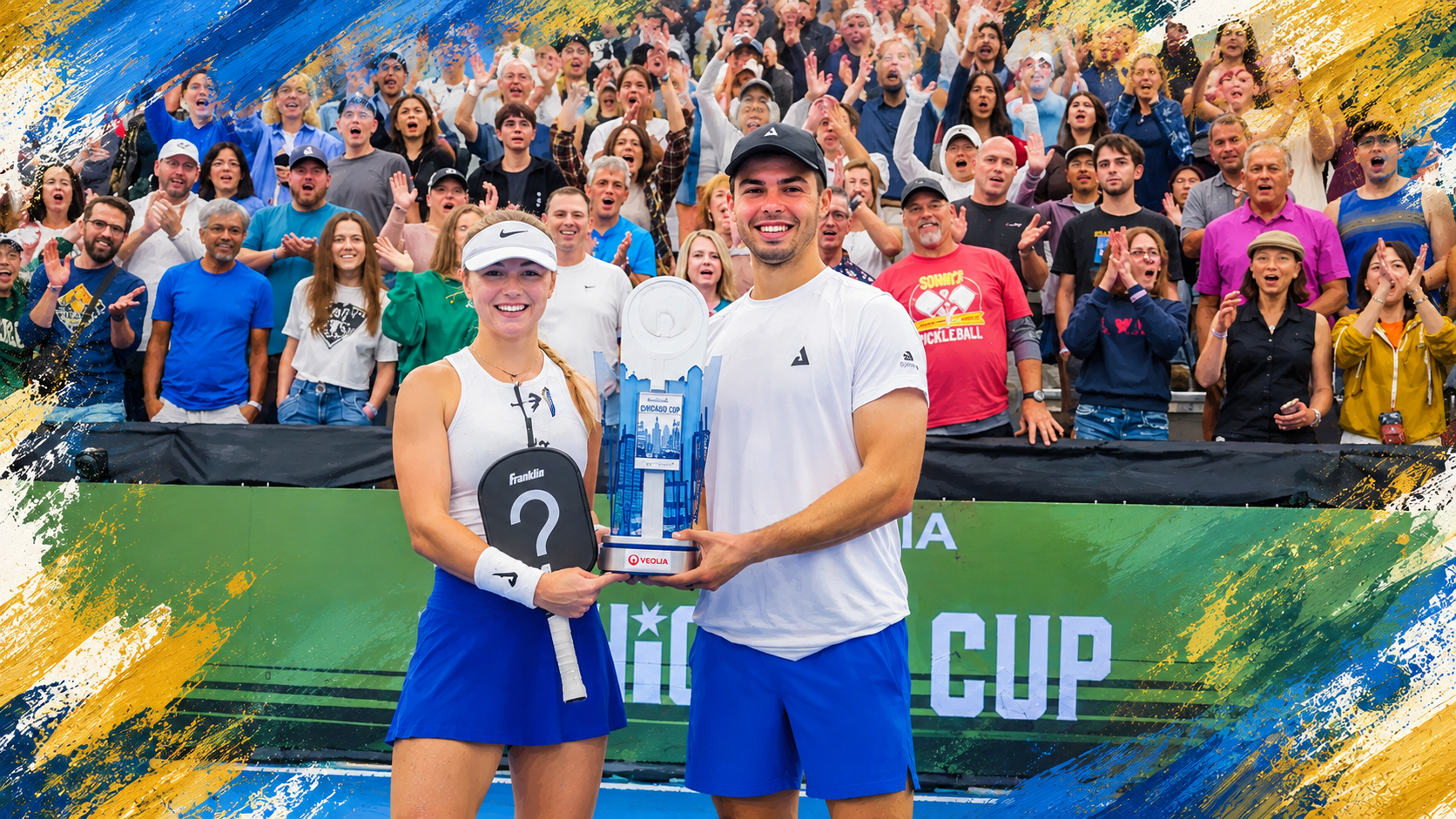
Anna Leigh Waters won three Chicago Cup golds to reach 202 PPA titles, and Roscoe Bellamy beat Chris Haworth 11-4, 11-5 for singles gold.
The short answer: Anna Leigh Waters won all three of her finals at the Veolia Chicago Cup, moving from 199 to 202 career PPA titles and completing her 45th triple crown. Roscoe Bellamy beat top seed Chris Haworth 11-4, 11-5 for men’s singles gold, and Federico Staksrud and Hayden Patriquin won men’s doubles. French qualifier Emilien Burnel reached the singles semi-finals.
Anna Leigh Waters completed her 45th triple crown at the Veolia Chicago Cup, Roscoe Bellamy defeated Chris Haworth for men’s singles gold, and European challengers Emilien Burnel, Anouar Braham and Bruno Faletto reshaped the draws. The champions retained their authority, but Chicago revealed a more competitive landscape beneath them.
Key takeaways
- Anna Leigh Waters won all three of her finals, moving from 199 to 202 career PPA titles and completing her 45th triple crown.
- Roscoe Bellamy defeated top seed Chris Haworth 11-4, 11-5 to claim his second career PPA title and first of 2026.
- Federico Staksrud and Hayden Patriquin defeated Jaume Martinez Vich and Nicolas Acevedo 11-1, 11-6 in men’s doubles.
- French qualifier Emilien Burnel reached the men’s singles semi-finals after eliminating Hunter Johnson and JW Johnson.
- Anouar Braham and Bruno Faletto defeated Ben Johns and Jack Sock before advancing to the men’s doubles semi-finals.
Anna Leigh Waters arrived at the Veolia Chicago Cup one title short of her 200th career PPA crown. By the time Championship Sunday finished at Life Time North Shore Sport and Racquet in Northbrook, Illinois, she had collected three gold medals, completed another triple crown and moved her career total to 202.
It was an emphatic response to Las Vegas, where Anna Bright and Hayden Patriquin had defeated Waters and Ben Johns in the mixed doubles final, delaying a milestone that had appeared within reach.
But Chicago was not simply another tournament defined by Waters’ dominance.
Roscoe Bellamy defeated Chris Haworth to claim men’s singles gold, Federico Staksrud and Hayden Patriquin reinforced their position among the leading men’s doubles partnerships, and European challengers produced some of the week’s most consequential results.
France’s Emilien Burnel progressed from qualifying to the men’s singles semi-finals after eliminating third seed Hunter Johnson and JW Johnson, while Anouar Braham and Bruno Faletto defeated Ben Johns and Jack Sock before reaching the last four of men’s doubles.
Neither European campaign ended with a championship, but both changed the shape of the competition and demonstrated that the established hierarchy can be challenged well before the final weekend.
Chicago ultimately revealed two sides of the PPA Tour. The leading players remained formidable when titles were decided, while those attempting to displace them showed an increasing ability to disrupt the route to Championship Sunday.
Waters turns 199 into 202
The pursuit of Waters’ 200th career title had become one of the dominant storylines heading into Chicago.
Her opportunity to reach the milestone in Las Vegas had disappeared when Bright and Patriquin defeated Waters and Johns in mixed doubles, leaving her on 199.
Seven days later, Waters had another chance.
Her first final came in mixed doubles alongside Johns, with the top seeds facing Jorja Johnson and JW Johnson.
Waters and Johns controlled the match, winning 11-4, 11-4 to secure the title in straight games. It was the victory that delivered Waters’ 200th PPA crown, restoring a partnership that had been beaten in the previous week’s final.
But the milestone was only the beginning of her afternoon.
In women’s doubles, Waters partnered Bright against Catherine Parenteau and Hurricane Tyra Black, a pairing capable of presenting a different challenge.
Parenteau and Black made an emphatic start, taking the opening game 11-2 and placing the favourites under immediate pressure.
The response was decisive. Bright and Waters won the second game 11-3 before completing the comeback 11-4 in the third, conceding just seven points across the final two games.
That recovery was perhaps the most revealing aspect of Waters’ championship programme. In mixed doubles, she and Johns had established control from the outset. In women’s doubles, she and Bright were required to respond to a substantial opening-game defeat.
The ability to succeed in both circumstances reinforced the quality of her performance.
Waters then completed the sweep against Kate Fahey in women’s singles. She dominated the opening game 11-1 before facing greater resistance in the second, eventually closing out the match 11-7.
Three finals had produced three victories, carrying Waters from 199 career titles to 202 and delivering her 45th triple crown.
The numbers are extraordinary, but the wider significance lies in the consistency required to produce them.
Singles, women’s doubles and mixed doubles present different tactical demands, opponents and partnerships. Winning all three at one tournament requires a player to maintain a high standard across multiple matches, often with limited recovery time.
Las Vegas had demonstrated that Waters could be beaten. Chicago demonstrated how quickly she could respond.
Bellamy makes his statement against Haworth
While Waters reinforced her position at the top of the women’s game, the men’s singles final produced a result with different implications.
Fourth seed Roscoe Bellamy defeated top seed Chris Haworth 11-4, 11-5 to claim his second career PPA Tour title and his first of 2026.
The result was particularly striking because Haworth had entered Championship Sunday following an emphatic semi-final performance against Emilien Burnel.
Haworth won that contest 11-1, 11-0, ending the French qualifier’s impressive campaign and suggesting he was approaching the final in commanding form.
Bellamy, however, presented a different challenge.
He established control in the opening game, limiting Haworth to four points and preventing the top seed from building the momentum that had characterised his semi-final.
The second game followed a similar pattern, with Bellamy maintaining his advantage and completing the victory 11-5.
For Haworth, the defeat represented a sharp contrast with his previous performance. For Bellamy, it was evidence that he could defeat one of the leading men’s singles contenders with a championship at stake.
It was also his first victory over Haworth in their head-to-head meetings, adding further significance to the result.
One final does not establish a permanent change in the competitive hierarchy, but Bellamy’s performance strengthens the argument that men’s singles remains one of the PPA Tour’s most open disciplines.
His next challenge will be converting that result into regular appearances at the latter stages of major tournaments.
For now, Chicago provides an important marker in his professional trajectory.
Staksrud and Patriquin reassert their authority
The men’s doubles final brought together the top-seeded partnership of Federico Staksrud and Hayden Patriquin and an unexpected combination in Jaume Martinez Vich and Nicolas Acevedo.
Martinez Vich and Acevedo had earned their place in the championship match after a closely contested semi-final victory over Bruno Faletto and Anouar Braham.
Their progress demonstrated that the established leading pairs were not enjoying an uninterrupted route through the draw.
But the final itself belonged emphatically to Staksrud and Patriquin.
They won 11-1, 11-6, establishing a substantial advantage in the opening game and maintaining control throughout the second.
The scoreline reflected the effectiveness of their partnership, with Staksrud’s consistency and rally construction complementing Patriquin’s speed, anticipation and attacking instincts.
Against Martinez Vich and Acevedo, that combination proved particularly difficult to disrupt.
The challengers struggled to establish themselves in the opening game, and although they offered greater resistance in the second, the top seeds remained in command.
For Staksrud and Patriquin, the result reinforced their standing in a men’s doubles landscape that has nevertheless produced significant upsets in recent tournaments.
For Martinez Vich and Acevedo, reaching the final remained an important achievement. Their campaign showed that less-established partnerships can exploit opportunities and progress deep into major competitions, even if the final demonstrated the additional level required to overcome one of the tour’s strongest combinations.
Burnel’s breakthrough begins with Hunter Johnson
Among the tournament’s most compelling stories was the performance of French player Emilien Burnel.
Burnel entered the men’s singles main draw through qualifying as the No. 55 seed, making his eventual semi-final appearance particularly significant.
His breakthrough came in the Round of 64 against third seed Hunter Johnson, who had won the previous week’s Las Vegas title.
Burnel won 13-11, 5-11, 11-9, recovering from the loss of the second game to eliminate one of the leading contenders.
The victory immediately changed the structure of the draw, removing a player expected to challenge deep into the tournament and opening a different route through that section.
But Burnel’s achievement was not confined to one exceptional result.
He followed the Johnson victory with an emphatic 11-3, 11-1 win over Mota Alhouni before defeating JW Johnson 11-9, 5-11, 11-7 in the Round of 16.
That sequence mattered because it demonstrated three different forms of competitive performance.
Against Hunter Johnson, Burnel had survived a close deciding game. Against Alhouni, he had produced a convincing straight-games victory. Against JW Johnson, he had again recovered after losing the second game.
Each result increased the significance of the previous one.
As WPM reported ahead of the quarter-finals, Burnel’s next opponent was Camden Chaffin, another lower-seeded player whose progress had opened an unexpected route to the last four.
Burnel came through another three-game contest to reach the semi-finals, an exceptional achievement for a player who had begun the tournament in qualifying.
His campaign ended emphatically against Haworth.
The top seed won their semi-final 11-1, 11-0, preventing Burnel from reaching Championship Sunday.
That scoreline cannot be ignored. It demonstrated the difficulty of sustaining a breakthrough run against successive elite opponents, particularly when the standard rises again in the final stages.
But it should not obscure the value of Burnel’s week.
A qualifier who defeats the third seed, removes another established opponent and reaches the semi-finals has demonstrated a level of competitiveness that deserves attention.
For Burnel, Chicago provides a benchmark against which future performances can be measured. The next challenge is consistency, particularly against opponents capable of adjusting to his game and applying pressure across successive rounds.
For European pickleball, his progress represents a tangible achievement on one of the sport’s most demanding professional tours.
Braham and Faletto remove Johns and Sock
The European presence in Chicago extended beyond singles.
Anouar Braham and Bruno Faletto arrived with an encouraging record together, having compiled 11 wins from 12 matches across two PPA Challenger events.
The partnership had already won the Houston Challenger and reached the Tampa Bay Challenger final, giving them competitive experience together before stepping into the deeper Chicago field.
Their most significant test arrived in the Round of 32 against second seeds Ben Johns and Jack Sock.
Johns and Sock took the opening game 11-8, placing Braham and Faletto under pressure.
The European partnership responded impressively, winning the second game 11-5 before taking the decider 11-3.
The result was significant because of the names involved, but its wider importance lay in the manner of the victory.
Braham and Faletto had not relied on a fast start or a narrow escape. They improved as the match progressed, winning the final two games by increasingly convincing margins.
The PPA Tour’s account of the contest highlighted Faletto’s ability to compete with Johns in crosscourt exchanges and Braham’s effectiveness when attacking opportunities emerged.
It was also important to recognise that Johns and Sock were playing their first tournament together. Braham and Faletto, by contrast, had already established a productive partnership through Challenger competition.
The result therefore demonstrated both the value of their existing understanding and the difficulties that even high-profile players can face when forming a new combination.
Their progress continued with another comeback victory over Kenta Miyoshi and Clayton Powell, followed by a quarter-final success that carried them into the last four.
There they faced Martinez Vich and Acevedo, with a place in the final at stake.
The semi-final was closely contested. Martinez Vich and Acevedo prevailed 11-9, 12-10, taking both games by two points to end the European pairing’s campaign.
For Braham and Faletto, the defeat was frustrating because the margins were so narrow. They had come close to reaching a PPA Cup final after already eliminating a high-profile partnership.
But their overall tournament offered more substantial evidence of progress than the victory over Johns and Sock alone.
One major upset can be dismissed as an exceptional performance. Reaching the semi-finals after multiple victories provides a stronger indication that a partnership can compete consistently against demanding opposition.
Braham and Faletto now have an opportunity to build on that evidence. The next step is converting deep runs into championship appearances, and eventually demonstrating that they can compete for titles against the strongest established combinations.
Europe is influencing the draw, but titles remain the next test
The performances of Burnel, Braham and Faletto gave Chicago an international significance that extended beyond individual results.
There is a temptation to describe such performances as proof that European players have caught up with the established American professional field.
One tournament cannot support that conclusion.
Burnel was comprehensively beaten by Haworth in the singles semi-finals, while Braham and Faletto were unable to convert their doubles campaign into a final appearance.
Neither result produced a European champion.
But the significance of Chicago lies in what happened before those defeats.
Burnel eliminated a top-three singles seed and reached the last four from qualifying. Braham and Faletto defeated Johns and Sock, then progressed to a semi-final decided by narrow margins.
Those achievements show that European players are capable of influencing major PPA draws rather than simply participating in them.
The distinction matters.
Professional pickleball’s international development cannot be measured solely by how many players enter tournaments outside their home regions. It must also be measured by how often they defeat established opposition, reach the latter stages and ultimately challenge for titles.
Chicago offered evidence of the first two developments. The third remains the challenge.
There is also a difference between individual breakthroughs and a wider shift in competitive standards.
Burnel’s performance does not establish the level of every European singles player, just as Braham and Faletto’s success cannot be used to make sweeping claims about European men’s doubles.
But repeated performances of this kind would begin to change expectations.
Chicago did not prove that the hierarchy has changed permanently. It showed where that hierarchy is beginning to face credible pressure.
Women’s doubles provides the strongest final comeback
While the men’s draws produced several unexpected results, the women’s doubles final delivered Championship Sunday’s clearest example of a match changing direction.
Anna Bright and Anna Leigh Waters faced Catherine Parenteau and Hurricane Tyra Black, with both partnerships possessing the quality to challenge for a major title.
Parenteau and Black made the stronger start, winning the opening game 11-2.
It was a striking result against one of the leading combinations in the sport, and it placed Bright and Waters under immediate pressure.
The difficulty for Parenteau and Black was sustaining that advantage.
Bright and Waters responded by winning the second game 11-3, completely reversing the balance of the contest before taking the deciding game 11-4.
Across the final two games, the eventual champions conceded just seven points.
That turnaround illustrated the ability of an established partnership to adjust under pressure rather than simply relying on its reputation.
For Parenteau and Black, the opening game demonstrated that they could trouble the favourites. The remaining two games showed how difficult it can be to maintain that level when Bright and Waters begin controlling the contest.
It was also a reminder that a final can contain very different competitive phases.
Judged solely by the opening game, Parenteau and Black appeared to have established a substantial advantage. Judged across the match, Bright and Waters had produced an emphatic recovery.
For Waters, the victory became the second stage of her Chicago triple crown, positioned between a controlled mixed doubles performance and a straight-games singles victory.
Johns and Waters respond to Las Vegas
The mixed doubles final carried additional significance because of the previous week’s result.
In Las Vegas, Bright and Patriquin had defeated Waters and Ben Johns, preventing Waters from reaching her 200th career title.
Chicago offered an immediate opportunity to respond.
Against Jorja Johnson and JW Johnson, Johns and Waters produced a controlled 11-4, 11-4 victory.
The result delivered Waters’ milestone and restored the partnership to the top of the podium.
It did not erase the significance of Las Vegas. Bright and Patriquin had demonstrated that Johns and Waters could be beaten in a major final.
But Chicago reinforced the difficulty of turning one victory against an established partnership into a sustained competitive advantage.
For the Johnson siblings, reaching the final was an important result, even though they were unable to push the champions into a deciding game.
Their challenge was not simply to match Johns and Waters in individual exchanges, but to sustain enough pressure across the contest to disrupt a partnership whose understanding and consistency remain formidable.
That proved beyond them on this occasion.
Chicago’s champions remain formidable, but the competition is changing
The Veolia Chicago Cup concluded with five championship results that offered a revealing picture of the PPA Tour.
Waters collected three titles and completed another triple crown, reinforcing her extraordinary consistency across singles and doubles.
Bellamy defeated the men’s singles top seed in straight games, demonstrating that the division remains open to significant challenges.
Staksrud and Patriquin dominated the men’s doubles final, while Bright and Waters showed their capacity to recover from a difficult opening game against elite opposition.
Those results confirmed that the leading players remain extremely difficult to defeat when championships are at stake.
But the earlier rounds revealed a more complicated competitive landscape.
Burnel’s victory over Hunter Johnson changed the men’s singles draw and carried a French qualifier into the semi-finals.
Braham and Faletto eliminated Johns and Sock, then came within narrow margins of reaching the men’s doubles final.
Martinez Vich and Acevedo took advantage of their opportunity to compete on Championship Sunday, even if they could not overcome Staksrud and Patriquin.
Those performances matter because the strength of a professional tour cannot be measured only by the names appearing on the podium.
It also depends on the quality of opposition those champions must overcome, the number of players capable of producing significant upsets and the extent to which emerging contenders can sustain their performances across successive rounds.
Chicago suggested that the established hierarchy remains strong, but the competition beneath it is becoming increasingly demanding.
For Bellamy, the challenge is to convert his victory over Haworth into a sustained period of success.
For Burnel, Braham and Faletto, the next step is turning semi-final appearances into regular opportunities to compete for championships.
And for Waters, Chicago offered another extraordinary demonstration of consistency, taking her from the frustration of Las Vegas to her 200th career title and then two more victories in the same afternoon.
She arrived chasing a milestone and left having moved beyond it.
The champions retained their authority, but the challengers ensured that the route to those titles was far from predictable.
Frequently asked questions
202, after winning all three finals and her 45th triple crown.
Roscoe Bellamy, 11-4, 11-5 over Chris Haworth.
Federico Staksrud and Hayden Patriquin, 11-1, 11-6 over Jaume Martinez Vich and Nicolas Acevedo.
Further reading
- No. 55 Emilien Burnel Stuns Hunter Johnson as PPA Chicago Draw Breaks Open
- Chicago Opens Up: Johns and Frazier Exit as Burnel’s Breakthrough Run Reaches the Last 16
- Burnel Reaches Chicago Quarter-Finals as Doubles Outsiders Claim Their Chance
- PPA Tour: Bellamy’s Victory and Waters’ Triple Crown
- PPA Tour: Emilien Burnel’s Route From Qualifying to the Semi-Finals

Chris Beaumont
Founder and Editor-in-ChiefChris Beaumont is the founder and Editor-in-Chief of World Pickleball Magazine, published by World Pickleball Media Ltd. He follows the global game closely, reporting on news, developments, stories and tournaments from all five continents. He also hosts the World Pickleball…
View All Articles →