
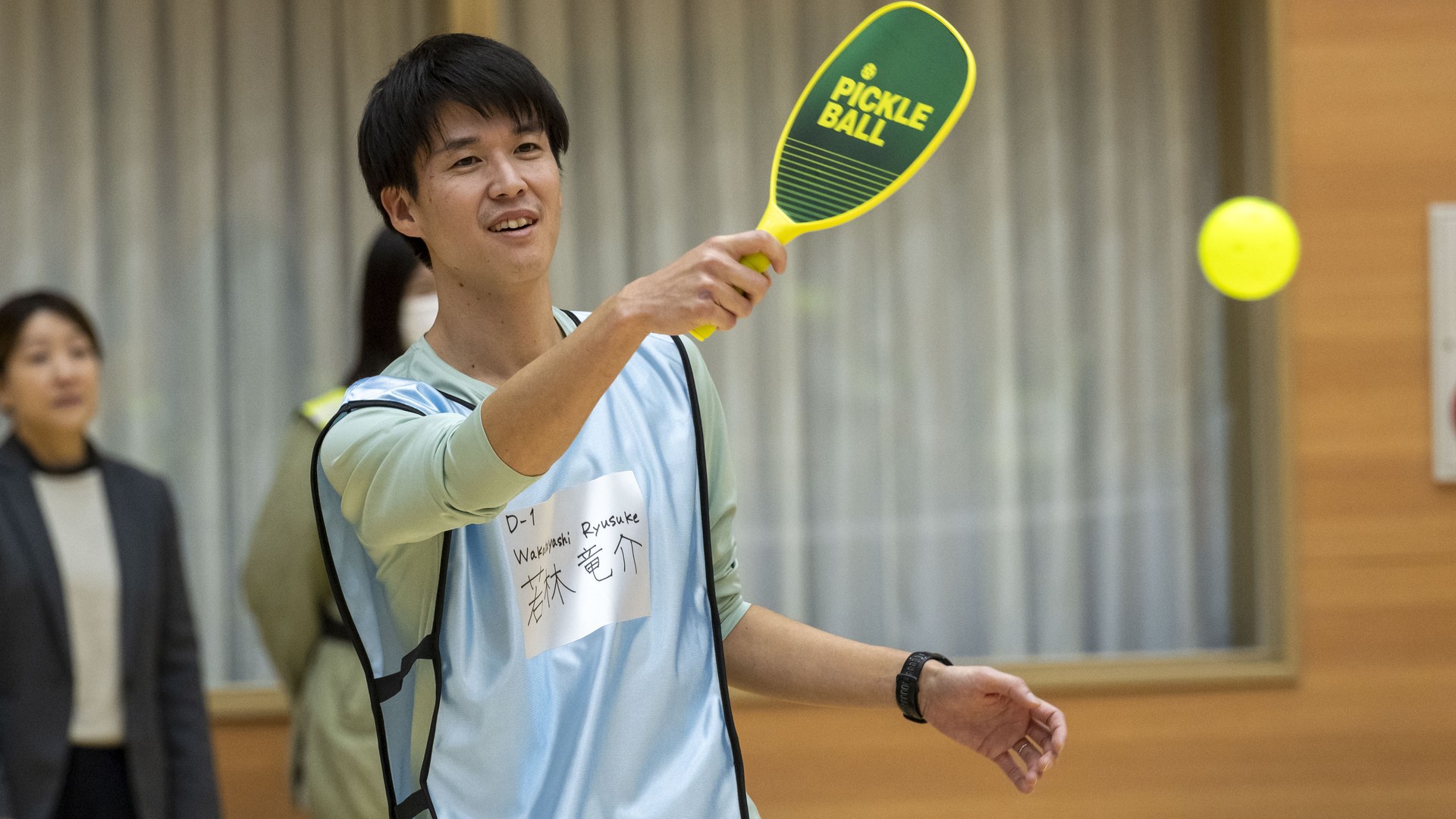
The short answer: THE DOTS TOKYO, Japan’s team in the first MLP Asia season, was set up jointly by TBS Holdings and dentsu Sports & Entertainment. The two companies also host the league’s Japan Round, which opens the season on Friday 13 November at the Sansan Pickleball Court in Ikebukuro. TBS already has a team in Sansan’s domestic PX League, and it put its name on this year’s PPA Asia 500 Tokyo Open. The last time TBS owned a big team, the Yokohama BayStars, it lasted ten seasons and sold at less than half the price. My view: this time the broadcaster has bought a better asset. In a league where each team gets one home night, a team is a television event with a roster attached. The people who make television events are the right owners.
A wall in America
Yuta Funemizu has told the story of his first months in the United States himself, and it is not glamorous. “Just after I arrived in America I couldn’t speak English, I had nobody to practise with, and I hit against a wall on my own,” he told Pickleball One after Major League Pickleball drafted him, the first Japanese player to be selected (WPM translation). He could not find doubles partners, so some weeks he could not enter tournaments at all. When he could, he lost for a while. After one event in late February he emailed all 16 MLP teams his results and a description of his game, and asked each for one meeting.
On 13 November, he walks out in Ikebukuro as captain of a team owned by one of Japan’s major broadcasters and its largest advertising group, to open a league that did not exist when he was hitting against that wall. It is a long way to travel in a short time. The question worth asking is not whether Funemizu has earned it. He has. It is what TBS and dentsu think they have bought.
What exactly has been set up?
The facts are in the 5 October release from both companies. TBS Holdings and dentsu Sports & Entertainment, “dentsu’s group-wide initiative”, have “jointly established” THE DOTS TOKYO under “a joint management structure”. They will also “jointly host and operate the league’s Japan Round”. The organiser of the league is United Pickleball Association Asia Pte. Ltd., and the season runs from 13 November to 12 December.
The roster is six: Funemizu (captain), Daniel Moore, Nasa Hatakeyama, Rika Fujiwara, Aiko Yoshitomi and Mihae Kwon. The name comes from “connecting the dots”, which the release explains at some length. Every dot is a player, a member of staff or a fan. Branding departments have done worse.
The release says the companies will handle “the operation and brand development of THE DOTS TOKYO, management of the Japan round of MLP Asia, sponsorship initiatives, and marketing activities”. Notice what that sentence leaves out. There is no mention of broadcasting. A television company has bought a team, and its press release does not say whether it will put the team on television. I’ll come back to that.
Has TBS done this before?
Yes, and the precedent is not encouraging, which is exactly why it is useful.
In January 2002, TBS and its satellite affiliate BS-i agreed to buy the seafood company Maruha’s entire stake in the Yokohama BayStars for ¥14 billion. TBS’s own release set out the split: ¥9.4 billion from TBS and ¥4.6 billion from BS-i, taking the group to 69.23% of the club. TBS had been a minority shareholder in the club since 1978, as The Japan Times reported at the time.
In November 2011, DeNA agreed to buy 66.92% of the BayStars from TBS Holdings and BS-TBS for ¥6.5 billion, according to DeNA’s own announcement. Nippon Professional Baseball approved the sale on 1 December, and TBS kept a 2.31% stake.
So: ¥14 billion in, ¥6.5 billion out, for a slightly smaller holding, ten seasons later. I don’t want to make too much of a comparison across a decade and two very different sports. Baseball clubs carry stadiums, farm systems and 70 or so home dates. But the lesson is clear enough. Owning a team because you broadcast its sport is an expensive way to buy content when the team needs to be fed every week of the year.
The conventional view of THE DOTS TOKYO will be that a broadcaster is dipping a toe in a fashionable sport. The BayStars suggest a better test. What does TBS have to feed this time?
How much does a team in MLP Asia actually play?
Very little, and that is the point.
MLP Asia’s six teams play 12 pool matches in total, on six nights. Each team hosts one of those nights and plays twice on it. Count THE DOTS TOKYO’s fixtures in the official schedule and you get four pool matches: Manila Helios and the Malayan Stripes at home on 13 November, the Viet Panthers away on 21 November and the Dragon Warriors away on 27 November. Then come the knockouts: semi-finals on 11 December and the final on 12 December.
Half of Tokyo’s pool matches are on one night in Ikebukuro. That is the decisive number in this story. One home night.
WPM wrote in August that MLP Asia’s home nights could change what a team means. A baseball club is a habit. A one-night franchise is an event. You cannot build a habit in one evening, but you can produce an event, and producing events is what a broadcaster and an advertising group do for a living. The fixed costs that sank the BayStars’ economics are simply not there. There are six players, two matches at home and a Friday evening to sell.
The tickets tell you how small and how deliberate this is. TBS’s own ticket page lists courtside seats (unreserved) at ¥3,000 and standing entry at ¥1,000. Doors open at 17:00 and the first match, against the Philippines, starts at 18:00, with Malaysia at 19:30. The venue is on the fourth floor of a building in Higashi-Ikebukuro. This is not a stadium launch. It is a studio audience.
Where else is TBS in pickleball?
This is where the ownership starts to look less like a toe in the water and more like a plan.
The PPA Asia 500 Tokyo Open this year carried a full title: “PPA ASIA 500 Sansan TOKYO OPEN 2026 Produced by TBS”, according to Sansan’s release. TBS Television also owns one of the six teams in the PX League, Sansan’s new corporate-owned domestic league: TBS Lucky Cats. Its rivals are owned by ASICS, Globeride, Sansan, transcosmos and Mercari. The PX League’s first regular round is on 22 November, nine days after MLP Asia’s Japan opener, and its home is the same Sansan Pickleball Court in Ikebukuro where THE DOTS TOKYO will play.
The Japanese pickleball site Pickle Times made the point neatly when the team was announced. A broadcaster owning a pickleball team was not new, it noted. What was new was a broadcaster and an advertising agency taking on team ownership and the hosting of the league’s Japan Round at the same time (WPM paraphrase).
So TBS now has a hand in a PPA Asia tour event, a domestic corporate league team, an international franchise and the hosting of that franchise’s home night. They sit at three levels of the pyramid. That is not a hobby. It is a content portfolio, and the BayStars problem has been turned upside down. The broadcaster isn’t feeding one hungry team. It has several small, cheap ones feeding it.
Is a broadcaster the right owner?
Let me make the case against first, because it deserves a hearing.
Broadcaster-owned teams can serve the schedule rather than the sport. A team built as a content asset is easy to drop when the ratings say so, as the BayStars showed. Owners like these can also end up on several sides of the same table. TBS is a team owner in two leagues that will both play in the same building in the same month, and the PX League is supported by the national federation.
Now the case for. MLP Asia has built a league in which a “home” is a single evening. A traditional owner, someone who has bought a club to be a club, would find that frustrating. There are no season tickets to sell and no weekly ritual to grow. A broadcaster and an agency can make one evening matter. They can bring sponsors, a camera plan and a promotional machine to an event that lasts three and a half hours. dentsu adds the sponsorship engine that a six-player team would otherwise not have.
And there is the market. The release cites research by Pickleball One that estimates about 330,000 players in Japan in 2026, roughly seven times the previous year. The same survey of 30,000 people found that only 13.1% of Japanese adults recognised the word “pickleball”. If you are trying to sell a sport that nearly nine in ten people have never heard of, you want a television company on your side more than you want a billionaire.
My verdict: on this format, TBS and dentsu are the right owners. That isn’t despite the BayStars. It is because of what that sale taught.
What would prove me wrong?
Three things are worth watching, and none of them is on a press release yet.
First, the screen. The 5 October release does not promise any broadcast of THE DOTS TOKYO, on terrestrial, BS or streaming. If a television company owns a team and does not show it, the content argument above collapses. Then THE DOTS TOKYO is just sponsorship with extra paperwork. We have not seen a broadcast plan, and nor has anyone else in print.
Second, the second season. The joint structure is announced for “MLP Asia 2026”. Neither company has said anything about 2027. One-night franchises are cheap to start and just as cheap to leave.
Third, the crowd. The release talks about growing “the spectator sports market”. The Japanese version puts it as the 「見るスポーツ」 market, sport you watch rather than play. Japan’s pickleball boom so far has been a boom in playing, and 49.5% of players in the Pickleball One survey play in public gyms. A sport people play in the gym down the road is not automatically one they will pay ¥3,000 to watch. Ikebukuro on 13 November is the first real measure.
The global angle
Look at the other five teams and their owners will be the story of MLP Asia’s second season. The league’s public material for those teams has so far been about players and home nights rather than who owns them. Tokyo is the first franchise whose backers have been set out in full by the companies themselves. If the broadcaster model works in Ikebukuro, expect it to be copied in Manila, Ho Chi Minh City and Kuala Lumpur, where media groups are the obvious buyers of a one-night product. If it doesn’t, the league will learn that a home night needs a home audience before it needs a camera.
A quick word on the method
Every fixture, roster name, price and date here comes from the TBS/dentsu release of 5 October, MLP Asia’s own team page, or TBS’s ticketing page. The BayStars figures are from TBS’s 2002 release, The Japan Times, DeNA’s 2011 announcements and Nikkan Sports. Funemizu’s words are translated by WPM from Pickleball One’s interview. We have not been told what TBS and dentsu paid, if anything, for the franchise. We have not assumed a number.
What happens next
At 18:00 Tokyo time on 13 November, which is 09:00 in London, THE DOTS TOKYO play Manila Helios in the first match of MLP Asia’s history. It will be the first time we can see what a broadcaster does with a team it owns. Watch the cameras as closely as the court.
Funemizu once emailed sixteen teams and asked for a single meeting. This time a television company has come to him. The question is whether it brings the television.

Chris Beaumont
Founder and Editor-in-ChiefChris Beaumont is the founder and Editor-in-Chief of World Pickleball Magazine, published by World Pickleball Media Ltd. He follows the global game closely, reporting on news, developments, stories and tournaments from all five continents. He also hosts the World Pickleball…
View All Articles →