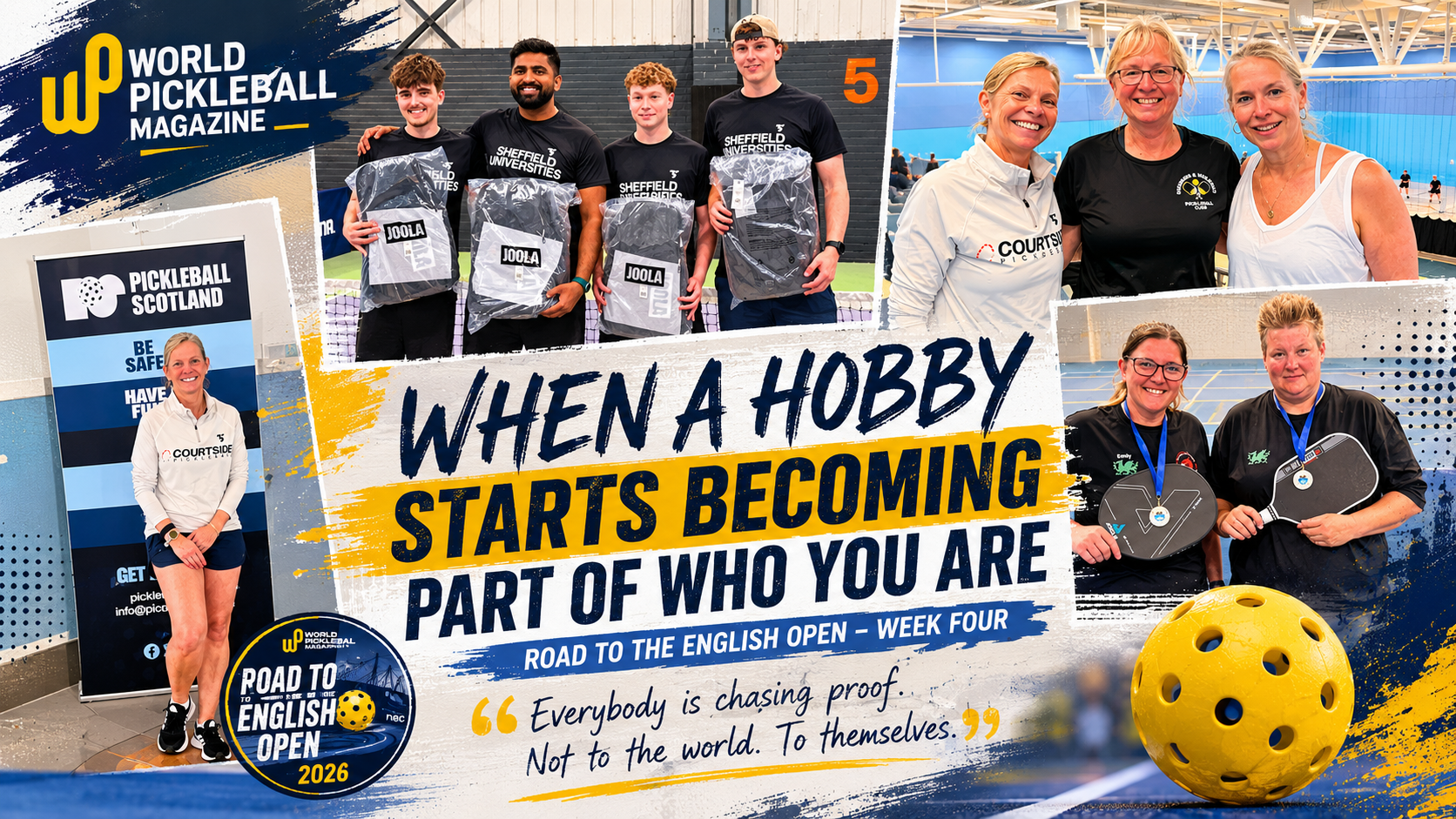
Emily Williams smashed the window of her own car to reach a pickleball tournament. That sounds ridiculous until you understand what Week Four revealed about the Road to the English Open. Somewhere between the drills, the tournaments and the WhatsApp groups, this project has stopped being only about preparing for Birmingham. It has become something far more personal.
- Emily Williams smashed her own car window to retrieve her paddle and trainers before winning two silver medals.
- Julie Vickerman admitted that the project itself has made her want to win more.
- Laura Yeomans discovered she needed distance from pickleball to rediscover why she loves it.
- Simon Heaps reflected on the seventh anniversary of losing his leg and what competition now means to him.
When The Tournament Starts Following You Home
At half past five on a Saturday morning, Emily Williams arrived at a train station ready for competition. The paddle was packed. The trainers were packed. The train was due. Everything was ready. Then she realised both the paddle and the trainers were locked inside her car. Along with the keys. For a few moments there was panic. The kind of panic familiar to anyone who has ever prepared for something that suddenly feels important. The train was not waiting. The tournament was not waiting. The day was moving forward whether she was ready or not. So Emily made a decision. She smashed the window of her own car. Retrieved the bag. Caught the train. Played the tournament. Won two silver medals. Later that evening she received a call from a neighbour informing her that police were investigating damage to her vehicle in the station car park. The explanation took some effort.
“It had my trainers in it and my paddle.”
The story is funny because of how casually she tells it now. It is also revealing. Nobody smashes a car window for a hobby. Not really. The more stories that arrive each week, the clearer it becomes that something is happening beneath the surface of this project. The Road to the English Open is still about preparation. The drills still matter. The tournaments still matter. The ratings, partnerships and results still matter. But Week Four revealed something deeper. The tournament is beginning to occupy space in people’s lives that was never supposed to belong to sport. It is appearing in conversations. In routines. In friendships. In worries. In confidence. In identity. The players are not simply preparing for Birmingham anymore. Something about the journey is beginning to change them.
The Project Starts Talking Back
Julie Vickerman may have delivered the most revealing sentence of the week.
“The project itself has made me more want to win.”
It appeared quietly in the middle of a much longer answer. Yet it explains a remarkable amount. This was the week when the Road to the English Open stopped feeling like a collection of individual stories and started feeling like a community. Julie finally met Sarah Reading and Bronn at the Scottish Open after weeks of reading their stories. The three set up a WhatsApp group beforehand to help them find one another at the venue. When they finally did, there were hugs, laughter and immediate conversation. Sarah shared advice about calming nerves before serving. About limiting post-match criticism. About spending longer reflecting on what went well than what did not. The project had stepped off the page. Hari found himself thinking about Simon Heaps. Kath found herself inspired by Emily. Simon worried about Kath’s recovery. Julie learned from Sarah. The participants are beginning to influence one another in ways nobody could have predicted when this started. The project is no longer sitting on the sidelines observing. It has become part of the story itself.
Everybody Wants More
One of the most striking developments this week was how many players found themselves wanting more than they did a month ago. Not necessarily more success. More understanding. More improvement. More possibility. Zoe Ashbridge realised she now enjoys drilling almost as much as playing. Perhaps more. A few weeks ago she would happily turn up and enjoy a session. Now she finds herself fascinated by the process of improvement itself. One small technical adjustment worked its way into a tournament match almost immediately. A different adjustment revealed that she had spent months reinforcing a flaw. The lesson was uncomfortable. Hard work alone is not enough. You have to work on the right things. Hari is discovering something similar. Improvement is becoming less physical and more intellectual. Patterns. Positioning. Decision-making. The game is turning into something that can be studied. Emily has reached a similar conclusion through competition. The higher she climbs, the harder it becomes to hide weaknesses. The serve that found the net twice at 10-10 in a gold medal match remains vivid. Not because it cost a medal. Because it exposed something she wants to improve. Balance. Pressure. Execution. The details matter more now. Even Julie, perhaps the least overtly competitive member of the group, discovered something new about herself. At the Scottish Open she and her partner were 6-1 ahead against a pair from Alabama. They eventually lost 11-8. The defeat stayed with her. Longer than she expected. Harder than she expected. What surprised her most was not the result. It was how disappointed she felt afterwards. She kept replaying the match. Kept thinking about the semi-final place that slipped away. Kept wondering what might have happened. That was new. And perhaps that is the point. The project is not simply showing people who they are. It is showing them who they might become.
The Hardest Opponent
For many participants, the real battle remains internal. Sarah Reading arrived at the Scottish Open convinced she was about to be exposed. She entered a 4.0 age-group event wondering whether she belonged there at all. Instead, she came home with evidence. Not evidence she could win. Evidence she could compete. The most revealing moment came when her partner became nervous. Usually Sarah is the one battling anxiety. Usually Sarah is the one needing reassurance. This time she found herself offering it. Calming somebody else. Reminding them to take one point at a time. Helping them settle. The nervous player had become the reassuring player. It happened so naturally she almost brushed past it. But it mattered. Perhaps more than any result. Sarah has spent much of this project questioning whether she belongs at a higher level. This week she behaved like somebody who already does. Julie and Karen understand that feeling too. Both speak about confidence as though it remains permanently out of reach. Both receive positive feedback from teammates and opponents. Both immediately focus on what they did wrong. Karen perhaps captured it most honestly.
“I want to be in my twenties and starting my journey again in this sport.”
It is one of those lines that hangs in the air. Not because it is sad. Because it feels universal. The awareness that you have found something you love and simultaneously wonder what might have happened had you found it earlier. Yet Karen is proving she can still compete. Still improve. Still belong. The challenge is not performance. The challenge is acceptance.
The Things Standing In The Way
If ambition is growing, reality has not suddenly become easier. Thomo spent much of the week celebrating Arsenal’s title triumph. The football was wonderful. The lack of pickleball was not. What surprised him most was how much he missed it. The frustration was not losing. It was standing still. Fitness continues to loom over his story. Not because he does not know what needs to be done. Because he does. That is the problem. The gap between knowledge and action is often where amateur sport really lives. Kath Knowles continues to make progress in recovery. Swimming is helping. The exercises are helping. For the first time in several weeks she sounds genuinely hopeful. Yet hope exists alongside absence.
“I should have been travelling to Rota tomorrow.”
A simple sentence. A heavy one. There has been a buzz around the club. Tournaments. Stories. Results. Achievements. Kath is delighted for everyone involved. She is also missing it terribly. The contradiction feels painfully human.
The Unexpected Voice
Then there is Laura Yeomans. Every story needs somebody moving against the current. This week, that person was Laura. While the rest of the group seem increasingly consumed by preparation, Laura has been in Canada. Away from home. Away from coaching. Away from tournaments. Away from expectation. And to her surprise, she discovered something uncomfortable. She does not miss pickleball. Not right now. In fact, she thinks she needed the break. That realisation disturbed her. Because it forced her to confront something she has been trying to ignore. She is struggling to enjoy the game. The disappointment of missing out on the PPL still lingers. Confidence remains fragile. Perfectionism remains exhausting. One moment stayed with her. She was playing at one of the best pickleball venues she had ever visited. Surrounded by friends. Surrounded by good people. And still unable to relax. Still feeling that her mistakes defined her. Still feeling the need to apologise.
“I was surrounded by friends and new faces but still felt like my mistakes define me.”
For the first time in this project, somebody openly questioned not how much they wanted the sport, but whether they were still enjoying it. The honesty of that answer may prove more important than any medal won this summer.
What Are We Really Chasing?
By this stage of the journey another question begins to emerge. Not how good can I become? Not can I win? Something deeper. Why does this matter so much? Friday marked seven years since Simon Heaps lost his right leg. His “ampuversary.” The day that changed everything. For much of this project Simon has been defined by determination. The travel. The training. The obsession. The urgency. The relentless desire to improve. This week he explained what sits underneath it. After losing his leg he needed something. Not simply competition. Something that would allow him to prove to himself that he could still compete. Still contribute. Still matter. Still be the person he believed himself to be.
“Pickleball has given me something to focus on, something that I can prove, to myself, that I can compete again, something that makes me worthy again.”
Something that makes me worthy again. Everything feels slightly different after reading that sentence. Karen’s battle with time. Sarah’s search for belief. Laura’s struggle to rediscover joy. Kath’s determination to return. All of it. Because beneath the drills and the tournaments and the ratings sits something far more personal. Everybody is chasing proof of something. Not necessarily to the world. To themselves.
Eight Weeks
There are roughly eight weeks until Birmingham. Depending on who you ask, that is either no time at all or an eternity. Hari says his road is finally leaving the country lanes. Thomo talks about a steam train. Karen describes a stop-start journey. Simon imagines a railway line gathering speed. Different metaphors. The same feeling. Momentum. Nobody feels stationary anymore. Not even Kath. Perhaps that is what Week Four ultimately revealed. Not that standards are improving. Not that confidence is growing. Not even that the tournament is getting closer. Something more subtle than that. Emily smashed a car window to make a tournament. Julie discovered she cares more than she thought. Sarah is beginning to believe she belongs. Karen is negotiating with time. Laura is trying to reconnect with joy. Simon is searching for proof. And Kath, perhaps, captured the entire project best of all.
“I have real hope that I’ll be back to being me.”
Not back to playing. Not back to winning. Back to being herself. Because nobody signed up for this project expecting to find answers to questions like these. They entered a tournament. What they found instead was a mirror. Every week Birmingham reveals something different. Not about pickleball. About themselves. And somewhere between Week One and Week Four, the Road to the English Open stopped being a story about preparing for a tournament. It became a story about what happens when a sport quietly becomes part of who you are.
Further Reading
- Road to the English Open hub
- Sign up to the World Pickleball Report
- Latest pickleball news from around the world
- Tournament coverage and results

Chris Beaumont
Founder and Editor-in-ChiefChris Beaumont is the founder and Editor-in-Chief of World Pickleball Magazine, published by World Pickleball Media Ltd. He follows the global game closely, reporting on news, developments, stories and tournaments from all five continents. He also hosts the World Pickleball…
View All Articles →