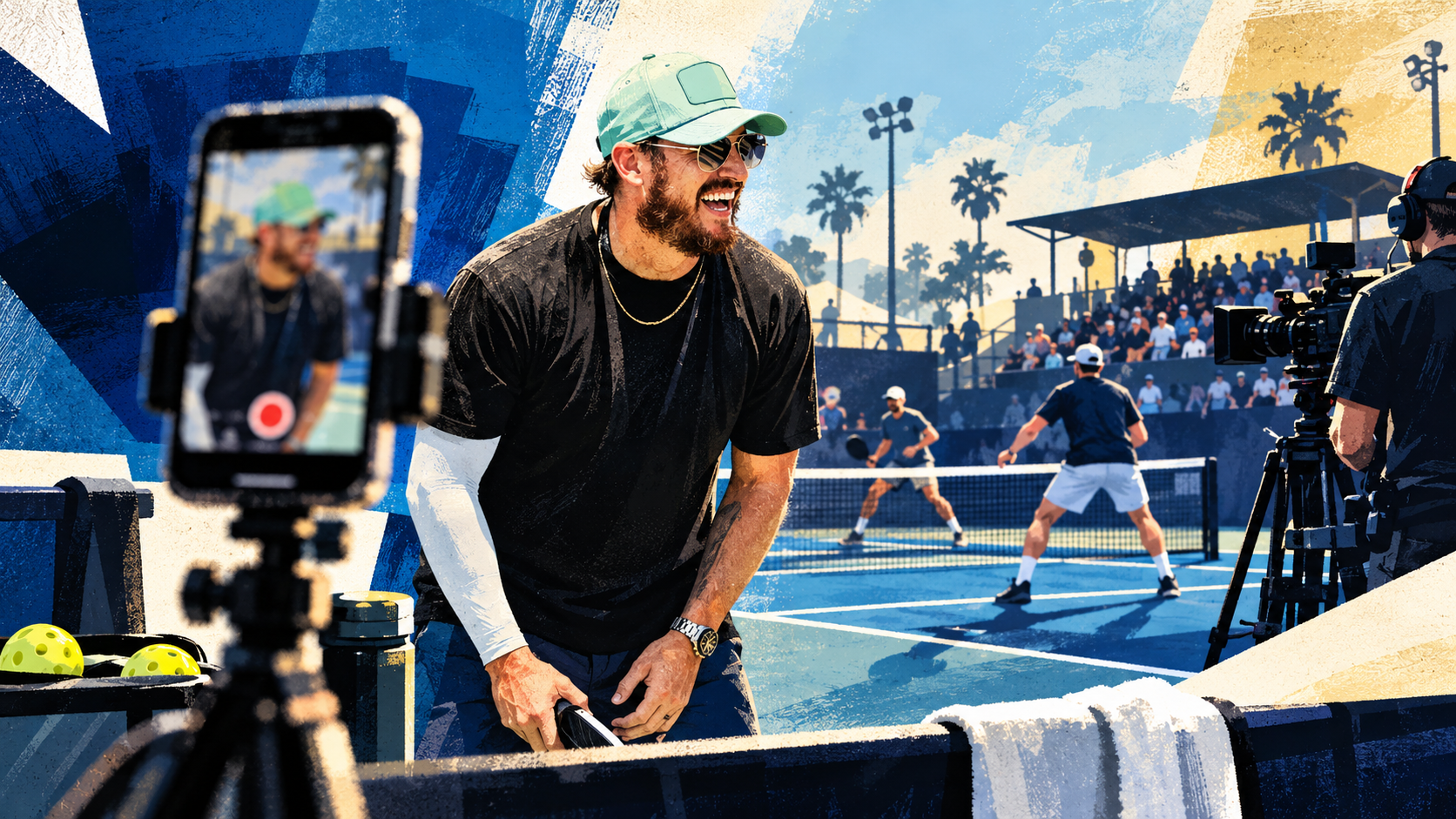
Sean Muñoz has built a recognisable place in pickleball without becoming a full-time professional player or abandoning his day job. His journey from recreational player to sponsored content creator reveals a changing commercial landscape, one in which entertainment, audience loyalty and the ability to tell compelling stories are becoming increasingly relevant to athletes, brands and professional leagues.
Key Takeaways
- Content creator Sean Muñoz, known as JuanSeanPB, has developed commercial relationships and collaborated with leading athletes while continuing to work full-time outside pickleball.
- His experience with Volair illustrates how a creator’s relationship with recreational players can offer manufacturers something different from a professional athlete’s competitive credibility.
- Muñoz argues that professional players outside the leading ranks increasingly need their own content to maintain visibility between tournament appearances.
- His interview also highlights opportunities for professional leagues to develop more behind-the-scenes storytelling and connect with audiences beyond established pickleball fans.
Professional pickleball has invested heavily in staging and broadcasting competition, but turning its players into personalities remains a different challenge. Winning tournaments establishes sporting credentials without necessarily creating the kind of public identity that attracts audiences between events, generates sustained commercial interest or gives casual viewers a reason to follow an individual athlete.
Sean Muñoz has approached that problem from the opposite direction.
Known online as JuanSeanPB, he has developed his profile around the familiar frustrations, rivalries and absurdities of recreational pickleball. His content has led to commercial relationships with equipment manufacturers and collaborations with professional players and athletes from other sports, including UFC fighter Sean O’Malley, yet his appeal has never depended on convincing audiences that he belongs among pickleball’s elite competitors.
In an interview with Fabian Rodriguez, published on 23 September by the This Is Pickleball podcast, Muñoz explained how his creative career developed, why he believes professional players need to think more seriously about their public identities and where he sees opportunities for more ambitious storytelling.
Together, those observations raise a question for a sport whose professional infrastructure is developing alongside an increasingly diverse media landscape: who will build the strongest relationships between pickleball’s personalities and its audience?
From Recreational Obsession to Commercial Opportunity
Muñoz discovered pickleball around 2021, initially approaching it as a recreational activity that offered exercise and the social interaction he had missed during the pandemic. After encountering the game at a public park in California, he returned with inexpensive equipment and quickly found himself playing almost every day.
He subsequently entered tournaments and travelled to PPA events, but the considerable time he was spending around pickleball eventually encouraged him to explore opportunities beyond competition. Content creation offered a way of making something from that enthusiasm without committing himself to a professional playing career or launching an equipment company.
His early videos focused on situations he encountered at public courts, including contentious line calls, unexpected defeats and the peculiar dynamics of recreational doubles. Comedy helped distinguish his work from the instructional material that dominated much of the content he was watching at the time, while a manageable publishing routine gave him room to develop ideas without making every video dependent on immediate commercial success.
Rather than asking viewers to admire his playing ability, Muñoz invited them to recognise themselves, their partners and their opponents in the situations he recreated. That distinction matters because recreational players represent an audience that professional broadcasts cannot always reach through competitive excellence alone.
Someone might have little interest in tournament rankings but still understand the frustration of an unreliable doubles partner or an argument over whose paddle should be next in the rack. By building his material around those experiences, Muñoz established a relationship with participants who do not necessarily follow the professional calendar.
For equipment manufacturers attempting to reach those same customers, that relationship has commercial potential.
Two Different Kinds of Sponsored Talent
Muñoz initially worked as a Selkirk ambassador before an approach from Volair opened the door to a different arrangement. According to his account, Volair was interested in working with a relatively small group of creators capable of producing distinctive material, rather than relying exclusively on a broad ambassador network built around discount codes and conventional product promotion.
He explained that the company’s approach did not always require a paddle to become the central subject of a video. Equipment could appear naturally within entertaining material, allowing the brand to become familiar to viewers without interrupting the reason they had chosen to watch.
That illustrates a distinction between two forms of sponsorship that are sometimes treated as interchangeable.
A professional player offers competitive credibility. Their equipment is visible during high-level matches, their performances can support a manufacturer’s technical positioning and their results provide a sporting narrative that brands can incorporate into their marketing. A creator such as Muñoz offers something different: repeated access to an audience that follows his personality and recognises his particular approach to the sport.
The two forms of influence are not mutually exclusive, and professional players who can combine competitive achievement with an engaging media presence may offer sponsors both. Nevertheless, Muñoz’s experience demonstrates that the ability to produce entertaining material can be a marketable skill in its own right, rather than merely an additional responsibility attached to a playing contract.
It is a useful addition to the wider commercial questions examined in WPM’s investigation into who controls pickleball’s developing business. Professional tours, manufacturers and media organisations may all want access to the sport’s audience, but that audience does not necessarily belong to whichever organisation controls the biggest tournaments.
Why Millions of Views May Not Be Enough
One of the interview’s more revealing moments concerns a simple meme that Muñoz recalled attracting approximately six to seven million views. The video introduced his account to a much wider audience and generated new followers, but he recognised that many viewers were responding to the humour rather than demonstrating any lasting interest in pickleball.
Some may have continued engaging with his subsequent work. Others may simply have enjoyed a viral joke and moved on.
The experience reinforced a distinction between generating attention and building an audience that returns because it cares about the subject. For a manufacturer selling specialist sporting equipment, a smaller community of committed players may be commercially relevant in ways that a much larger, less focused audience is not.
That does not establish that Muñoz’s more specialised videos generate greater sales than his viral material. The interview contains no independently verified conversion figures, sponsorship valuations or detailed audience data. It does, however, illustrate why brands need to understand who is watching and why, rather than treating total views as a complete measure of influence.
Professional pickleball faces a similar challenge. Reaching someone through an entertaining clip is one achievement; giving that person a reason to follow a player, watch a match or return for the next tournament requires a more substantial relationship.
The Professional Player’s Second Competition
The interview’s most consequential argument emerged when the conversation turned towards professional players who do not consistently reach the closing stages of tournaments. Muñoz believes that athletes outside the leading ranks face increasing pressure to develop their own content because competitive results alone may not provide enough visibility to establish a recognisable commercial identity.
It is a challenge that becomes more apparent as the professional field deepens. A player can train extensively, travel to major tournaments and compete at an exceptional standard while remaining relatively unfamiliar to recreational audiences. Unless they progress far enough to receive substantial broadcast exposure, opportunities to demonstrate their personality, explain their journey or attract new supporters may be limited.
Muñoz cited Zane Navratil and Roscoe Bellamy as examples of players developing a presence through content rather than depending entirely on tournament results. His assessment is not a universal rule for professional athletes, but it identifies an additional route through which players can develop relationships with supporters and potential sponsors.
He also acknowledged the practical difficulties involved. For athletes whose primary occupation is training and competing, maintaining a publishing schedule creates another demand on their time, particularly when the material requires them to be entertaining immediately after a disappointing result.
A player who loses a match they expected to win may have little enthusiasm for producing a video about the experience. Travel, physical preparation and existing sponsorship obligations create further demands, while developing an independent media identity requires skills that have relatively little to do with competitive performance.
Muñoz can plan material around recreational experiences, record several videos during a visit to the courts and distribute them over subsequent weeks. A professional player must accommodate content production around a competitive calendar in which performances and results can determine both their availability and their willingness to appear on camera.
Visibility and commercial value should not be confused. A widely recognised personality does not automatically command a profitable sponsorship agreement, just as an athlete with relatively modest social media numbers may provide considerable value through their credibility, specialist knowledge or influence within a particular community.
Nevertheless, direct access to an audience gives players another way of developing their careers beyond the competitive hierarchy. For those whose tournament results fluctuate, that relationship may become particularly valuable.
Reaching Players Who Do Not Watch Professional Pickleball
Much of Muñoz’s content is directed towards people who participate in pickleball rather than those who necessarily follow its professional competitions. They understand the jokes because they recognise the situations, even if they could not identify the leading players on the PPA Tour or explain the structure of Major League Pickleball.
That creates a potential connection between two audiences that professional pickleball has a clear interest in bringing closer together.
A recreational player who follows Muñoz for his comedy might encounter a professional athlete through one of his collaborations. A viewer attracted by that athlete’s personality might subsequently become interested in their tournament appearances, partnerships or wider career.
Muñoz described filming with Sean O’Malley and his team after contacting the UFC fighter’s pickleball facility in Arizona. Alongside professional player Andre Mercado, he participated in recreational challenges before recording further material with O’Malley and coach Tim Welch.
The collaboration brought together audiences with different interests. MMA supporters could encounter pickleball through an athlete they already followed, while existing pickleball viewers could discover another side of O’Malley’s sporting interests.
Muñoz also discussed participating in charity events involving baseball star Mookie Betts and his interest in developing more substantial collaborations with professional pickleball players. The potential significance of those appearances lies less in the novelty of a celebrity holding a paddle than in the opportunity to introduce people to the sport through personalities they already recognise.
Whether those viewers subsequently engage with professional pickleball remains an open question. The interview provides no conversion data, but it helps explain why relationships between independent creators, established athletes and professional organisations deserve attention beyond the occasional promotional appearance.
Pickleball Needs More Than Another Match Broadcast
When Rodriguez asked where pickleball’s content landscape could develop, their discussion moved towards the kind of storytelling that established sports organisations have spent years refining.
Rodriguez highlighted the UFC’s behind-the-scenes video programming, particularly its Embedded series, which follows fighters as they prepare for major events and introduces viewers to their lives beyond competition. Rather than concentrating exclusively on the contest itself, the format explores preparation, relationships and personal circumstances while building anticipation before the sporting outcome is known.
Muñoz agreed that pickleball could benefit from a similar approach, particularly within Major League Pickleball. He expressed interest in seeing the conversations before matches, the influence of general managers and the relationships between teammates preparing to face rival franchises.
Those subjects are potentially compelling because team competition creates narratives that extend beyond any individual performance. Selection decisions, changing partnerships, tactical disagreements and the demands of representing a franchise can all help explain what happens away from the court, giving audiences a deeper understanding of the people involved before they watch the competition itself.
Rodriguez also stressed the importance of timing. Documentary content published during the build-up to an event can become part of the audience’s experience, whereas a programme released months later may offer an interesting retrospective without contributing to the same immediate anticipation.
The opportunity is familiar to WPM readers. Our coverage of Ron Shell’s approach to building sporting culture at NPL Australia explored a related challenge: professional competition needs more than strong players and a fixture list if it wants people who have never followed the sport to become invested in its teams and rivalries.
There are practical obstacles to the kind of access Rodriguez and Muñoz envisage. Documentary production requires editorial judgement, cooperation from players and teams, and sufficient resources to publish material while it remains relevant. Professional organisations must also decide how much access they are willing to provide when the most interesting stories may involve disappointment, disagreement or decisions they would ordinarily prefer to keep private.
Yet the underlying opportunity is substantial. Pickleball already has athletes, rivalries, contrasting personalities and a demanding international calendar. Much of that material remains difficult to discover unless audiences already follow the sport closely.
Creators as Media Partners, Not Just Promotional Channels
The relationship between creators and professional organisations is often framed in terms of promotional reach. A league invites an influencer to an event, the creator produces several videos and the organisation gains exposure to a different audience.
Muñoz’s experience suggests the possibility of a more substantial relationship.
He has developed an understanding of situations that resonate with recreational players, learned to produce material quickly and found ways to present established athletes in settings where their personalities become more accessible. Those are capabilities that professional organisations could potentially incorporate into their wider media operations, particularly when trying to reach audiences unfamiliar with the sport’s competitive structure.
The opportunity extends beyond comedy. Independent creators may specialise in tactical analysis, player interviews, documentary production, regional reporting or the recreational culture surrounding the game, each reaching people whose interests are not necessarily served by conventional match coverage.
But the relationship raises an important question about control. A creator who has developed an independent audience may want to preserve their style, publishing decisions and commercial partnerships, while a professional organisation may require sponsor protection, predictable output and editorial oversight of material produced within its events.
Effective partnerships would need to accommodate both interests rather than treating creators simply as additional distribution channels for official promotional material. The interview does not establish that such arrangements are already standard practice, but it identifies why they could become increasingly relevant as pickleball’s media businesses mature.
Why Muñoz Has No Plans to Quit His Day Job
There is a revealing contradiction at the centre of Muñoz’s experience. He has developed commercial relationships, established a recognisable identity and collaborated with athletes whose audiences extend beyond pickleball, yet he does not currently aspire to make the sport his sole occupation.
He explained that working in behavioural therapy provides a valuable contrast to content production, allowing him to return to pickleball with enthusiasm rather than approaching every visit to the courts as another professional obligation.
It also gives him the freedom to be selective about commercial opportunities. Someone relying entirely on content creation for income might need to accept more sponsored projects, whereas Muñoz can balance those opportunities against the demands of his existing career and personal life.
That independence comes with limitations. Working full-time restricts the number of projects he can undertake, while filming, editing and maintaining sponsor relationships must fit around other commitments. His production process has therefore remained comparatively simple, with most of his material recorded on an iPhone and more elaborate projects occasionally involving friends with professional filming experience.
He also warned against the pressure to publish excessively, arguing that creators should concentrate on producing material their audiences genuinely enjoy rather than pursuing an unsustainable schedule.
For aspiring creators, his experience offers an alternative to the assumption that success necessarily involves leaving conventional employment, building a production team or attempting to compete with established sports broadcasters. For commercial partners, it raises the question of whether the independence that makes a creator attractive can survive an arrangement that demands ever-increasing output.
From Sports Equipment to Entertainment
Muñoz’s discussion of Volair offered another illustration of how pickleball’s commercial landscape is extending beyond conventional professional endorsements.
The manufacturer has developed licensed collections featuring Spider-Man and Keith Haring, alongside SpongeBob SquarePants designs discussed during the interview. Its Spider-Man blind-bag products introduce an element of surprise familiar to collectors in other consumer markets.
Muñoz described the appeal of collecting limited-edition paddles, including examples he would prefer to display rather than use in competition. That approach connects pickleball with popular culture, personal identity and collecting habits rather than relying exclusively on technical specifications or the equipment choices of leading professionals.
There is no guarantee that limited-edition paddles will develop a substantial secondary market, and suggestions about their future resale value remain speculative. The collections do, however, illustrate how manufacturers are experimenting with ways to appeal to customers whose interest in pickleball extends beyond competitive performance.
For creators, such products provide entertaining material through unboxing videos, collaborations and the humour of competing with a paddle decorated with a familiar cartoon character. For manufacturers, they create another way of connecting their products with personality and cultural recognition.
Who Will Build Pickleball’s Next Audience?
Competitive success will remain central to professional pickleball, and leading players will continue to attract attention through their performances. Yet the sport’s commercial development also depends on the relationships that form around competition, including the personalities capable of engaging audiences who may never have watched a professional match.
Muñoz’s experience illustrates one version of that alternative career. He has created a recognisable identity without becoming a full-time professional player, attracted commercial interest through entertainment rather than tournament results and demonstrated how creators can introduce established athletes to audiences beyond their usual followers.
His observations about professional players suggest that an independent media presence may become an increasingly useful part of an athlete’s commercial identity, while his interest in behind-the-scenes storytelling points towards opportunities for leagues and broadcasters to make the people involved in competition more accessible.
The important distinction is that those relationships cannot necessarily be manufactured by commissioning more promotional videos. Creators establish their appeal through a particular voice, an understanding of their audience and the freedom to produce material that people actively choose to watch.
For professional pickleball, the question is not whether every player needs to become an influencer or whether creators will replace conventional sports broadcasting. It is whether the organisations investing in the sport can work effectively with the people who are already building connections to audiences that tournament results alone may never reach.
Further Reading
- Pickleball Has a Culture Problem. Ron Shell Thinks You Have to Build One — how professional leagues can develop identities, rivalries and audiences.
- The Business: Who Owns Pickleball in 2026? — WPM’s investigation into the organisations and commercial interests shaping the sport.
- World Pickleball Magazine: June 2026 — including features on Anna Bright’s vlogging and the Partners documentary.
- Latest Pickleball News — WPM’s reporting across professional competition, business, equipment and culture.
- Watch Sean Muñoz on This Is Pickleball — the complete interview with Fabian Rodriguez.

Chris Beaumont
Founder and Editor-in-ChiefChris Beaumont is the founder and Editor-in-Chief of World Pickleball Magazine, published by World Pickleball Media Ltd. He follows the global game closely, reporting on news, developments, stories and tournaments from all five continents. He also hosts the World Pickleball…
View All Articles →