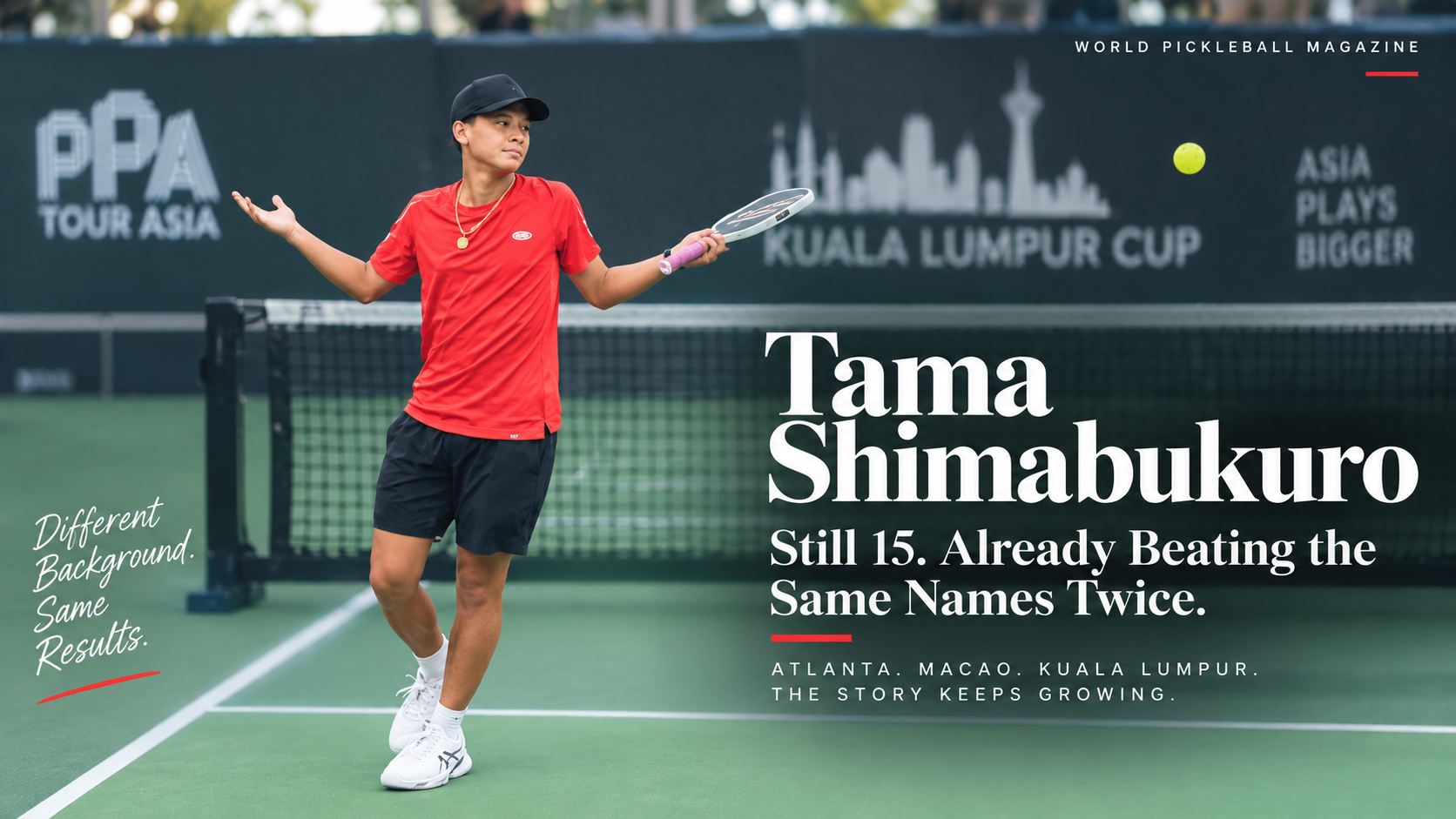
Tama Shimabukuro, 15, beat Noe Khlif 11-8, 11-5 at the Leapmotor Kuala Lumpur Cup, while Tardio and Irvine each won double gold.
The short answer: Fifteen-year-old Tama Shimabukuro won his second PPA Tour Asia men’s singles title at the Leapmotor Kuala Lumpur Cup, beating Noe Khlif 11-8, 11-5 after defeating Hong Kit Wong in the semi-final. Gabriel Tardio and Jessie Irvine each won two golds, and Kaitlyn Christian beat Brooke Buckner for a third straight PPA Tour Asia women’s singles title.
Jessie Irvine and Gabriel Tardio left Malaysia with two gold medals apiece, while Kaitlyn Christian extended her winning run in women’s singles. Yet 15-year-old Tama Shimabukuro’s second PPA Tour Asia singles title belongs to a much bigger sequence. Atlanta announced him. Macao proved he could win. Kuala Lumpur showed that the same established opponents are beginning to lose to him twice.
Key takeaways
- Gabriel Tardio and Jessie Irvine completed double-gold weekends at the Leapmotor Kuala Lumpur Cup.
- Tardio and Noe Khlif recovered from 10-0 down in the opening game of their first men’s doubles match before eventually winning the title.
- Tama Shimabukuro defeated Noe Khlif 11-8, 11-5 to claim his second PPA Tour Asia men’s singles crown.
- The 15-year-old had already beaten Khlif during his breakthrough Atlanta run and defeated Hong Kit Wong in both Macao and Kuala Lumpur.
- Kaitlyn Christian beat Brooke Buckner in three games to win a third consecutive PPA Tour Asia women’s singles title.
Gabriel Tardio’s men’s doubles tournament in Kuala Lumpur began with his team 10-0 down.
It ended with a gold medal around his neck.
There were several ways to tell the story of the Leapmotor Kuala Lumpur Cup by the time Championship Sunday finished at The Hood.
Jessie Irvine and Tardio had both completed double-gold weekends. Kaitlyn Christian had won women’s singles for a third consecutive PPA Tour Asia event. Noe Khlif had reached two finals on his first appearance on the circuit.
Then there was Tama Shimabukuro.
Fifteen years old. Men’s singles champion for the second time on PPA Tour Asia.
And increasingly difficult to explain through his age alone.
Shimabukuro’s 11-8, 11-5 victory over Khlif did not arrive from nowhere. Nor was it simply a precocious teenager producing another exceptional week.
Khlif had lost to him before.
So had Shimabukuro’s semi-final opponent Hong Kit Wong.
That is what changed in Kuala Lumpur.
The remarkable thing about Tama Shimabukuro is becoming less that he is 15 and more that the evidence keeps surviving the next tournament.
Tardio’s tournament nearly disappeared at 10-0
Before Shimabukuro took centre stage, Tardio produced a tournament arc that would have been difficult to invent.
Partnering Khlif in men’s doubles, he found himself staring at a 10-0 opening-game deficit against Park Seong Yong and Syed Uzair Sufi in their first match.
One more point and the eventual champions would have started their campaign with an 11-0 game against them.
They avoided that, but still lost 11-3.
Then everything changed.
Tardio and Khlif took the next two games 11-5, 11-1 and survived.
WPM examined that escape earlier in the tournament in Ten Points From Disaster: Tardio and Khlif Survive as Kuala Lumpur Bites Back.
By Sunday, Tardio was standing in two finals.
He won both.
Irvine and Tardio survive the final of the day
The first came alongside Irvine against Danni-Elle Townsend and Joey Wild in mixed doubles.
Townsend and Wild took the opening game 11-5.
Irvine and Tardio responded 11-3 before falling 7-2 behind in the deciding game.
At that stage, their first final was moving away from them.
They pulled it back.
Not in one overwhelming burst, but by keeping the match alive long enough for the pressure to shift again, eventually forcing the game beyond 11 before closing it 12-10.
From 2-7 down, Irvine and Tardio had their first gold.
Neither was finished.
From 10-0 down to men’s doubles champion
Tardio returned with Khlif to face Augustus Ge and Len Yang.
This time there was no opening-game disaster and no three-game rescue.
Tardio and Khlif won 11-9, 11-4.
The first game kept Ge and Yang close enough to threaten. The second removed the uncertainty.
It completed an extraordinary distance between the first and last significant moments of their tournament.
At 10-0 down in their opening match, Tardio and Khlif were one point from being blanked. Even after avoiding that, they still had to recover from a game down simply to remain in the draw.
By Championship Sunday, they were champions.
That is the part a podium list cannot capture.
Tardio did not simply arrive in Kuala Lumpur as one of the strongest international players in the field and collect another title. His tournament nearly disappeared before it had begun, then expanded into a double-gold weekend.
Irvine’s followed a remarkably similar pattern.
Irvine loses the first game twice and wins two titles
Irvine’s second final came alongside Alix Truong against Sahra Dennehy and Townsend.
Again, the opening game went to the other side.
Dennehy and Townsend won 11-5, giving Townsend an immediate opportunity to turn her mixed doubles silver into women’s doubles gold.
Irvine and Truong reversed the score in the second.
11-5.
Then they won the decider 11-6.
For Irvine, both Championship Sunday finals had therefore begun with defeat. Both ended with her holding gold.
That matters because double-gold weekends can sometimes create a misleading impression of control. Irvine’s was built on adjustment. The mixed final required her partnership to recover from 7-2 down in the deciding game. Women’s doubles demanded another response after the opening game had gone.
She and Tardio shared one title and then collected another each.
Four gold medals between two players.
Yet the result with the greatest potential to matter beyond Kuala Lumpur came in men’s singles.
Tama Shimabukuro was never simply an Asian-tour discovery
The first correction to make about Shimabukuro is an important one.
He is American, from Honolulu, Hawai’i.
PPA Tour Asia did not discover him, and his Kuala Lumpur title should not be treated as evidence of an Asian player pathway simply because the tournament happened in Malaysia.
His rise had already reached the main PPA Tour in the United States.
What PPA Tour Asia is doing is something different.
It is giving one of professional pickleball’s most unusual young talents another competitive laboratory in which to develop.
Shimabukuro did not emerge from the standard elite-junior-tennis route that now feeds so much professional pickleball talent.
His early sporting background was in surfing and skateboarding in Hawai’i before pickleball entered the picture.
He only began playing seriously around 2023 and turned professional in 2025.
By September 2026, his official PPA profile listed him at No. 9 in singles and No. 11 in both men’s and mixed doubles.
That speed of development is striking.
But even that is becoming less interesting than what has happened since his first major breakthrough.
Atlanta announced him
At the Veolia Atlanta Pickleball Championships in the spring, Shimabukuro entered men’s singles as the No. 22 seed.
He beat No. 13 Jaume Martinez Vich.
Then he beat Federico Staksrud.
The No. 2 seed took the opening game 11-6, but Shimabukuro responded 11-8, 11-9 in a match that lasted almost 70 minutes.
Noe Khlif came next.
Shimabukuro beat him.
Then No. 3 Hunter Johnson.
Another three-game match, another victory: 11-7, 8-11, 11-1.
Only Chris Haworth, the top seed, stopped him in the final, winning 11-5, 11-1.
The Atlanta crowd became so invested in the teenager that “Tama Town” emerged around his run.
It would have been easy to treat the entire thing as one extraordinary week.
He has spent the months since making that explanation increasingly difficult.
The results kept coming
The following week, Shimabukuro and Yuta Funemizu won the men’s doubles title in the 500-level draw at the PPA Finals in San Clemente, defeating Nicolas Acevedo and Clayton Powell 11-9, 11-4 in the final.
Shimabukuro also reached the men’s singles final in that section of the event.
Then his attention shifted towards Asia.
At the earlier Panas Kuala Lumpur Open, he reached the men’s doubles final alongside Armaan Bhatia.
Macao came next.
This time, he finished the job twice.
Shimabukuro beat Hong Kit Wong 11-9, 11-9 to claim his first PPA Tour Asia men’s singles title, then partnered Bhatia to defeat Mitchell Hargreaves and Kenta Miyoshi 12-10, 11-5 for men’s doubles gold.
Before Macao, he had already reached two PPA Tour Asia men’s singles quarter-finals.
He had been close.
Macao turned contention into victory.
That was why WPM wrote at the time that Shimabukuro’s next challenge was proving he was more than pickleball’s next big thing.
Kuala Lumpur provides another answer.
First Wong. Then Khlif. Again.
Hong Kit Wong stood between Shimabukuro and another men’s singles final.
There was history there.
Wong was the player Shimabukuro had beaten for his first PPA Tour Asia singles title in Macao.
This time the score was 11-7, 11-8.
Different tournament.
Same winner.
Khlif was waiting in the final.
There was history there too.
When Shimabukuro’s Atlanta run first made him impossible to ignore, Khlif had been one of the established professionals standing in his path.
Shimabukuro beat him then.
In Kuala Lumpur, months later and on the other side of the world, they met again.
Shimabukuro won 11-8, 11-5.
Those repetitions are more important than the novelty of his age.
Young players can arrive before opponents fully understand what makes them difficult. Surprise has competitive value. Then the field gets footage, experience and another opportunity.
Wong had another opportunity.
So did Khlif.
Neither changed the result.
Atlanta announced Shimabukuro.
Macao proved he could win.
Kuala Lumpur showed that the same names are beginning to lose to him twice.
His game is changing while the results improve
There is another reason to take the progression seriously.
Shimabukuro is not simply reproducing the same game and waiting for everybody else to solve it.
He is changing it.
His background in skateboarding and surfing has often been used to explain the improvisational quality of his game, and there is something persuasive in that. His movement and problem-solving do not always look as though they emerged from a conventional racket-sport development system.
But instinct alone does not explain his 2026 results.
One technical development has been particularly noticeable.
Earlier in his progression, Shimabukuro relied heavily on a two-handed backhand, including around the kitchen. That provided stability and power but could leave him cramped when opponents attacked directly into his body.
Analysis of his Atlanta run showed him increasingly using a one-handed backhand volley while retaining the two-hander in situations where it gave him an advantage.
It sounds like a small change.
At elite level, small changes expand the number of answers a player possesses.
The significance is not that Shimabukuro has abandoned an unconventional game for something more orthodox. It is that structure is being added to the instincts that made him interesting in the first place.
He is learning while winning.
At 15, that may be the uncomfortable part for everybody trying to catch him.
PPA Asia can accelerate him without claiming him
Shimabukuro also provides a useful way of understanding what PPA Tour Asia can become.
The circuit does not need every important player on it to have been developed in Asia for the project to matter.
It can serve as a competitive bridge.
Shimabukuro can face Staksrud, Haworth and Hunter Johnson in the United States, then travel through Asia and encounter Wong, Khlif and a changing group of regional and international opponents across different countries and tournament environments.
He can play singles.
He can build partnerships in doubles.
He can test himself in mixed.
All of that is happening while most athletes his age are still being introduced gradually to senior competition.
The benefit is accumulated experience.
Different opponents ask different questions. Travel changes preparation. New partnerships demand communication and tactical adjustment. Success creates pressure, while returning to another tournament after winning somewhere else changes the way opponents approach the match.
PPA Tour Asia did not create Tama Shimabukuro.
It may be helping accelerate him.
That is potentially just as valuable.
It also fits a wider question WPM raised before Kuala Lumpur in From Cary to Kuala Lumpur: Why PPA Tour Asia Is Becoming Part of the Elite Pickleball Calendar.
The test for the circuit is no longer merely whether it can stage professional tournaments.
It is whether those tournaments become important enough to alter player development, rankings, schedules and careers.
Shimabukuro is beginning to make that argument for them.
Christian’s winning streak reaches three
While Shimabukuro is still building repeatability, Kaitlyn Christian is already living with the expectations created by it.
Brooke Buckner made her work for the women’s singles title.
Buckner took the opening game 11-9, putting Christian behind and continuing Championship Sunday’s recurring pattern of eventual champions being forced to respond.
Christian did.
She took the second 11-4 and the third 11-5.
It was her third consecutive PPA Tour Asia women’s singles title.
That sequence offers an interesting contrast with Shimabukuro.
For him, every repeated result strengthens the argument that the breakthrough is becoming something durable.
For Christian, durability is already assumed.
By the third consecutive title, winning no longer creates surprise. Losing would.
Buckner pushed her into a deciding game.
Christian still left with gold.
What Kuala Lumpur actually told us
The obvious headline from Kuala Lumpur is double gold.
Irvine won twice.
Tardio won twice.
Their shared mixed title contained a comeback from 7-2 down in the deciding game, while Tardio’s men’s doubles title completed a journey that had begun at 10-0 down in the first game of his tournament.
Those are Championship Sunday stories worth telling.
Christian’s third consecutive singles title is another.
But Shimabukuro’s result sits differently.
His Kuala Lumpur title belongs to a sequence stretching from Atlanta through San Clemente and Macao before returning to Malaysia.
The opponents repeat.
So do the results.
That is what makes the sequence compelling.
At 15, Shimabukuro’s ceiling remains impossible to judge and unnecessary to predict. There will be setbacks. Opponents will continue adjusting. His own game will change, and the demands surrounding him will increase as his ranking begins to reflect what everybody has already seen.
The more interesting question is whether he continues finding answers quickly enough to stay ahead of those adjustments.
So far, he has.
Hong Kong comes next
PPA Tour Asia now pauses before the Hang Seng Bank Hong Kong Slam at Kai Tak Arena from 19-25 October.
For Irvine, Kuala Lumpur becomes the weekend when she lost the opening game of both finals and won both anyway.
For Tardio, it becomes the tournament that nearly began with an 11-0 game against him and finished with two gold medals.
For Christian, another stop has been added to an increasingly imposing sequence.
And for shimabukuro?
Macao made him a PPA Tour Asia singles champion.
Kuala Lumpur made him one twice.
But perhaps the most important detail is hidden inside the opponents rather than the trophies.
Hong Kit Wong had already lost to him.
Noe Khlif had already lost to him.
Both got another chance.
Both lost again.
At some point, the story of a 15-year-old stops being about what he might eventually become.
It starts becoming about what everybody else has to do about him now.
Frequently asked questions
Tama Shimabukuro, beating Noe Khlif 11-8, 11-5.
Kaitlyn Christian, beating Brooke Buckner in three games.
Gabriel Tardio and Jessie Irvine.
Further reading
- Ten Points From Disaster: Tardio and Khlif Survive as Kuala Lumpur Bites Back
- Sahra Dennehy Chases Kuala Lumpur Triple Crown
- From Cary to Kuala Lumpur: Why PPA Tour Asia Is Becoming Part of the Elite Pickleball Calendar
- Tama Shimabukuro Has Another Chance To Show He Is More Than Pickleball’s Next Big Thing
- The Macao Open Suggested Asian Pickleball Is Entering a New Competitive Phase

Chris Beaumont
Founder and Editor-in-ChiefChris Beaumont is the founder and Editor-in-Chief of World Pickleball Magazine, published by World Pickleball Media Ltd. He follows the global game closely, reporting on news, developments, stories and tournaments from all five continents. He also hosts the World Pickleball…
View All Articles →