
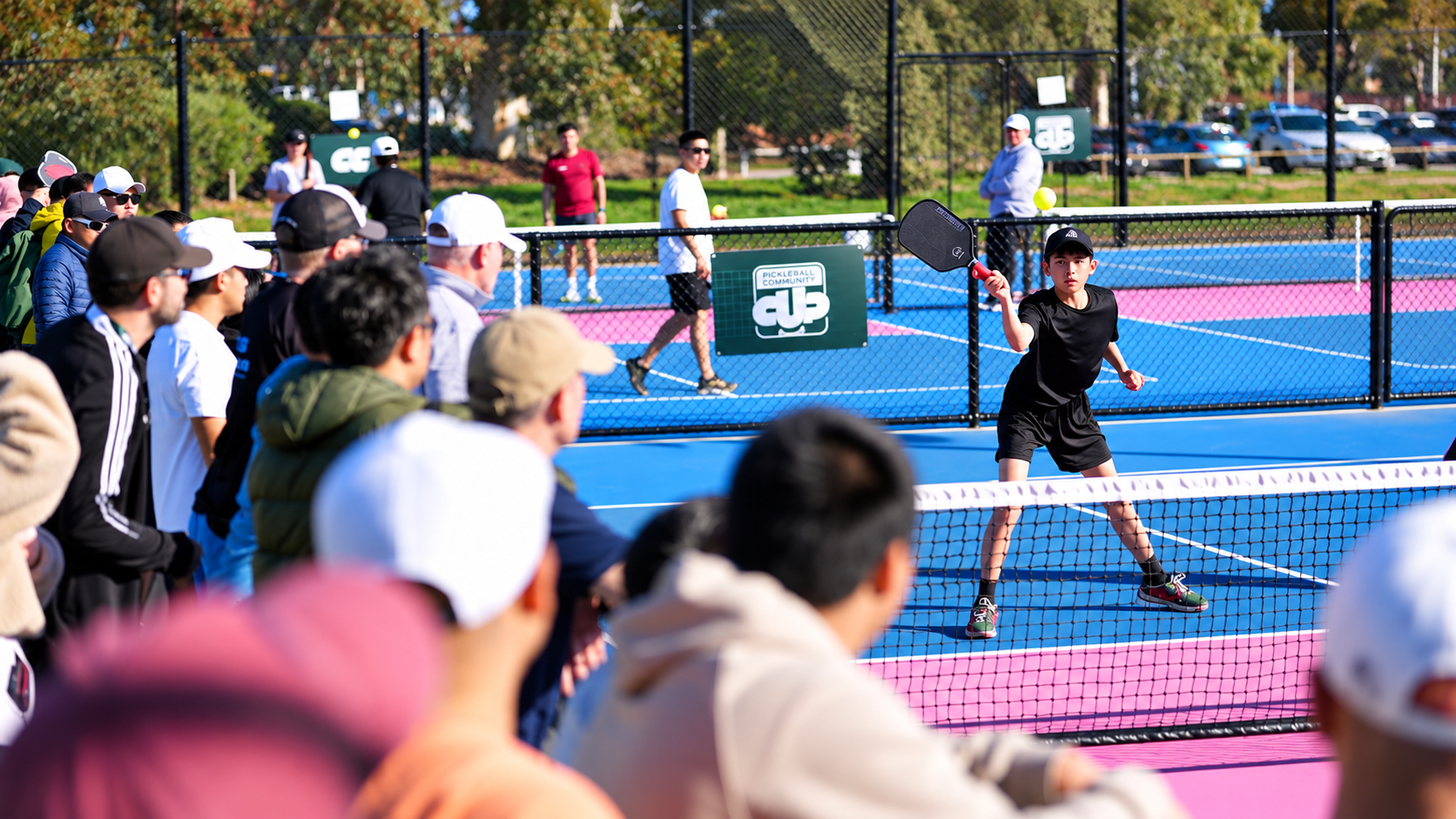
Tennis Australia’s relationship with the National Pickleball League is moving beyond tournaments and partnership language. Existing tennis centres are being targeted for multi-racquet conversion, NPL technology is being used to run competitions and a new grassroots tournament series is moving around the country. Piece by piece, pickleball is beginning to be built into Australian tennis infrastructure.
Key Takeaways
- Tennis Australia and NPL are working on converting traditional tennis centres into multi-sport Racquet Hubs while maintaining tennis participation.
- NPL’s LADER competition platform was adopted for the 2026 Australian Open Pickleball Slam and has also been used to deliver the Pickleball Community Cup.
- Tennis Australia is supporting NPL’s PARK Racquet Club concept, with developments in Baringa and Townsville.
- The bigger experiment is whether existing tennis infrastructure can evolve into a broader racquet-sport network rather than forcing tennis and pickleball to compete for the same space.
For much of pickleball’s international expansion, tennis has been cast as either landlord or reluctant neighbour.
Pickleball needs courts. Tennis already has them. The resulting debate has often centred on lines, noise, scheduling and the question of which sport should control limited space.
Australia is beginning to explore a more interesting answer.
What if the infrastructure does not have to belong exclusively to either sport?
Ten months after Tennis Australia and the National Pickleball League announced their partnership, the relationship is moving from broad statements of intent towards something much more tangible.
Existing tennis centres are being considered for conversion into multi-sport Racquet Hubs, NPL’s LADER technology has entered Tennis Australia-backed competition, the PARK Racquet Club concept is receiving institutional support and the Pickleball Community Cup is taking the sport directly into established tennis venues.
None of those developments alone represents a transformation.
Together, however, they suggest that Tennis Australia is beginning to think about pickleball not simply as another event to host, but as something that can exist within the infrastructure of Australian racquet sport.
That is a considerably bigger bet.
From Partnership to Something Physical
The direction has been developing throughout 2026.
In January, NPL was selected as one of nine companies for Tennis Australia’s AO StartUps programme, which connects emerging businesses with Tennis Australia expertise, facilities and opportunities to test ideas within its wider ecosystem.
NPL was an intriguing choice because it was not simply bringing another piece of technology into tennis.
It was bringing another sport.
That distinction is beginning to matter.
Tennis Australia now says the relationship has moved “beyond strategy and into delivery”, and the projects emerging from it demonstrate what that means in practice.
One of the first is technological.
NPL’s proprietary LADER competition-management platform was adopted for the Australian Open Pickleball Slam 2026. It has also been used for the Pickleball Community Cup, including live scoring, scheduling, results and tournament management.
Software is hardly the most glamorous part of a sporting ecosystem, but it can be one of the most important.
A sport cannot scale simply by producing more courts and attracting more players. Competition needs to be organised, entries processed, matches scheduled and results recorded. Events need systems that can be reproduced rather than administrative machinery rebuilt each time.
The fact that NPL technology is being used inside Tennis Australia-backed pickleball competition therefore tells us something about how the relationship is evolving.
But software is only one layer.
The more consequential experiment concerns the courts themselves.
When a Tennis Centre Becomes a Racquet Hub
Tennis Australia and NPL are working together on the conversion of traditional tennis centres into what they describe as Racquet Hubs.
That terminology deserves attention.
The idea is not simply to paint pickleball lines onto unused tennis courts. Nor, based on what has been announced, is it an attempt to remove tennis and replace it with whichever racquet sport currently attracts the most commercial attention.
The proposition is that an existing facility can serve several sports.
Tennis remains part of the equation. Pickleball enters it. Other racquet sports can sit alongside both. Programming and infrastructure can then be organised around broader demand for racquet sport rather than the assumption that one venue must belong permanently to one discipline.
That reframes one of pickleball’s most persistent infrastructure problems.
Across developing markets, the sport faces a familiar choice. Dedicated pickleball facilities can be built, but doing so requires land, investment and time. Existing sports facilities offer a much faster route to participation, but sharing them can create conflict.
Australia is testing whether there is a third route.
Instead of borrowing tennis infrastructure, pickleball becomes part of the reason that infrastructure exists.
For Tennis Australia, the attraction is equally clear.
A court is an asset. An empty court is an underperforming one.
If a tennis centre can attract tennis players at one time and pickleball players at another, the commercial and community value of that facility potentially changes without abandoning its tennis identity.
That is not a pickleball takeover.
It is a different way of defining a tennis centre.
PARK Provides the Commercial Test
NPL’s PARK Racquet Club concept provides another piece of the strategy.
Tennis Australia describes PARK as a racquet-sports destination combining participation, community and venue innovation, and says its support for the model reflects growing confidence in integrated facilities.
PARK Baringa has been awarded a facility operating contract following a competitive tender process, while PARK Townsville has been named preferred operator for an emerging racquet-sports offering. Further opportunities are being explored around Australia.
For NPL, that creates another potential route for physical expansion.
Dedicated pickleball venues remain part of its model, but PARK allows the organisation to participate in a much larger conversation about how existing sporting facilities should be operated.
That broader ambition fits a theme NPL CEO Ron Shell discussed with WPM earlier this year. As Shell explained on the World Pickleball Podcast, NPL increasingly operates across professional competition, participation, pathways and venues rather than treating the league as a standalone product.
For Tennis Australia, meanwhile, the Racquet Hub and PARK initiatives create a live test of whether supporting tennis requires every facility to remain exclusively tennis.
The answer may increasingly be no.
And that is where the relationship becomes internationally relevant.
Pickleball’s infrastructure challenge is not uniquely Australian. Mature tennis markets around the world contain thousands of courts, clubs and facilities built for an older racquet-sport ecosystem. At the same time, pickleball and other racquet formats are changing what consumers expect from those spaces.
Australia is effectively asking whether the future venue should be defined by its sport or by the community it serves.
The Community Cup Fills Another Gap
Infrastructure only matters if people have reasons to use it.
That makes the Pickleball Community Cup more significant than it initially appears.
The travelling competition, launched by Pickleball Aus and NPL with support from Tennis Australia, sits below the professional end of the ecosystem and provides a tournament product for recreational and developing competitive players.
The inaugural event in Gawler, South Australia, ran from 31 July to 2 August and attracted more than 160 entrants.
The second stop begins on Friday, 9 October, at Mooloolaba Tennis Club in Queensland, with three days of competition running through Sunday.
The programme covers Open and Masters 50+ age groups across Beginner, Intermediate and Intermediate Plus divisions, with entry limited to players rated below 4.5 DUPR. Friday begins with a social teams event before men’s and women’s doubles on Saturday and mixed doubles on Sunday.
There are larger pickleball tournaments.
There are more prestigious ones.
But the location is almost as interesting as the draw.
This is a national pickleball series arriving at a tennis club through an ecosystem involving Pickleball Aus, NPL and Tennis Australia.
The abstract idea of a Racquet Hub becomes easier to understand at that level.
A tennis facility already has courts, amenities, staff and a local sporting community. Pickleball provides another activity, another competition and another group of people capable of using that infrastructure.
The relationship works only if those players actually arrive.
At Gawler, more than 160 did.
Building the Layers Between a First Game and Professional Sport
There is another reason these developments belong together.
NPL is increasingly assembling several parts of a pickleball pathway rather than concentrating exclusively on professional competition.
At one end sits the professional National Pickleball League. Below it are tournaments and community competition. Alongside them are dedicated pickleball venues and the developing multi-racquet model. Underneath the events sits LADER.
The result is the beginnings of a connected system: places to play, reasons to compete, technology to organise competition and a professional product at the top.
WPM has already seen how the professional end of that structure is evolving. The Opals’ run to the 2026 NPL Championship demonstrated a league with conference races, meaningful seeding, a structured finals system and significant prize money.
Tennis Australia brings something different.
Scale.
It has facilities, state and territory networks, institutional relationships, tournament expertise and an established national racquet-sport audience.
Neither organisation needs to become the other for the relationship to be useful.
NPL does not need to become Tennis Australia, and Tennis Australia does not need to operate pickleball as though it were simply smaller tennis.
The opportunity lies in connecting assets that each already possesses.
That is why the infrastructure element matters more than another partnership announcement.
Tennis Does Not Have to Lose for Pickleball to Win
There is an understandable sensitivity around any conversation involving tennis courts and pickleball.
In some markets, pickleball’s rapid arrival has produced genuine conflict over public facilities. Existing tennis players can reasonably object when courts they use disappear. Pickleball players can reasonably ask why underused facilities should remain unavailable when their sport is struggling to satisfy demand.
That argument becomes particularly unhelpful when the success of one sport is assumed to require the retreat of the other.
The Australian experiment offers a different proposition.
What if tennis organisations can benefit from pickleball participation?
What if pickleball can access existing facilities without pretending tennis no longer matters?
And what if a venue becomes stronger precisely because more than one racquet sport has a reason to use it?
There will still be difficult decisions.
Court allocation matters. So does scheduling. Commercially attractive pickleball sessions could eventually compete with traditional tennis programming, while local participation patterns will differ from venue to venue.
Not every tennis centre should become a Racquet Hub, and not every tennis court needs pickleball lines. Multi-sport branding does not automatically produce a viable business either.
The important development is that Tennis Australia appears willing to test the model rather than reject the premise.
Four Pieces of the Same Experiment
That is why the latest stage of the Tennis Australia-NPL relationship matters beyond Australia.
The announcement is easy to reduce to four initiatives: LADER, Racquet Hubs, PARK and the Community Cup.
The more interesting story is what connects them.
They represent four different pieces of infrastructure: digital, physical, commercial and competitive.
Put them together and a broader strategy begins to appear.
A player can discover pickleball at a local facility. That facility can operate within a wider racquet-sport model. The player can enter organised community competition. Technology can manage that competition. Higher-level pathways can eventually lead towards larger tournaments and professional play.
Not every participant will travel through that entire system.
They do not need to.
The significance is that more of the pieces increasingly exist within the same ecosystem.
There is a commercial dimension too. WPM has previously examined how NPL is attempting to build sponsorship relationships that extend beyond professional-event impressions and into venues, memberships and recreational participation. The Tennis Australia relationship adds another layer to the same broader question: how much of a pickleball ecosystem can be connected rather than operated as separate products?
When Tennis Australia and NPL first announced their relationship in December 2025, it was reasonable to ask whether one of the world’s established tennis organisations was simply acknowledging the arrival of another racquet sport.
Ten months later, the answer is becoming clearer.
Tennis Australia is not merely acknowledging pickleball.
It is experimenting with where pickleball fits.
The results are not yet in. Racquet Hubs still have to prove that the concept works operationally and commercially. PARK must demonstrate that multi-racquet demand translates into sustainable venues. The Community Cup has to develop beyond its opening events, and technology only matters if the competitions using it continue to expand.
But that is precisely why Australia is worth watching.
It is moving beyond the theoretical argument over whether tennis and pickleball can coexist and beginning to test what that coexistence looks like in practice.
The most consequential outcome may eventually have little to do with one tournament, one technology platform or even one partnership.
It may be a change in the question being asked about the courts themselves.
Not:
How much tennis infrastructure should pickleball be allowed to use?
But:
What should racquet-sport infrastructure look like now?
Further Reading
- Pickleball Has a Culture Problem. Ron Shell Thinks You Have to Build One
- Opals Sweep Heat as Nicola Schoeman Completes an MVP Season
- What If Pickleball Sold Sponsors Players, Not Impressions?

Chris Beaumont
Founder and Editor-in-ChiefChris Beaumont is the founder and Editor-in-Chief of World Pickleball Magazine, published by World Pickleball Media Ltd. He follows the global game closely, reporting on news, developments, stories and tournaments from all five continents. He also hosts the World Pickleball…
View All Articles →