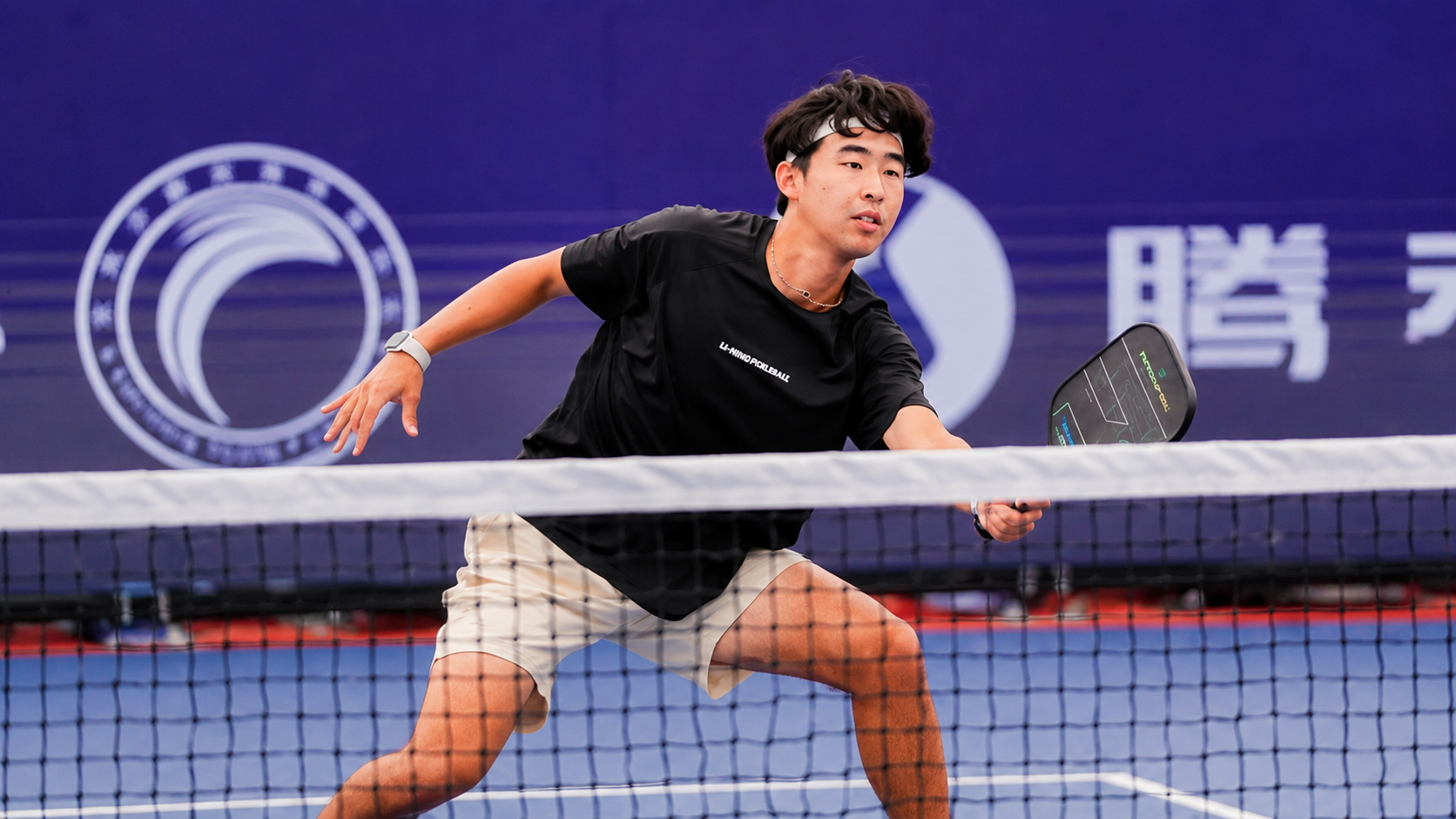
Thomas Yu broke even in his first full-time year as a pro by mixing coaching, sponsorship and commercial work, including a move to Li-Ning.
The short answer: Thomas Yu, a former ITA All-American at Johns Hopkins, went full-time in pickleball in 2025 and broke even in his first year by combining competition with coaching, sponsorship and commercial work. He moved from RAM Sports to Li-Ning, which he says is developing a signature paddle with him, and his APP Chicago default showed how sponsor obligations can clash with tournament rules.
Thomas Yu went full-time as a professional pickleball player in 2025 and finished his first year having achieved something that sounds underwhelming until he explains the job: he broke even. His experience reveals an awkward truth beneath pickleball’s expanding professional game. Being good enough to compete for a living and actually earning one are still very different things.
Key takeaways
- Thomas Yu says he broke even during his first year as a full-time professional by combining competition with coaching, sponsorship and commercial work.
- His move from RAM Sports to Li-Ning shows how identity, geography and market value can matter alongside tournament results.
- His controversial APP Chicago default exposed a problem facing modern pros: the commercial obligations needed to support a career can collide with tournament rules.
Thomas Yu has a useful way of explaining what he does for a living.
“The job isn’t being good at pickleball.”
Coming from a professional pickleball player, that requires some explanation.
Yu is certainly good at pickleball. Before changing sports, he was an elite college tennis player at Johns Hopkins University. He was a multiple ITA All-American, the 2022 Centennial Conference Player of the Year and, according to Johns Hopkins’ official record, the fastest player in programme history to reach 100 combined career victories.
He committed seriously to pickleball in 2024 and says he went full-time the following year. He has since played professional draws, competed against some of the best players in the game and attracted sponsorship from Chinese sportswear company Li-Ning.
Yu says the company is now developing a signature paddle with him.
But ask him about his first year as a full-time professional and the number he returns to is not a ranking or a medal count.
He broke even.
Not rich. Not financially secure. Not suddenly rewarded for having reached a level of sporting ability that only a tiny percentage of pickleball players will ever approach.
He made enough from the world surrounding his pickleball career to cover the cost of having one.
For Yu, that counted as success.
“The job is figuring out how you can monetise your skill set.”
There is a considerable amount of professional pickleball contained inside that sentence.
What exactly is a professional player?
From a distance, the sport now carries most of the familiar furniture of professionalism.
There are international tours, franchise leagues, player contracts, broadcasts, sponsors, prize purses and manufacturers spending significant money to compete for players and customers. At the very top, pickleball has already produced athletes earning extraordinary sums.
Yu lives farther down that pyramid, where the definition becomes less comfortable.
Tournament prize money alone is not the business.
He coaches. Sponsorship matters. Relationships matter. His ability to create attention matters. The places he competes matter. The audiences and markets to which he can provide access matter.
The playing creates the credibility for everything else, but the playing cannot necessarily support itself.
That changes the calculation facing an ambitious professional.
A player can improve his backhand, become better in transition, add another weapon and climb the competitive ladder without automatically becoming more commercially valuable. Sporting merit and market value overlap, but they are not the same thing.
Yu understood that early.
His first major paddle relationship came with Shenzhen-based RAM Sports. The company subsequently named him its first international brand ambassador and produced a Thomas Yu edition of its Typhoon paddle.
Yu says the original relationship started much less formally, through an Instagram message from a company looking for an Asian or Chinese player who could represent its brand.
The detail matters.
RAM was not simply looking down a ranking and selecting the next available player. Yu offered something beyond his results.
His Chinese heritage mattered. His ability to operate in Asian pickleball mattered. The relationships he could build there mattered.
Those connections eventually helped lead towards Li-Ning. Yu says RAM supported the move when the opportunity arose.
That is a significant commercial progression for a player who is not yet one of professional pickleball’s household names.
It also explains Yu’s argument better than any business theory could.
He became valuable to a sponsor for reasons that included, but extended beyond, how well he could hit a pickleball.
The opportunity is not only in America
The geography of Yu’s career makes the equation more interesting.
American professional pickleball is deeper, richer and considerably more established than the game elsewhere. It is also crowded.
Every aspiring professional is trying to climb into a system containing established stars, experienced touring players and another wave of athletes convinced they can reach them.
His experiences in China and Vietnam have convinced him that Asia should not simply be regarded as a future consumer market for a sport developed elsewhere.
Yu points particularly to badminton and table-tennis backgrounds. He sees active feet, quick hands, comfort in rapid exchanges and athletes already familiar with repetitive technical work.
He sees players approaching pickleball with the seriousness already established around other racket sports. They do not need to be persuaded that becoming technically excellent might require monotonous hours of repetition.
WPM has been following that development closely, from the creation of a dual-sanctioned APP Asia pathway to Asian manufacturers increasingly using professional players to establish themselves internationally.
For Yu, the difference creates a rare alignment between sporting and commercial opportunity. He can compete against a developing pool of players while becoming more recognisable in a region where his background has value to sponsors.
When the business follows you onto the court
There is a catch to treating yourself as a business.
Other businesses acquire an interest in what you do.
Yu discovered how complicated that can become at the APP Vlasic Classic in Chicago on August 8, during an incident he now calls the “Purple Fiasco”.
He and doubles partner Max Manthou, known as “Purple Jesus”, had reached the men’s pro doubles semi-finals. They were at the venue, healthy, warmed up and expecting to play.
Both were wearing purple.
The problem was that the purple did not match closely enough.
Yu was competing in Li-Ning clothing. Manthou had his own sponsor obligations. Tournament officials ruled that the pair did not satisfy the matching-attire standard required on centre court.
The disagreement that followed has now been reported beyond Yu’s own account. Officials proposed an alternative clothing arrangement, which the pair rejected, while Yu says other possible solutions were discussed and that he remained willing to compete. The semi-final was ultimately defaulted.
Yu strongly objects to the episode being characterised as the pair simply withdrawing from that match.
His reasoning is straightforward. They were at the venue and wanted to play.
Whatever judgement is made about the decisions on the day, the underlying conflict is revealing.
Yu needed a sponsor partly because tournament pickleball alone did not provide his entire living.
The sponsor imposed clothing obligations because that is part of the commercial exchange.
The tournament imposed its own clothing requirement.
The two became incompatible and a professional player lost the opportunity to contest a professional semi-final.
If professional pickleball expects athletes to build commercial relationships to support themselves, its competition structures eventually need to accommodate the commercial obligations those relationships create.
Meanwhile, you still have to beat Ben Johns
Yu has competed across the net from Ben Johns, including at the 2025 MB Vietnam Cup, and his description of the experience removes any illusion that the commercial work makes the sporting task less demanding.
What impressed Yu was not simply one spectacular shot.
Johns has weapons, including a flick Yu found particularly difficult to deal with, but the larger difference was how few opportunities he presented.
Yu’s impression was of a player capable of operating well below maximum intensity without losing quality. There was no obvious area to attack repeatedly and wait for it to collapse. The baseline level across the game remained too high.
For Yu, that is what the top of the mountain looks like.
He still needs to coach. He still needs sponsors. He still needs to understand where his commercial value lies. He needs to travel intelligently enough to find the right competition and build relationships capable of supporting another season.
The signature paddle tells the story
That is why Yu’s account of a forthcoming Li-Ning paddle matters more than another equipment launch normally would.
The technical details are important to him. Yu favours control over uncomplicated power and wants a paddle that allows him to trust where the ball is going rather than simply how quickly it gets there.
A major Chinese sports company sees enough value in Thomas Yu to develop a product around him.
Breaking even
For a full-time athlete, that hardly resembles the traditional image of professional success. Yet it meant Yu had found a way through his first year without the pursuit simply becoming an expensive hobby subsidised indefinitely from somewhere else.
His ability on court gives him something to sell. Coaching turns expertise into income. His background creates opportunities in Asia. Sponsors extend the runway. Commercial partnerships create further possibilities. Tournament results determine how seriously the entire proposition continues to be taken.
Those pieces supported one another well enough for his first professional year to pay for itself.
Frequently asked questions
He says he broke even.
Li-Ning, after an earlier deal with RAM Sports.
Yu and Max Manthou were ruled not to meet matching-attire rules before their semi-final.
Further reading
- What Pickleball’s Highest Earners Tell Us About the Pro Game
- Quang Duong Signs Major Vietnam Sponsorship Deal
- APP Asia Tour Creates a New Professional Pathway
- Rankings and player profiles

Chris Beaumont
Founder and Editor-in-ChiefChris Beaumont is the founder and Editor-in-Chief of World Pickleball Magazine, published by World Pickleball Media Ltd. He follows the global game closely, reporting on news, developments, stories and tournaments from all five continents. He also hosts the World Pickleball…
View All Articles →