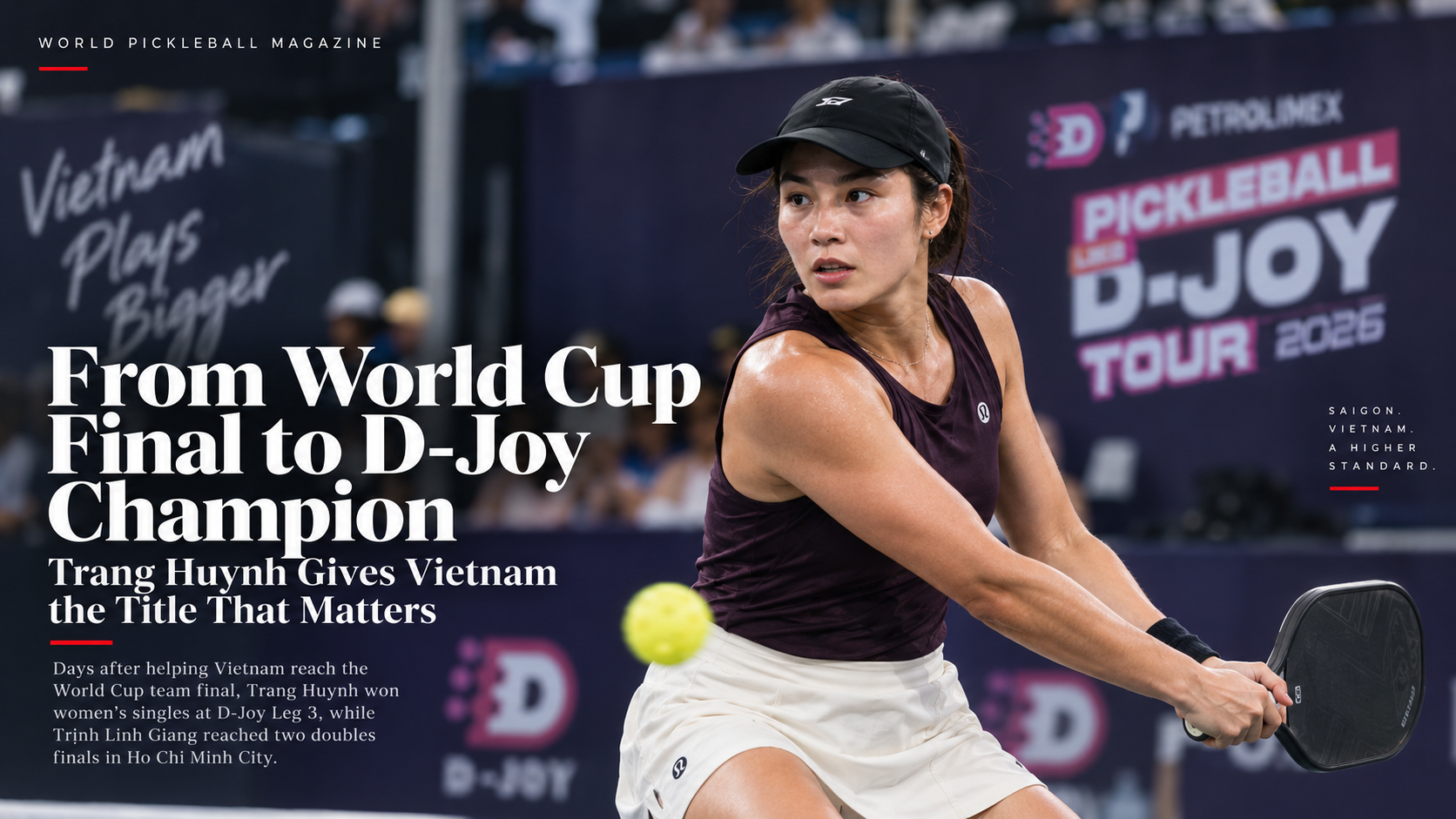
Days after Vietnam’s World Cup final run, Trang Huynh won D-Joy Leg 3 women’s singles in Ho Chi Minh City, beating Katerina Stewart.
The short answer: Trang Huynh won women’s singles at D-Joy Leg 3 in Ho Chi Minh City, beating Katerina Stewart, days after helping Vietnam reach the Open team final at the Pickleball World Cup. It was the only one of five pro titles won by a Vietnamese player. Ronan Camron took men’s singles, and Trịnh Linh Giang reached two doubles finals.
Only one of the five professional titles at D-Joy Leg 3 stayed with a Vietnamese champion, but the medal count tells only part of the story. Days after helping Vietnam reach the Open team final at the Pickleball World Cup, Trang Huynh won women’s singles, while Trịnh Linh Giang reached two doubles finals against a field carrying recent World Cup and international success into Ho Chi Minh City.
Key takeaways
- Trang Huynh won women’s singles after representing Vietnam during its run to the Open team final at the Pickleball World Cup in Da Nang.
- Ronan Camron followed his World Cup singles bronze with the D-Joy men’s singles title.
- Trịnh Linh Giang reached both the mixed and men’s doubles finals, extending Vietnam’s presence deep into the professional draws.
- Bobbi Oshiro-Alconcel and Brandon Lane won mixed doubles, Vivian Glozman and Megan Fudge took women’s doubles, and Richard Livornese Jr and Jack Munro won men’s doubles.
- Leg 3 was the final D-Joy ranking-points stop before the Vietnam Masters, giving the tournament significance beyond its five championship matches.
A week after representing Vietnam in a World Cup team that reached the Open final, Trang Huynh walked into another international field in Ho Chi Minh City and did something the home contingent had spent much of D-Joy Leg 3 threatening to do: she finished the job. Her women’s singles victory over Katerina Stewart gave the Petrolimex Saigon Cup its clearest Vietnamese success, but its significance came from considerably more than the nationality of the player holding the trophy.
Stewart had just won women’s singles at the World Cup in Da Nang, while Huynh had been part of the 10-player Vietnamese Open squad that progressed through South Africa, the Netherlands, Australia and Japan before losing the team final to the United States. Within days, both were back in competition, this time on opposite sides of an individual championship match, and Huynh was the player who emerged with the title.
There were four other professional champions at D-Joy, most of them drawn from an international group that made Leg 3 considerably stronger than a conventional domestic tournament. Ronan Camron won men’s singles after taking World Cup bronze, Bobbi Oshiro-Alconcel and Brandon Lane completed a mixed doubles run that repeatedly came close to disappearing, Vivian Glozman and Megan Fudge took women’s doubles, while Richard Livornese Jr and Jack Munro followed their World Cup men’s doubles victory with another title together.
Measured purely by gold medals, the international players dominated. Yet that is precisely why Huynh’s victory, and the two finals reached by Trịnh Linh Giang, provide a more useful measure of where Vietnamese pickleball currently stands: local players were not being protected from the strongest opposition in order to produce an attractive medal table, but were being asked to compete against professionals carrying recent success from other tours and from the World Cup itself.
Huynh goes from World Cup finalist to D-joy champion
Huynh arrived at D-Joy with a different status from the one the tournament alone might suggest. She had been selected for Vietnam’s Open World Cup squad alongside established domestic names including Lý Hoàng Nam, Phúc Huỳnh and Trịnh Linh Giang, and was also among five CAND Pickleball Club players selected for the team, placing her firmly inside the group currently representing Vietnam at its highest international level.
Her transition from Da Nang to Ho Chi Minh City was emphatic. Huynh defeated Pei Chuan Kao 11-1, 11-6 in the D-Joy semi-final, while Stewart had to negotiate a much more demanding contest on the opposite side of the draw, eventually beating Bobbi Oshiro-Alconcel 11-3, 5-11, 11-3 to reach the championship match.
That gave the final context which a simple home-player-against-international-player description misses. Stewart’s World Cup singles title had already demonstrated her form against international opposition, while Huynh had just spent the same week competing within a Vietnamese team whose run to the Open final had increased expectations around the country’s leading players. Her D-Joy victory therefore represented an immediate transfer from national-team competition into an individual professional setting, against an opponent whose level had been established only days earlier.
Vietnamese pickleball does not need victories made impressive primarily by describing the nationality of the winner. It needs players capable of beating opponents whose recent results establish the standard for them, and Huynh did precisely that against Stewart.
Camron finds the title that escaped him in Da Nang
Ronan Camron’s victory belonged to the same World Cup-to-D-Joy sequence, although his route through it was very different. He had entered men’s singles in Da Nang as the top seed before Martin Stanchev stopped him in the quarter-finals, and although Camron recovered to take bronze, the tournament ended without the title his seeding had suggested was available.
Ho Chi Minh City provided another opportunity almost immediately, which is becoming one of the more interesting features of the current Asian calendar. Players are increasingly able to move between international and regional events against overlapping but changing fields, meaning form, disappointment, confidence and fatigue travel with them rather than disappearing when one tournament ends.
Camron’s semi-final against Mikar Fisher produced one of his clearest performances of the week, a 11-6, 11-2 victory over a player who had looked dangerous through the earlier rounds. Yet Drake Palm reached the final with an even more startling score behind him after dismissing Richard Livornese Jr 11-1, 11-1, creating a championship match between two players who had arrived through emphatic semi-finals.
Camron ultimately converted the opportunity that had escaped him in Da Nang, turning World Cup bronze into D-Joy gold within days. That is valuable context for the result because the two tournaments did not exist independently for the players living through them: one result flowed almost immediately into another chance to compete.
Oshiro and Lane kept finding another way through
No champions in Ho Chi Minh City spent more time close to elimination than Bobbi Oshiro-Alconcel and Brandon Lane. Their mixed doubles campaign could easily have ended when Anne-Sophie Courteau and Jay Devilliers took the opening game against them 11-3, before Oshiro and Lane survived an extended second 13-11 and then another tight decider 12-10.
The margins barely widened in the quarter-finals, where Jada Bui and Phúc Huỳnh pushed the opening game to 15-13 before Oshiro and Lane closed the second 11-7. Their semi-final against Jack Munro and Roos van Reek produced another late test, with an 11-5, 12-10 victory finally putting them into the championship match after a tournament in which surviving close games had become less an isolated episode than the defining characteristic of their run.
Waiting there were Trịnh Linh Giang and Domenika Turkovic, whose own partnership appeared to strengthen as the draw progressed. They defeated Max Manthou and Shelby Bates 11-8, 11-3 in the semi-final after already negotiating a three-game quarter-final, putting Giang into the first of two professional finals he would contest during the closing stages of Leg 3.
Oshiro and Lane ultimately took the title, completing a run whose eventual gold becomes more impressive once the number of moments capable of eliminating them is considered. For Giang, silver represented something different, because the mixed final was only one part of a weekend in which another championship opportunity was still to come.
Giang keeps carrying Vietnam deeper into the draw
Like Huynh, Giang arrived at D-Joy immediately after representing Vietnam during its World Cup Open team run, and he was another of the five CAND Pickleball Club players selected for the national squad. Unlike Huynh, his week did not end with gold, but two finals across different partnerships may be just as useful when assessing the competitive depth Vietnam is beginning to build.
Giang reached the mixed final alongside Turkovic before returning in men’s doubles with Max Manthou, where another run took him all the way to the championship match against Munro and Livornese. Competing deep into two disciplines with different partners demands continual adjustment in role, patterns and communication, particularly when the opposition includes players carrying substantial professional experience into the tournament.
The men’s doubles final provided an especially clear benchmark. Munro and Livornese had won the World Cup title together only days earlier, beating Lý Hoàng Nam and Nguyễn Ảnh Gia Huy in the final, and their partnership already possessed a body of APP success before they arrived in Vietnam. Giang and Manthou therefore reached a championship match in which the hardest question was still waiting for them rather than having been removed earlier in the draw.
Munro and Livornese won again, following one title in Vietnam with another and strengthening their position as one of the most reliable men’s partnerships moving through this part of the international calendar. For Giang, reaching them without beating them provided a more honest measurement than a protected route to domestic gold ever could.
The international champions establish the benchmark
There was probably no less surprising champion across the five divisions than Munro and Livornese, but predictability does not make their victory irrelevant. In a market developing as quickly as Vietnam, experienced international partnerships provide the level against which domestic progress can actually be judged, and their presence becomes useful only when the standard they bring is genuine enough to expose the gaps that remain.
The same principle applied in women’s doubles, where Vivian Glozman and Megan Fudge took the title after arriving with considerable professional experience behind them. Glozman had already gone deep at the World Cup alongside Roos van Reek, while Fudge brought a much broader record across APP and international competition, ensuring another D-Joy division required local and visiting challengers to negotiate players accustomed to competing for professional titles.
That circulation of talent gave Leg 3 something a standalone tournament cannot easily manufacture. Munro and Livornese arrived as World Cup champions, Stewart arrived as the women’s singles champion, Camron carried singles bronze into the next draw, while Huynh and Giang had just helped Vietnam reach the Open team final. The players therefore arrived in Ho Chi Minh City with recent histories already attached to them, allowing each new result to be measured against something that had happened only days earlier.
One Vietnamese champion does not tell the story
If Leg 3 is assessed only through the nationality of its winners, the conclusion is straightforward: Vietnam produced one champion across five professional divisions. That number could be presented as disappointing evidence that the international field remains stronger, or exaggerated into proof that Vietnam has already reached the same competitive level, but neither interpretation tells us much about what actually happened.
Huynh defeated the reigning World Cup women’s singles champion to take the home title, while Giang reached two finals, including one against the reigning World Cup men’s doubles champions. Other Vietnamese players progressed through a draw deliberately strengthened by international professionals, which created a considerably more demanding environment than one designed to guarantee domestic success.
The objective of a developing professional ecosystem cannot be to protect local players from stronger opposition until the medal table becomes attractive. It has to expose them to enough high-level competition that, when victories arrive, they carry genuine weight and can eventually be repeated against different opponents in different environments.
Huynh’s title matters because Stewart was standing across the net, while Giang’s finals matter because Oshiro, Lane, Munro, Livornese and other established professionals occupied the same draws. The international winners are therefore not evidence against the development of Vietnamese pickleball. They are part of the mechanism through which that development can be measured.
D-joy is trying to connect the pieces
The tournament becomes more interesting when placed within the wider structure developing around D-Joy. Rather than staging isolated competitions, the organisation is attempting to connect facilities and academy development with a tour carrying rankings and points, while the Vietnam Masters gives those accumulated performances somewhere to lead later in the season.
Leg 3 was the final D-Joy ranking-points stop before that Masters, which meant the results in Ho Chi Minh City carried consequences beyond the five championship matches. That continuity matters because emerging sports rarely struggle to stage one attractive weekend. The harder task is creating enough infrastructure around it that players continue training, competing and returning, with one event influencing the importance of the next.
There is not yet enough evidence to declare that D-Joy has created a mature professional pathway, and the organisation’s ambitions should not be confused with proof that every part of the system already works. What Leg 3 did provide was a stronger competitive test inside that structure, with credible international players and leading Vietnamese professionals meeting in draws whose results fed towards another event rather than disappearing once the courts emptied.
The World Cup did not really end in Da Nang
Perhaps the most revealing feature of the week was what happened after Vietnam’s World Cup supposedly finished. The medals were awarded in Da Nang and the team competition ended, yet many of the players moved directly into another substantial tournament, carrying the competitive effect of one event into the next.
Huynh came into D-Joy and won. Giang reached two finals, Munro and Livornese won again, Stewart reached another singles final, Camron converted World Cup bronze into gold, and other players from Da Nang remained deep inside the professional draws. Instead of functioning as an isolated showcase, the World Cup fed directly into a tournament whose field was stronger because those players were still in Vietnam.
That is how a calendar begins to acquire meaning beyond individual events. Players meet again, previous results change the way the next match is understood, and standards become visible because the same people are being tested repeatedly rather than appearing once before disappearing into unrelated schedules.
For Vietnam, the most encouraging part was that its leading players remained inside that story. Huynh and Giang did not leave their World Cup performance behind in Da Nang. Within days, they were back against international opposition and deep into another tournament.
What Leg 3 leaves behind
Five professional titles were awarded in Ho Chi Minh City and four went to international players or partnerships. Camron won men’s singles, Oshiro and Lane took mixed doubles, Glozman and Fudge won women’s doubles, while Munro and Livornese continued their successful run together in men’s doubles.
Trang Huynh was the exception, but by the end of Leg 3 that exception carried more meaning than a simple home medal because of everything surrounding it: Vietnam’s World Cup final the previous week, Stewart’s own singles success in Da Nang, Giang’s two D-Joy finals and a tournament structure attempting to make these meetings recur rather than treating them as a one-off opportunity.
Vietnam has not closed the competitive gap with the strongest international professionals moving through the country, and there is no need to pretend otherwise. What matters is that the gap can increasingly be measured in real matches against credible opponents, with Vietnamese players reaching enough of the closing stages for those comparisons to become useful rather than theoretical.
A week after the World Cup demonstrated how far Vietnam had travelled as a team, D-Joy offered the first indication of what some of those players could do with that experience once they returned to individual competition. Huynh supplied the clearest answer by winning, while Giang’s two finals suggested she was not the only Vietnamese player capable of carrying the level forward.
The next test for D-Joy is whether it can make such encounters routine. If Huynh, Giang and the players developing behind them continue meeting international opposition of this standard, the most revealing sign of progress will eventually be that a Vietnamese champion no longer feels like the exception worth building the entire story around.
Frequently asked questions
Trang Huynh, who beat Katerina Stewart in the final.
Ronan Camron, following his World Cup singles bronze.
It was the final D-Joy ranking-points stop before the Vietnam Masters.
Further reading
- Camron and Palm Set the Final as Trang Huynh Keeps Vietnam in the Fight at D-Joy
- Trịnh Linh Giang Reaches D-Joy Mixed Doubles Final
- D-Joy Day One: International Favourites Advance as Vietnam Stays in the Fight

Chris Beaumont
Founder and Editor-in-ChiefChris Beaumont is the founder and Editor-in-Chief of World Pickleball Magazine, published by World Pickleball Media Ltd. He follows the global game closely, reporting on news, developments, stories and tournaments from all five continents. He also hosts the World Pickleball…
View All Articles →