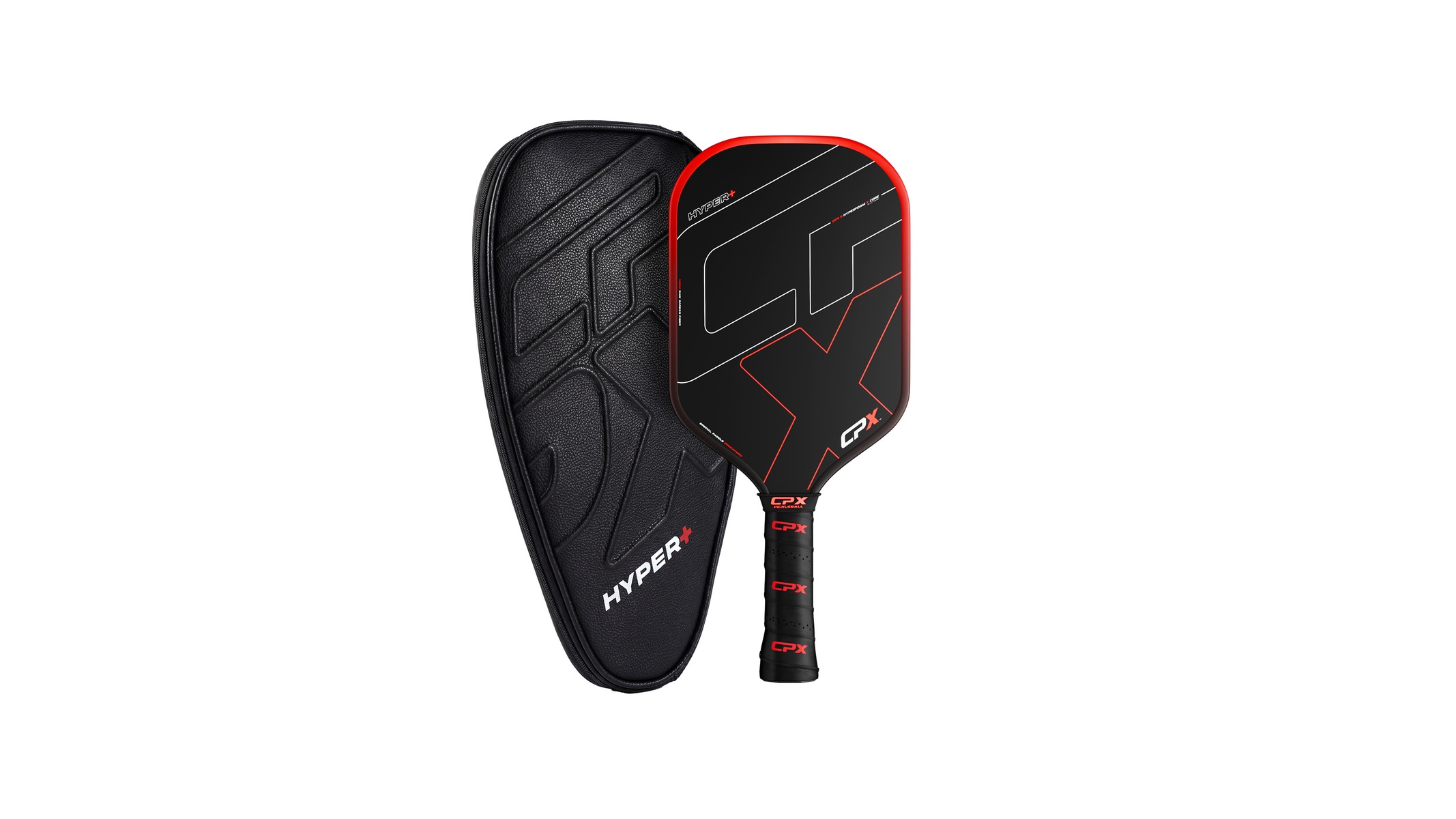
On 2 November 2026, USA Pickleball removed the CPX Hyper+ 14mm and Hyper+ 16mm from its certified list after market samples failed to match the paddles that earned approval. Owners can still play recreationally. Sanctioned USAP competition is off limits until a replacement clears the list. No fine has been announced.
On 2 November 2026, USA Pickleball published a short equipment statement and took two paddles off its certified list: the CPX Hyper+ 14mm and the CPX Hyper+ 16mm. The reason was not a new power rule. It was a compliance finding. Through what the governing body calls its process of Courtside Testing, Market Sampling, Analysis and Notice of Escape, testers found “a significant difference in PBCoR and Deflection values” between the Hyper+ models submitted for certification and the mass-production units sold to the market. Both models were removed. USA Pickleball says it is working with CPX on new versions under a new model name.
That is the confirmed core of the story. Everything else — including talk of fines — has to be weighed against what the primary statements actually say.
What exactly came off the list
USA Pickleball’s own wording is the cleanest inventory. The 2 November statement names the CPX Hyper+ 14mm and Hyper+ 16mm. CPX’s own update page narrows the same episode further, referring to “some recent Hyper+ Elongated 14mm and 16mm production units” that “do not match the certified specification.” The delisting is therefore about those certified Hyper+ models and retail units that diverged from them — not about every paddle CPX has ever sold, and not about a blanket ban on the brand.
Two distinctions matter for players who already own one.
First, delisting is not a recreational ban. USA Pickleball’s equipment FAQ is explicit: “The decertification only applies to sanctioned tournament play. Players can still use the paddles for recreational play.” CPX says the same on its Hyper+ update page: open play and tournaments that do not require an approved paddle are unaffected; USA Pickleball-sanctioned events, and other events that require an approved paddle, are the problem.
Second, USA Pickleball’s list is not the only list in the sport. UPA-A’s certified paddle list — the one that governs professional play on the PPA Tour and in Major League Pickleball — is independent. A paddle can sit on one list and not the other. As of this writing, the CPX Hyper+ models named in the USA Pickleball statement do not appear on the UPA-A list we checked. The immediate competitive consequence of this delisting is therefore concentrated on USA Pickleball-sanctioned amateur competition and on any club, league or national federation event that requires a USA Pickleball-approved paddle.
That second audience is larger than it looks from San Diego. Outside the United States, many clubs and national events still lean on the USA Pickleball approved list as a default reference because it is public, searchable and familiar. A delisting there does not automatically rewrite every local rulebook — but it does force tournament directors and federation equipment chairs to decide whether they follow USA Pickleball’s current certified list or keep using a paddle that list no longer carries.
Why the paddles came off — and what “too hot” actually means
The technical language in the USA Pickleball statement is narrow and useful. The finding was a significant difference in PBCoR and Deflection between the certification samples and mass-production units.
PBCoR — the paddle/ball coefficient of restitution — is USA Pickleball’s dynamic measure of trampoline effect: how much ball rebound the paddle face returns relative to inbound speed. It sits behind rule 2.E.6.f and the organisation’s power ceiling. Deflection is the older static face-stiffness measurement that has long sat alongside it. In plain English, the retail paddles USA Pickleball sampled were playing hotter than the paddles that had been approved.
USA Pickleball’s market-compliance FAQ puts the burden where certification always puts it: once a paddle is certified, “manufacturers are responsible for ensuring that production units continue to meet the same specifications as the original certified samples.” Equipment is decertified when it fails to meet the conditions of its certification, including failure to maintain consistent production standards. That is the frame for Hyper+: not that the submitted samples never passed, but that what reached the market did not match what earned the stamp.
CPX has accepted that frame in public. On its update page the company says some recent production units “came out more powerful than the certified specification” and “playing hotter than the paddles we submitted for certification.” That acknowledgement matters. It moves the story out of rumour and into a documented manufacturer admission, the same structural problem that defined the Facolos Pro Series Elite X case earlier in 2026, when USA Pickleball removed that paddle after Facolos acknowledged that the production version differed from the certified sample. Different test failure — roughness then, PBCoR and deflection now — same trust question: was the paddle in the bag the paddle that was approved?
One administrative detail is worth flagging without overstating it. USA Pickleball’s public compliance-status page still lists Facolos, among others, but did not yet show a CPX Hyper+ entry when we checked it for this piece. The delisting itself rests on the dated equipment statement and on CPX’s own update, not on that compliance table catching up in real time. Players should treat the approved paddle list and the 2 November statement as the controlling sources.
What owners can do now
For most recreational players, the practical answer is simple and a little unsatisfying: keep using the paddle at open play, keep the lifetime warranty CPX says remains intact, and do not walk into a USA Pickleball-sanctioned event with it.
For players who need a sanctioned-legal paddle, CPX has set out three routes on its update page:
- a swap to a Hyper+ 2 once that model is available, for owners who play USA Pickleball-sanctioned events;
- a rebate toward a Hyper+ 2 for owners who want to keep the original paddle and add the new one;
- warranty replacements shifting to Hyper+ 2 once that model ships.
CPX says it expects an initial Hyper+ 2 release in one to two weeks from the date of its update, with Hyper+ owners getting priority access, and that Hyper+ 2 “is in the process of recertification.” That last clause is the one that matters for tournament bags. A replacement paddle that has not yet reappeared on the USA Pickleball certified list is not a sanctioned-legal paddle, whatever the marketing timeline says. Until Hyper+ 2 — or another CPX model under a new name — is back on the approved equipment database, owners who need USA Pickleball approval will need a different listed paddle.
CPX is also pitching a manufacturing response: Pickleball Instruments machines for dual testing at the factory and at its West Chicago warehouse, serial numbers on every Hyper+ 2, and a public batch-lookup system it calls CPX Trace. That is manufacturer process, not USA Pickleball approval. CPX itself says as much: the dual-gate programme “does not replace USA Pickleball approval.” Approval covers the design; the company’s gates, if they work as described, cover what ships.
One caution for shoppers still browsing the live Hyper+ product page: the page still sells elongated and widebody variants and now carries a clear line that the paddle is “Not for use in USA Pickleball sanctioned events.” That is consistent with the delisting. It is not a promise that every shape and colourway on the page was separately named in the USA Pickleball statement. Buy against the certified list, not against a product carousel.
Are fines coming? What is confirmed — and what is not
This is where secondary reporting and primary silence have to be kept apart.
USA Pickleball’s 2 November statement does not mention fines, financial penalties, a tariff schedule, or a dollar figure. It confirms removal from the certified list and says the organisation is working with CPX on new versions under a new model name. That is the whole public penalty record from USA Pickleball itself as of 6 November 2026: delisting, cooperation on a renamed resubmission, nothing further in writing.
The Dink, citing paddle reviewer John Kew’s interview with USA Pickleball officials at the USA Pickleball National Championships in San Diego, reported that potential financial penalties against CPX are “in consideration.” No amount was published. No USA Pickleball press release has confirmed a fine. We have not independently obtained the Kew interview audio or a USA Pickleball transcript of those remarks. Until USA Pickleball puts a penalty in writing, “weighing fines” remains secondary reporting of an oral comment, not an announced sanction.
That distinction is not pedantry. Delisting is a competitive fact today. A fine would be a commercial fact — and, for the rest of the paddle industry, a precedent. Treating the two as equal would overstate what USA Pickleball has actually done.
The bigger pattern, and what still has to be answered
Pickleball’s equipment fights used to be about whether a face was too rough or a core too springy. The Facolos case earlier this year, and now Hyper+, keep pushing the argument one step further upstream: whether the retail paddle matches the certified sample at all. USA Pickleball has spent the past two years hardening that machinery — PBCoR limits, courtside testing with Pickleball Instruments, market sampling, Notices of Escape. The Hyper+ delisting is what that machinery looks like when it bites a current production run rather than a sunset cohort from an older power-test wave.
Three questions remain open on the primary record.
- Which production batches failed, and by how much? USA Pickleball has not published numerical PBCoR or deflection deltas for the Hyper+ samples. “Significant difference” is the official phrase; the score sheet is not public.
- Will there be a fine — and under what published schedule? Nothing in the USA Pickleball statement answers that. Secondary reporting says penalties are under consideration. That is all that can be said honestly today.
- When does a replacement return to the certified list? CPX says Hyper+ 2 is in recertification and expects a short initial-release window. USA Pickleball says it is working with CPX on new versions under a new model name. Neither statement yet points to a live listing.
Until those answers arrive, the player-facing facts are narrower and firmer. The CPX Hyper+ 14mm and Hyper+ 16mm are off the USA Pickleball certified list. Recreational play is unaffected. Sanctioned USA Pickleball competition is not. No fine has been announced. The replacement paddle is not approved until the list says it is.
That is not a paddle scandal in search of a villain. It is a compliance system doing the job it keeps telling manufacturers it will do: certify the sample, sample the market, and pull the stamp when the two no longer match.
Image: CPX Pickleball.

Chris Beaumont
Founder and Editor-in-ChiefChris Beaumont is the founder and Editor-in-Chief of World Pickleball Magazine, published by World Pickleball Media Ltd. He follows the global game closely, reporting on news, developments, stories and tournaments from all five continents. He also hosts the World Pickleball…
View All Articles →