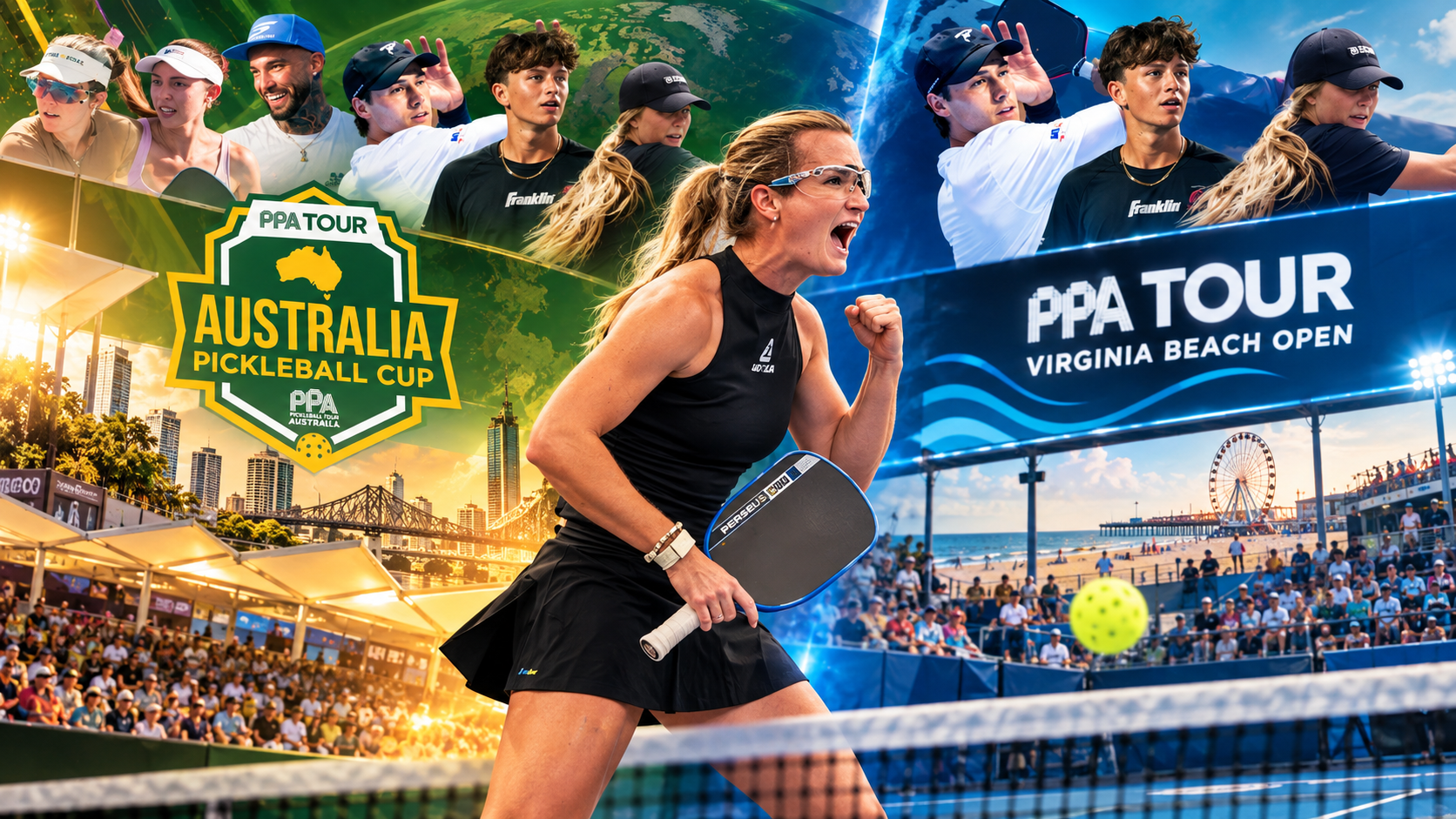
Brisbane’s WALKER Australia Pickleball Cup offers 1,500 points while the Virginia Beach Open offers 1,000. Draws, contenders and the ranking race.
The short answer: The PPA Tour splits this week between the WALKER Australia Pickleball Cup in Brisbane, a PPA1500 with over $500,000 in advertised prize money, and the 1,000-point Virginia Beach Open. Federico Staksrud leads the Brisbane men’s singles field and Hunter Johnson seeks a response to Chicago. In Virginia Beach, Roscoe Bellamy and Kate Fahey are top seeds with Anna Leigh Waters absent.
Two PPA tournaments on opposite sides of the world offer contrasting opportunities this week. Brisbane brings a stronger international field and 1,500 ranking points for champions, while Virginia Beach’s open draws give Roscoe Bellamy, Kate Fahey and several emerging partnerships a chance to strengthen their positions before November’s World Championships.
Key takeaways
- The WALKER Australia Pickleball Cup in Brisbane offers 1,500 ranking points to champions, compared with 1,000 at the Virginia Beach Open.
- Hunter Johnson seeks an immediate response to his early Chicago Cup defeat, while Federico Staksrud leads the Australian men’s singles field.
- Sahra Dennehy and Andie Dikosavljevic carry significant Australian hopes in women’s singles, with local players also involved in notable international doubles partnerships.
- Roscoe Bellamy arrives in Virginia Beach as the top men’s singles seed following his Chicago title, while Kate Fahey leads a women’s singles draw without Anna Leigh Waters.
- The simultaneous events highlight the increasingly complex choices facing players as the international professional calendar expands.
Two professional pickleball tournaments taking place on opposite sides of the world this week are offering players markedly different opportunities, creating an unusual test of how ranking points, field strength and competitive momentum influence decisions at the highest level.
In Brisbane, the WALKER Australia Pickleball Cup brings leading American professionals into direct competition with some of Australia and Asia’s strongest players. The tournament carries a PPA1500 classification, with 1,500 ranking points available to champions and more than $500,000 in prize money advertised for the event.
Meanwhile, the Mojo Energy Pouches Virginia Beach Open offers 1,000 points to its champions, but the absence of several of the sport’s leading names creates openings throughout the five professional draws.
The difference is more complicated than a straightforward choice between two prize structures. Brisbane offers greater rewards at the top of the ranking system, but its international field includes Federico Staksrud, Hunter Johnson, Christian Alshon, Gabriel Tardio and Hayden Patriquin. Virginia Beach carries fewer points, yet players who regularly encounter the sport’s dominant professionals may find a more realistic opportunity to reach the later rounds.
With November’s PPA World Championships approaching, those opportunities matter. The tournaments also provide different measures of competitive progress, with Australia testing the strength of its developing professional scene and Virginia Beach examining the depth of the American circuit when several of its most successful players are absent.
Brisbane’s bigger prize comes with a bigger challenge
The Australia Pickleball Cup takes place at the Queensland Tennis Centre in Brisbane, with Pat Rafter Arena providing the showcase setting. The main tournament runs from 14–18 October, following earlier event activity.
The prize money and ranking points make the event significant, but the strength of the international field gives it particular competitive importance.
For Australian players, opportunities to compete against leading American professionals have historically required substantial international travel, financial commitment and time away from domestic competition. Brisbane brings that level of opposition to Australia, allowing local players to measure their progress without leaving the country.
Sahra Dennehy, Andie Dikosavljevic, Mitch Hargreaves and Joey Wild are among those attempting to convert home advantage into meaningful results.
The tournament follows another important week for Australian pickleball, when Northern Crocs won the MLPA Brisbane Premier title after surviving a dramatic semi-final DreamBreaker against The Coasters.
Dikosavljevic played a central role in that championship, helping Northern Crocs establish their advantage in women’s doubles before partnering Prycen Haas to secure the decisive mixed doubles victory against Pacific Flame.
The transition from team competition to an international individual tournament presents a different challenge, but it also highlights the increasingly substantial competition schedule developing within Australia.
The question now is whether domestic success can translate into sustained performances against established international opposition. A single upset would attract attention, but several Australian players reaching the quarter-finals or beyond would provide stronger evidence of competitive depth.
Hunter Johnson seeks an immediate response to Chicago
One of Brisbane’s strongest individual storylines concerns Hunter Johnson.
The American enters as the second seed in men’s singles, with Federico Staksrud occupying the top position. Christian Alshon is seeded third, Connor Garnett fourth and Tama Shimabukuro fifth.
Johnson’s position makes him an obvious championship contender, but his recent results add another dimension.
At the Chicago Cup, Johnson suffered a remarkable early defeat against French qualifier Emilien Burnel, losing 13-11, 5-11, 11-9. Burnel subsequently advanced to the semi-finals, demonstrating that the upset was part of a substantial breakthrough rather than an isolated performance.
Brisbane now offers Johnson an immediate opportunity to respond.
His section includes a possible quarter-final against Hien Truong or Dylan Frazier, depending on how the earlier rounds develop. Neither would represent a straightforward opponent, particularly in a discipline where changes in momentum can quickly overturn expectations.
The challenge for Johnson is to establish control early and avoid allowing lower-seeded opponents to dictate the tempo. His ability to manage difficult opening stages will be particularly important after Chicago, where the expectations attached to his seeding did not translate into progression.
A deep run in Brisbane would restore momentum and provide a valuable ranking opportunity before the World Championships.
For Staksrud, the challenge is different.
The top seed could encounter Australian Mitch Hargreaves in the round of 16, with Zane Ford a potential quarter-final opponent. Staksrud’s experience and consistency make him a formidable contender, but the presence of several dangerous attacking players means his route to the final is unlikely to be straightforward.
Another particularly interesting potential quarter-final involves Alshon and Shimabukuro.
Both possess the ability to dictate rallies through aggressive shot-making, although their approaches to constructing points can differ. Their meeting would offer an examination of whether Shimabukuro can reproduce his regional success against another established American professional.
Hong Kit Wong is also among the seeded contenders, adding an important Asian presence to the men’s singles competition.
The draw therefore provides several opportunities to assess the competitive relationship between the established American professional circuit and the developing Asia-Pacific game.
Dennehy and Dikosavljevic carry australia’s women’s singles challenge
The women’s singles draw provides one of Australia’s strongest opportunities to make a significant impression.
Sahra Dennehy enters as the second seed, behind Kaitlyn Christian, while Kiora Kunimoto and Judit Castillo occupy the third and fourth positions. Andie Dikosavljevic is seeded seventh, giving Australia another competitor with an opportunity to progress.
Dennehy’s position is particularly interesting because her success within the Asian circuit has already demonstrated an ability to win important matches against strong regional opposition.
Brisbane offers another opportunity to assess that progress against an international field.
Her potential quarter-final opponent is Rika Fujiwara, while Christian could encounter Yufei Long in the same round.
If the leading seeds progress, Dennehy may eventually face opponents whose experience of high-level American competition presents a different tactical challenge from much of her regional schedule.
Players who achieve success within a developing regional circuit must eventually demonstrate that their performances can withstand stronger and more varied opposition. Dennehy has already established herself as a serious competitor, but a strong Brisbane result would provide further evidence that she can sustain that standard.
Dikosavljevic has a different opportunity.
Her position in the draw creates the possibility of a semi-final against Kunimoto, provided both players progress through their earlier matches. Kunimoto’s recent performances make her a difficult opponent, particularly when she can control the pace of rallies and create attacking opportunities from deep positions.
For Dikosavljevic, reaching that stage would represent a significant achievement in front of an Australian audience, particularly so soon after her contribution to Northern Crocs’ MLPA success.
The wider significance is that the women’s draw contains more than one credible Australian challenger. If Dennehy and Dikosavljevic both make substantial progress, the result would offer a stronger indication of domestic competitive depth than an isolated breakthrough.
New doubles partnerships add another competitive dimension
The Brisbane doubles competitions introduce another layer of uncertainty, with several combinations that are less familiar than the established partnerships regularly competing on the American tour.
Gabriel Tardio and Hayden Patriquin head the men’s doubles seedings, while Staksrud partners Alshon as the second seeds. Tama Shimabukuro joins JW Johnson as the third seeds, with Dylan Frazier and Connor Garnett occupying fourth position.
The quality of the individual players is considerable, but their success will depend on how effectively they operate as partnerships.
Doubles demands coordination that cannot be established through individual ability alone. Players must understand each other’s movement, recognise opportunities to change the pace of exchanges and maintain disciplined positioning when opponents apply pressure.
Tardio and Patriquin bring exceptional attacking potential, while Staksrud and Alshon offer another combination of established talent. Shimabukuro’s partnership with Johnson provides one of the most interesting cross-regional combinations in the field.
For Shimabukuro, competing alongside an experienced American professional offers another opportunity to develop his doubles game against high-level opposition.
Australian Mitch Hargreaves also has a significant opportunity alongside Collin Johns.
The partnership is seeded seventh and could encounter Frazier and Garnett in the quarter-finals. Johns brings extensive professional doubles experience, particularly in controlling the kitchen line and managing the tactical demands of extended exchanges.
For Hargreaves, the opportunity to compete alongside that experience in a major home tournament could be valuable regardless of the final result.
In mixed doubles, Staksrud partners Australia’s Danni-Elle Townsend as the fifth seeds, while Dikosavljevic and Joey Wild form another Australian combination worth following.
The leading mixed doubles seeds are Jorja Johnson and JW Johnson, with Jessie Irvine and Hayden Patriquin occupying second position.
In women’s doubles, Hurricane Tyra Black and Jorja Johnson head the field, with Parris Todd and Townsend seeded second.
These partnerships illustrate the international character of the event. Established American professionals are competing alongside regional players, creating opportunities for tactical development and results that may influence future partnership decisions.
Virginia Beach gives Bellamy a different kind of challenge
While Brisbane brings together a strong international field, Virginia Beach offers opportunities created by the absence of several leading professionals.
Anna Leigh Waters, Ben Johns, Anna Bright and Hayden Patriquin are among those not competing in Virginia Beach, leaving a collection of draws in which several players have realistic ambitions of reaching the final.
Roscoe Bellamy enters men’s singles as the top seed following his Chicago Cup victory over Christopher Haworth.
As WPM reported in its Chicago Cup review, Bellamy defeated Haworth 11-4, 11-5 to secure his second career PPA title and first of 2026.
The result represented an important moment in his season, but Virginia Beach immediately presents a different challenge.
In Chicago, Bellamy had to overcome established expectations. In Virginia, he carries them.
His recent success makes him the player opponents will be particularly determined to beat, and the draw provides little room for complacency.
Jaume Martinez Vich is a potential quarter-final opponent, while Noe Khlif, Zane Ford, Jack Sock and John Lucian Goins are among the other players capable of challenging for the title.
The men’s singles competition has become increasingly unpredictable, with lower-seeded players regularly producing substantial runs. Burnel’s progress in Chicago provided another reminder of that volatility.
For Bellamy, the central question is whether his Chicago performance marked the beginning of a sustained period of success.
Winning consecutive titles would be a significant achievement in a discipline where consistency has proved difficult for many leading professionals. It would also strengthen his position heading towards the final major tournaments of the season.
However, the opportunity extends beyond Bellamy.
Khlif, Ford, Sock and Goins all have reasons to believe that the draw offers a realistic route towards a title. Virginia Beach may therefore provide another example of how quickly the hierarchy in men’s singles can change.
Fahey has the opportunity to turn consistency into another title
Kate Fahey enters the women’s singles competition as the top seed, with Anna Leigh Waters absent from the tournament.
Fahey’s recent performances have established her among the leading challengers in the discipline, including another appearance in the Chicago Cup final.
Waters won that contest 11-1, 11-7, completing her latest triple crown, but Fahey’s presence in another championship match reinforced her competitive standing.
Her challenge in Virginia Beach is to convert that position into a title.
Brooke Buckner is seeded second, Lea Jansen third, Chao Yi Wang fourth and Catherine Parenteau fifth. Genie Bouchard is the sixth seed, adding another experienced competitor to a draw that remains demanding despite Waters’ absence.
Parenteau could be a particularly difficult opponent for Fahey. Her defensive consistency and ability to extend rallies can make her difficult to overcome, especially when opponents become impatient or attempt to force attacking opportunities.
Buckner offers another significant challenge through her experience and ability to maintain pressure during long exchanges, while Jansen and Wang have opportunities to capitalise from the opposite half of the draw.
For Fahey, the tournament presents an opportunity to demonstrate that she can consistently occupy the leading position when Waters is absent.
That is a different responsibility from reaching finals as a challenger.
The leading seed must manage the expectation that she should progress, while facing opponents who recognise that the absence of the dominant player creates an opportunity for them as well.
Virginia Beach will test Fahey’s ability to manage that pressure.
New partnerships could produce new doubles champions
The absence of several established combinations also changes the doubles competitions.
Catherine Parenteau and Sofia Sewing enter as the leading women’s doubles seeds, while Fahey partners Lea Jansen as the second seeds. Tina Pisnik and Elsie Hendershot occupy third position, with Meghan Dizon and Cailyn Campbell fourth.
These combinations bring contrasting strengths, but several have limited experience together.
Parenteau’s consistency and court awareness provide a stable foundation for Sewing’s attacking game. Their challenge will be to establish an effective understanding quickly enough to withstand opponents attempting to exploit uncertainty in positioning and movement.
Fahey and Jansen also have an opportunity to make a significant run, particularly given Fahey’s recent singles form.
The men’s doubles draw presents another collection of interesting partnerships.
Eric Oncins and CJ Klinger are the leading seeds, with Andrei Daescu and Will Howells occupying second position. Noe Khlif partners Riley Newman as the third seeds, while Augustus Ge and Armaan Bhatia form the fourth-seeded combination.
One of the most interesting partnerships features Yuta Funemizu and Nicolas Acevedo, who are seeded sixth.
Funemizu has demonstrated his ability to compete against leading American professionals, while Acevedo has produced several strong recent doubles performances. Their combination could challenge the higher seeds, particularly if they establish control at the kitchen line and force opponents into extended defensive exchanges.
The mixed doubles draw may be even more unpredictable.
Tina Pisnik and Noe Khlif are the leading seeds, with Meghan Dizon and Andrei Daescu second. Fahey partners Eric Oncins as the third seeds, while Parenteau joins Riley Newman as the fourth-seeded combination.
With 48 teams listed in the competition, the draw provides considerable scope for unexpected results.
The challenge for the leading partnerships will be to justify their positions in a field where several combinations possess enough individual ability to produce an upset.
The ranking-point calculation is more complicated than the headline numbers
The difference between Brisbane and Virginia Beach is significant, but the comparison requires more than simply examining the points awarded to champions.
Brisbane’s PPA1500 classification offers 1,500 points for victory, compared with 1,000 at the PPA1000 Virginia Beach Open.
That creates a 500-point difference at the top of the ranking structure, but players do not make their tournament decisions based solely on the maximum points available.
The strength of the field, their likely route through the draw and the possibility of reaching the later rounds all influence the calculation.
A player may judge a deep run in Virginia Beach more achievable than an equivalent result in Brisbane, even though the Australian tournament carries the higher classification. The precise ranking benefit depends on the points awarded at each stage and the applicable ranking rules.
The important distinction is between the theoretical reward offered by a tournament and the realistic opportunity available to an individual player.
Brisbane provides greater rewards for those capable of progressing through a strong international field. Virginia Beach offers a potentially more accessible route to the later stages for players who might ordinarily encounter the sport’s dominant professionals earlier in the competition.
Neither option guarantees a better outcome.
The calculation also includes travel, preparation, physical condition and the demands of the wider calendar.
With the PPA Tour’s Virginia Beach event followed by the World Championships in November, players must balance immediate ranking opportunities against the importance of arriving at the season’s major events in suitable condition.
The simultaneous tournaments provide a particularly clear example of how those decisions are becoming more complicated as professional pickleball expands internationally.
Two tournaments will reveal different kinds of progress
The Australia Pickleball Cup and Virginia Beach Open will award different ranking points, attract different fields and produce different competitive challenges.
Yet both events have significance beyond their eventual champions.
Brisbane provides an opportunity to examine the progress of Australian and Asian professionals against a strong international field. The performances of Dennehy, Dikosavljevic, Hargreaves and other regional competitors will offer evidence of whether expanding domestic and Asia-Pacific competition structures are producing players capable of challenging established international opposition.
The tournament also creates opportunities for younger players and new doubles partnerships to gain experience against leading professionals.
Virginia Beach offers a different measure.
With several dominant players absent, the tournament will reveal which competitors can convert favourable circumstances into meaningful results.
Bellamy has an opportunity to build on his Chicago breakthrough, while Fahey can pursue another title as the leading seed. New doubles partnerships will attempt to establish themselves in draws where the usual hierarchy has been disrupted.
The contrast reflects a wider change in professional pickleball.
As the international calendar becomes more substantial, players face increasingly complex decisions about where to compete and how to balance immediate opportunities against longer-term ambitions.
For established professionals, that creates new calculations about ranking points and preparation. For emerging players, it creates opportunities to compete at a higher level or progress further through draws that might ordinarily be dominated by the same leading names.
By Sunday, both tournaments will have produced champions.
The more revealing question may be which players have used the divided week to change expectations about what they can achieve next.
Frequently asked questions
The Brisbane PPA1500 gives champions 1,500 points; the Virginia Beach Open gives 1,000.
Roscoe Bellamy leads men’s singles after his Chicago title, and Kate Fahey leads women’s singles without Anna Leigh Waters.
Sahra Dennehy and Andie Dikosavljevic carry the main Australian hopes in women’s singles.
Further reading
- Waters Hits 202 as Bellamy Breaks Through at PPA Chicago
- No. 55 Emilien Burnel Stuns Hunter Johnson at Chicago
- Northern Crocs Win MLPA Brisbane After DreamBreaker Drama

Chris Beaumont
Founder and Editor-in-ChiefChris Beaumont is the founder and Editor-in-Chief of World Pickleball Magazine, published by World Pickleball Media Ltd. He follows the global game closely, reporting on news, developments, stories and tournaments from all five continents. He also hosts the World Pickleball…
View All Articles →